
Drug-Acid Reducer Interaction Checker
Check your medications for acid-reducer interactions
Interaction Results
Medication:
Key Information:
Most people think taking a pill for heartburn is harmless-something simple, like popping an antacid after a big meal. But if you’re also on medications for HIV, cancer, or fungal infections, that daily proton pump inhibitor (PPI) could be quietly ruining your treatment. It’s not a myth. It’s not rare. And it’s not always caught by doctors.
How Acid-Reducing Drugs Change Your Body’s Chemistry
Proton pump inhibitors like omeprazole, esomeprazole, and lansoprazole, and H2 blockers like famotidine and ranitidine, work by turning down stomach acid. That’s their job. Normal stomach pH hovers between 1.0 and 3.5 when you’re fasting-sharp enough to break down food and kill bacteria. These drugs push that pH up to 4.0 or even 6.0. Sounds good for your esophagus, right? But your stomach isn’t just a digestion chamber-it’s the first stop for most oral drugs. Here’s the catch: many medications need that acidic environment to dissolve properly. If the acid is gone, the drug doesn’t break down. And if it doesn’t break down, your body can’t absorb it. That means the medicine you’re taking for something serious-like cancer or HIV-might as well be water.Which Drugs Are Most at Risk?
Not all drugs are affected the same way. The big red flags are weak bases-medications that rely on acid to dissolve. About 70% of oral drugs fall into this category. Among the most dangerous interactions are:- Atazanavir (HIV treatment): When taken with a PPI, its absorption drops by up to 95%. Patients have gone from undetectable viral loads to over 12,000 copies/mL after starting omeprazole.
- Dasatinib (leukemia drug): Absorption falls by 60%. Without enough in the bloodstream, the cancer can come back.
- Ketoconazole (antifungal): Nearly useless when paired with PPIs. The drug just doesn’t get absorbed.
- Nilotinib and erlotinib: Both cancer drugs show major drops in effectiveness with acid reducers.
Why PPIs Are Worse Than H2 Blockers
Not all acid reducers are created equal. PPIs are the heavy hitters. They shut down acid production for 14 to 18 hours a day. That’s almost the entire waking day. H2 blockers? They last 8 to 12 hours. That’s a big difference. A 2024 study in JAMA Network Open found PPIs cut drug absorption by 40-80%. H2 blockers? More like 20-40%. So if you’re stuck needing an acid reducer and you’re on a sensitive drug, switching from omeprazole to famotidine might be a safer move. Not perfect-but better. And timing matters. Immediate-release pills are more vulnerable than extended-release ones. If your drug is designed to dissolve slowly, it’s less likely to get wrecked by a pH shift.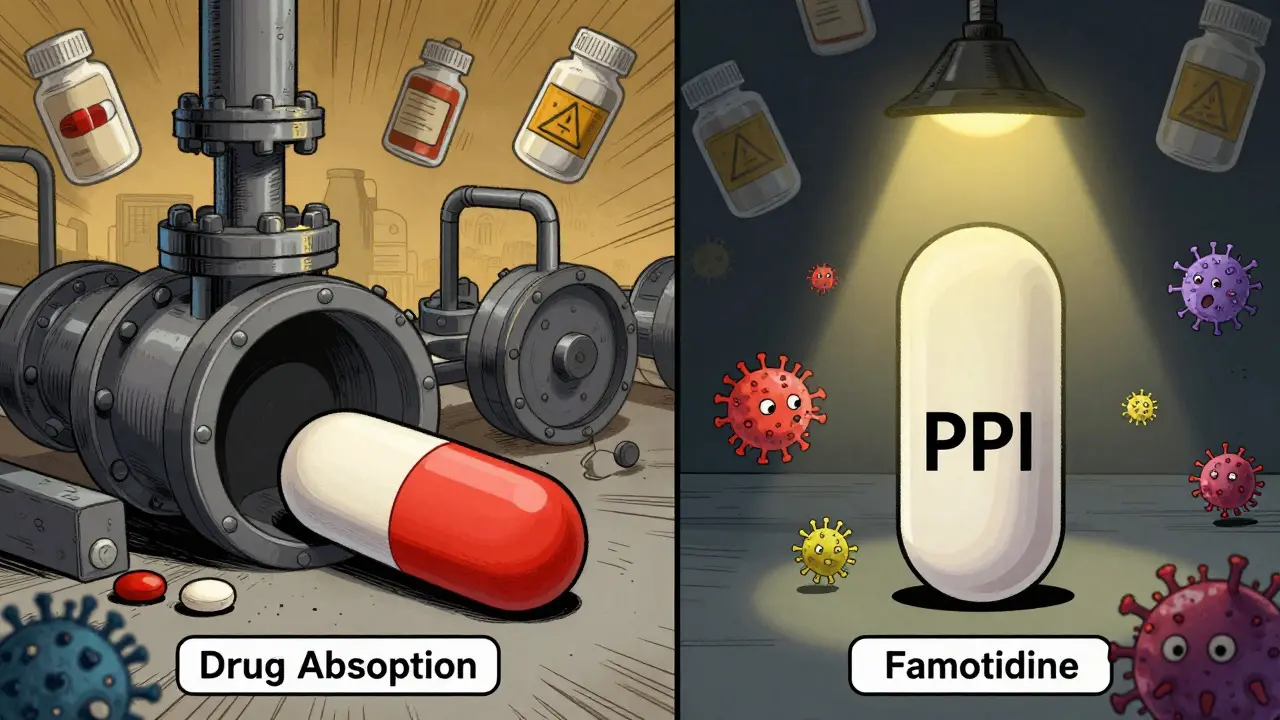
What About Acidic Drugs?
You might think, “If bases don’t work well without acid, then acids should work better.” And technically, yes. Drugs like aspirin (pKa 3.5) or dasiglucagon become slightly more soluble in higher pH. But the effect is tiny-usually a 15-25% increase in absorption. That’s rarely enough to cause harm. No one needs to adjust their blood pressure or pain meds because of heartburn pills. The real danger is on the other side: weak bases with narrow therapeutic windows. That means the difference between a helpful dose and a useless one is small. Even a 30% drop can mean treatment failure.Real-World Consequences
This isn’t theoretical. A 2023 study of over 12,500 patients found those on dasatinib and PPIs had a 37% higher chance of treatment failure. That’s not a small number. That’s people dying because their cancer drug didn’t work. Reddit threads are full of stories. One user wrote: “My viral load jumped to 12,000 after I started Prilosec for heartburn. My infectious disease doctor said this is textbook.” Another said: “My blood pressure meds stopped working until we figured out Nexium was blocking them.” The FDA’s adverse event database shows over 1,200 reports between 2020 and 2023 of therapeutic failure linked to acid-reducing drugs. Atazanavir, dasatinib, and ketoconazole top the list.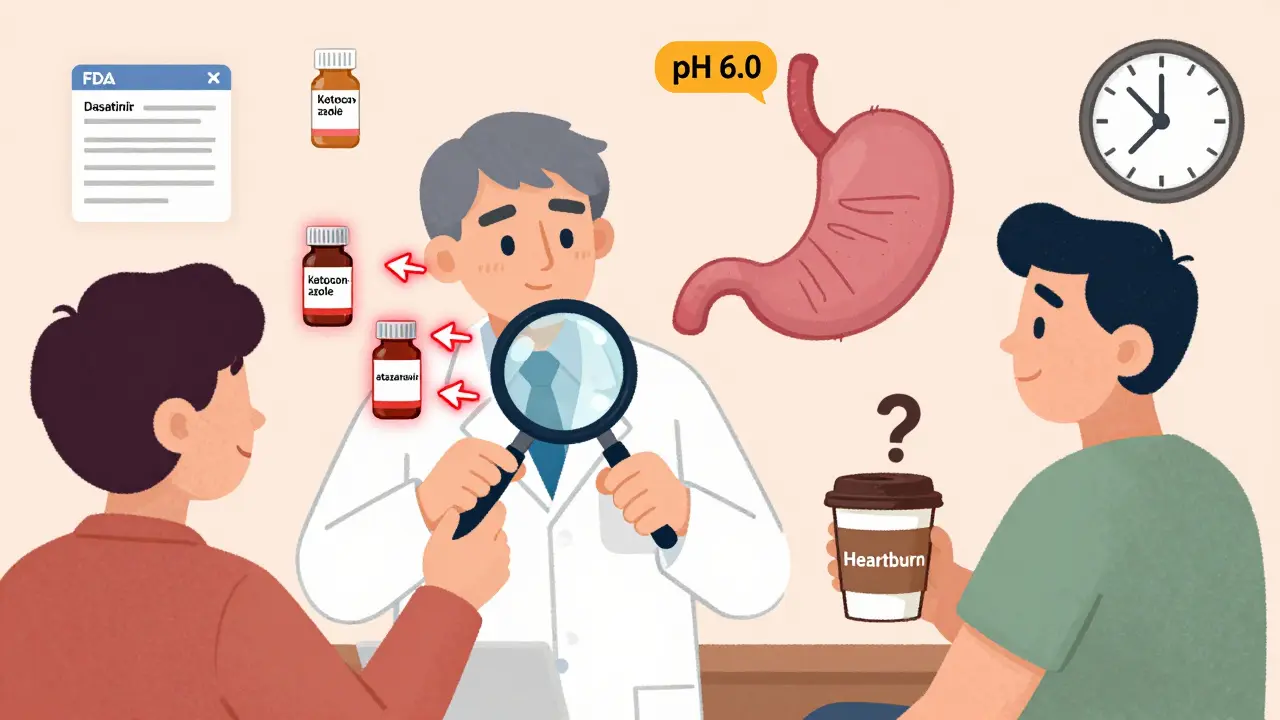
What Can You Do?
If you’re on one of these high-risk drugs and you take an acid reducer, here’s what actually helps:- Ask your doctor if you even need the acid reducer. About 30-50% of long-term PPI users don’t have a valid reason to be on them. The American College of Gastroenterology recommends deprescribing in these cases.
- Try H2 blockers instead. If you need something, famotidine is less disruptive than omeprazole.
- Time your doses. Take your main drug (like dasatinib or atazanavir) at least 2 hours before your PPI. It won’t fix everything, but it can reduce the interaction by 30-40%.
- Use antacids sparingly. They work fast but wear off quickly. If you take them 2-4 hours apart from your other meds, they’re safer than daily PPIs.
- Ask your pharmacist. A 2023 study showed pharmacist-led reviews cut inappropriate ARA co-prescribing by 62% in Medicare patients. Pharmacists are trained to catch these.
The Bigger Picture
Over 15 million Americans take PPIs long-term. Many of them don’t need to. The CDC says 15% of adults in developed countries use acid reducers chronically-often for symptoms that could be managed with diet, weight loss, or lifestyle changes. The cost? Not just in dollars. It’s in failed treatments, hospital visits, and lost time. The FDA estimates these interactions waste $1.2 billion a year in the U.S. alone. Pharmaceutical companies are starting to respond. Nearly 40% of new drugs in development now include pH-independent delivery systems-things like enteric coatings that only dissolve in the intestine, or nanoparticle carriers that bypass stomach pH entirely. Electronic health records now flag dangerous combinations. Epic Systems reports 78% of doctors follow those alerts. That’s progress. But it’s not enough.Bottom Line
If you’re on a medication for HIV, cancer, or a serious fungal infection, and you’re taking an acid reducer-stop assuming it’s safe. Ask your doctor or pharmacist: “Could this be making my other drug less effective?” Don’t wait for a viral load spike or a tumor to grow. This interaction is predictable. It’s documented. And it’s preventable. The goal isn’t to avoid acid reducers forever. It’s to use them only when necessary-and to make sure they don’t accidentally sabotage your other treatments.Can acid-reducing medications make my HIV treatment fail?
Yes. Taking a proton pump inhibitor like omeprazole with atazanavir can reduce the drug’s absorption by up to 95%. This can cause your viral load to rise rapidly-even if you’ve been undetectable for years. The FDA and drug labels explicitly warn against combining these two. If you’re on atazanavir, you must avoid PPIs. H2 blockers like famotidine may be safer, but only if timed correctly and approved by your infectious disease specialist.
Are H2 blockers safer than PPIs when taking other drugs?
Generally, yes. H2 blockers like famotidine or ranitidine raise stomach pH for only 8-12 hours, compared to 14-18 hours with PPIs. Studies show they reduce absorption of pH-dependent drugs by 20-40%, while PPIs cause 40-80% drops. If you need an acid reducer and are on a sensitive medication like dasatinib or ketoconazole, switching to an H2 blocker may help-but timing still matters. Always check with your doctor or pharmacist before making any change.
How do I know if my medication is affected by acid reducers?
Look for drugs used to treat HIV, leukemia, fungal infections, or certain cancers. These are most likely to be affected. Check the drug’s prescribing information for warnings about “gastric pH,” “acid-reducing agents,” or “PPIs.” If your drug is a weak base (pKa >7) and has low solubility at higher pH, it’s at risk. If you’re unsure, ask your pharmacist to check your medication profile. Many pharmacies now flag these interactions automatically.
Can I just take my acid reducer at a different time of day?
It helps-but not enough. Taking your main drug (like dasatinib or atazanavir) 2 hours before your PPI can reduce the interaction by 30-40%. But because PPIs work for so long, the stomach pH stays elevated all day. This approach might work for some drugs, but not for others. For high-risk combinations like atazanavir and PPIs, timing is not a reliable solution. Avoidance is the only safe option.
Should I stop my acid reducer if I’m on other medications?
Don’t stop without talking to your doctor. But do ask: “Do I still need this?” About half of long-term PPI users don’t have a clear medical reason for taking them. Conditions like occasional heartburn or mild indigestion often don’t require daily acid suppression. If your doctor agrees, tapering off may be safer than risking a dangerous interaction. Always get guidance before stopping any medication.
Andy Heinlein
just took my dasatinib and famotidine like the post said and my heartburn is fine so far lol
Bryan Anderson
This is one of those topics that gets buried under the noise. I'm a pharmacist and I've seen this exact scenario play out too many times-patients on HIV meds who start Omeprazole for 'a little indigestion' and then show up with detectable viral loads. The scary part? Most of them had no idea the interaction existed. Doctors don't always check. Pharmacies flag it, but patients don't always listen. We need better education, not just alerts.
Todd Nickel
There's a deeper issue here beyond drug interactions. The overprescription of PPIs is a systemic failure of medical culture. We treat symptoms without addressing root causes-obesity, stress, poor diet, late-night eating. The fact that 30-50% of long-term users don't need them suggests we've normalized pharmaceutical fixes for lifestyle issues. It's not just about absorption coefficients-it's about how medicine has become transactional rather than preventive. We're optimizing for convenience, not health.
Ann Romine
I'm from a country where PPIs are sold over the counter and I'm shocked to learn how dangerous this is. My uncle took omeprazole for 8 years with his cancer meds-he never knew. He passed last year. I wish someone had told us. This needs to be in public health campaigns, not just medical journals.
Paul Ong
pharmacists are the real heroes here dont let anyone tell you different
Liam George
Let me guess-Big Pharma knows this. They pushed PPIs because they're profitable. They downplayed the risks. They lobbied against labeling. And now they're 'developing pH-independent delivery systems' like it's some breakthrough when it should've been standard from day one. This isn't science-it's profit engineering disguised as innovation. The FDA? Complicit. Doctors? Complicit. You're being played.
Bill Medley
Timing matters. H2 blockers preferred. PPIs avoidable. Consult pharmacist. Document interaction history. Follow guidelines. These are actionable steps. No speculation required.
Phoebe McKenzie
Of course people are dying. They didn't read the label. They didn't ask. They just popped pills like candy. This isn't a medical failure-it's a personal failure. If you're on life-saving drugs and you're casually taking heartburn pills, you're not a patient-you're a liability. Stop blaming doctors. Start taking responsibility.
Austin Mac-Anabraba
Let's be brutally honest: the entire system is broken. Patients are treated as passive recipients, not collaborators. Doctors are overworked and undertrained in pharmacokinetics. Pharmacists are ignored until something goes wrong. And the public? They believe 'natural' means safe and 'prescription' means harmless. This isn't an interaction-it's a symptom of a society that outsources health to pills and ignores context. We need systemic reform, not just dosing advice.
Richard Thomas
There's something almost poetic about this. Our bodies evolved in an acidic environment, and we've spent the last century trying to neutralize discomfort instead of understanding it. We suppress acid because we fear pain, but we forget that pain is a signal. And now, in our attempt to silence one symptom, we've accidentally silenced the efficacy of drugs meant to save lives. It's not just about chemistry-it's about our relationship with our own biology. We want quick fixes, but biology doesn't work in shortcuts. Maybe the real question isn't how to time the pills-but why we feel we need them at all.