
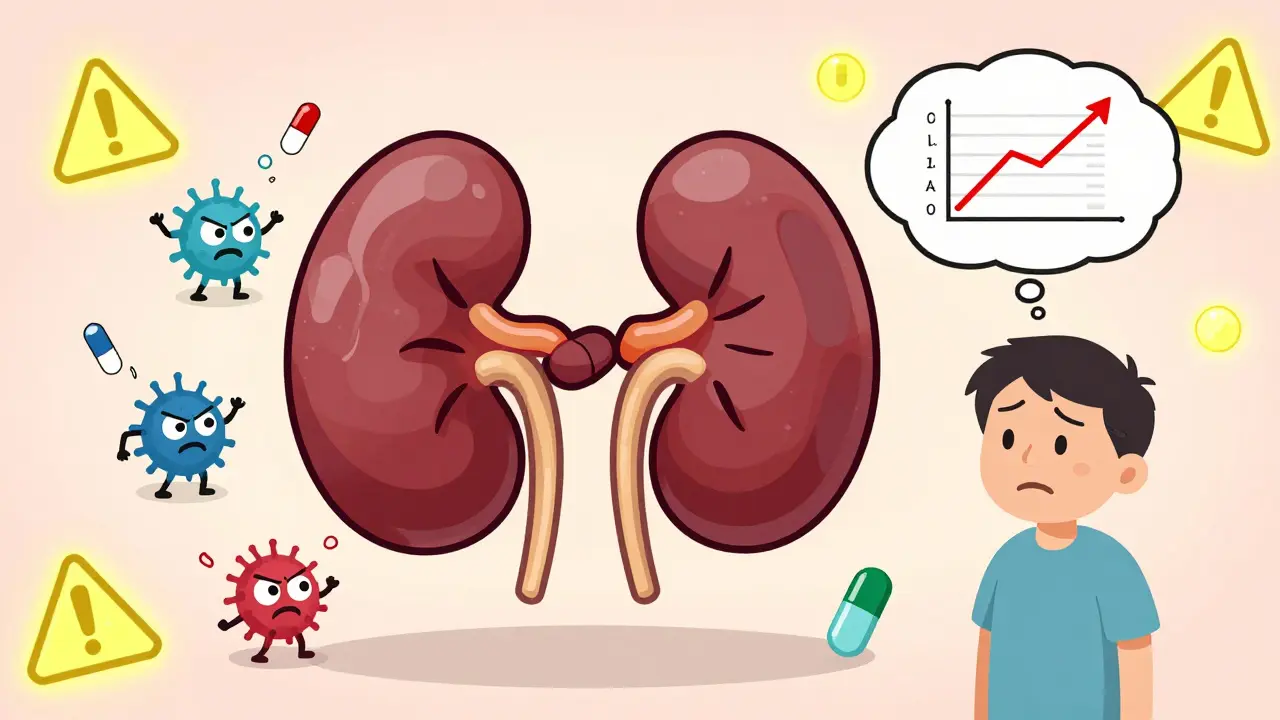
When your kidneys suddenly stop working right, it’s easy to blame dehydration, infection, or even bad luck. But for thousands of people each year, the real culprit is something they never thought could hurt them: a common medication. Acute interstitial nephritis (AIN) is one of the most underdiagnosed causes of sudden kidney failure - and it’s mostly triggered by drugs you take every day.
What Actually Happens in Your Kidneys
AIN isn’t a disease you catch. It’s a reaction. Your immune system, confused by a drug, starts attacking the space between your kidney tubules. This area - the interstitium - is where your kidneys balance fluids, filter waste, and regulate electrolytes. When it swells up with immune cells, your kidneys can’t do their job. That’s when creatinine rises, urine drops, and you feel exhausted, nauseous, or just "off."
It’s not dramatic. No one wakes up with a kidney attack. Symptoms creep in over days or weeks: a dull backache, less urine than usual, swelling in the ankles, or just a general sense of fatigue. Many patients are told they have a UTI or the flu. In fact, over 250 different medications have been linked to AIN. The most common? Antibiotics, NSAIDs, and proton pump inhibitors (PPIs) like omeprazole or pantoprazole.
Which Drugs Are Most Likely to Cause It?
Not all drugs are equal when it comes to triggering AIN. Here’s what the data shows:
| Drug Class | Percentage of AIN Cases | Typical Latency | Recovery Rate |
|---|---|---|---|
| NSAIDs (ibuprofen, naproxen) | 44% | 6-12 months | 50-60% |
| Antibiotics (penicillin, ciprofloxacin) | 33% | 7-14 days | 70-80% |
| Proton Pump Inhibitors (omeprazole, esomeprazole) | 29% | 3-18 months | 50-60% |
| Immune Checkpoint Inhibitors | Under investigation | Varies | Variable |
NSAIDs are the most frequent cause - especially in older adults with arthritis or chronic pain. But here’s the twist: they rarely cause the classic "hypersensitivity triad" of rash, fever, and eosinophilia. Instead, they sneak in slowly. You’ve been taking Advil for years. Then, one day, your blood test shows a sudden drop in kidney function. No warning. No rash. Just damage.
Antibiotics, on the other hand, tend to hit fast. You start a course of amoxicillin for a sinus infection. Ten days later, you feel sick, your urine is dark, and your creatinine is up. This type often comes with fever, rash, or blood in the urine. The good news? If caught early, recovery is usually complete.
PPIs are the new wildcard. Once considered safe for long-term use, we now know they’re the second most common trigger for AIN. People take them for heartburn, sometimes for years. The damage builds quietly. A 63-year-old woman in a documented case took omeprazole for 18 months before her kidneys failed. She needed dialysis for three weeks. Even after recovery, her kidney function never fully bounced back.
Why Diagnosis Takes So Long
Doctors don’t think of AIN unless they’re looking for it. There’s no blood test. No imaging scan. The only way to confirm it is a kidney biopsy - and most GPs won’t order one unless kidney function is severely low.
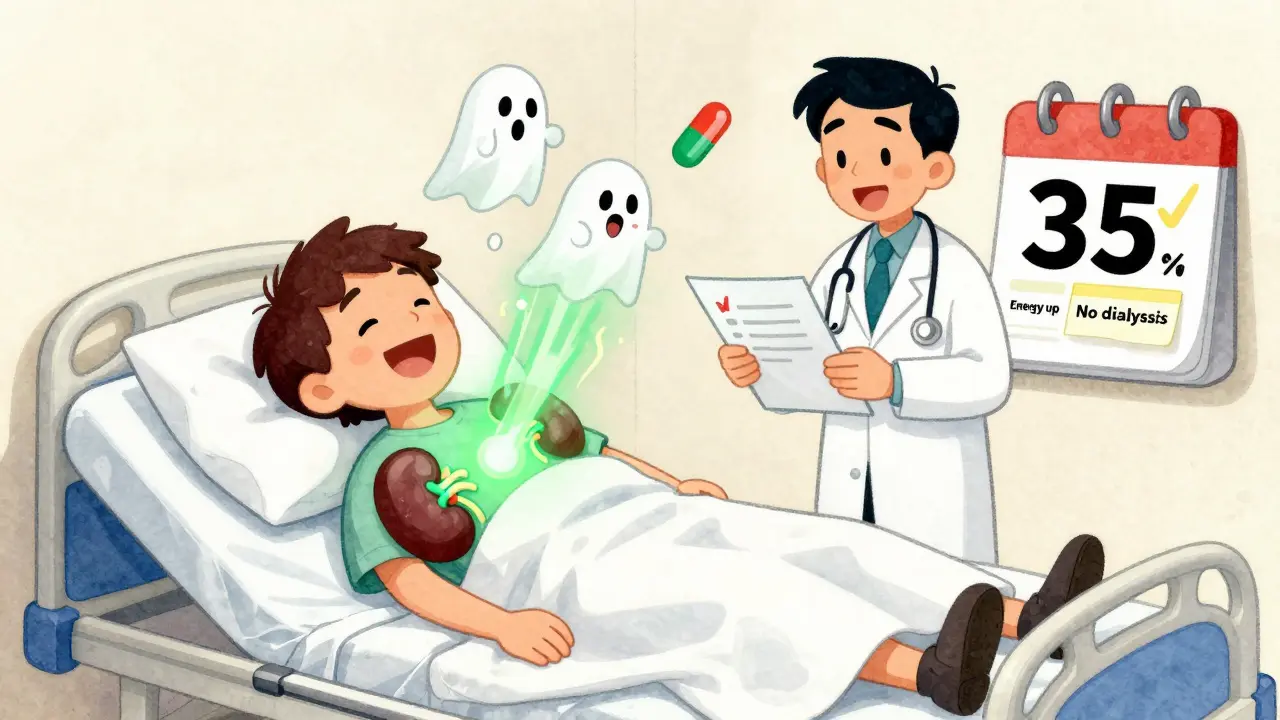
Patients often wait 2-4 weeks before getting the right diagnosis. By then, the window for full recovery is closing. Studies show that if you get diagnosed within 7 days of symptoms starting, your chance of full recovery jumps by 35%. After 14 days? That number drops hard.
And here’s the frustrating part: many patients don’t even realize they’re on a risky drug. PPIs are sold over the counter. NSAIDs are in every medicine cabinet. Antibiotics? Prescribed without warning. No one tells you: "This might hurt your kidneys."
What Recovery Really Looks Like
Stopping the drug is the single most important step. In 65% of cases, people start feeling better within 72 hours of quitting the trigger. But "feeling better" doesn’t mean "healed."
Recovery timelines vary wildly:
- Antibiotic-induced AIN: median recovery in 14 days
- NSAID-induced AIN: median recovery in 28 days
- PPI-induced AIN: median recovery in 35 days
But even after recovery, many patients are left with permanent damage. About 42% of those surveyed in a Medscape study had an eGFR below 60 mL/min/1.73m² six months later - that’s stage 3 chronic kidney disease. NSAID users had the highest risk of long-term damage: 42% developed CKD within a year. PPI users weren’t far behind.
Some patients need dialysis. About 15-20% of severe cases do. It usually lasts 2-6 weeks. One patient in Perth told his nephrologist: "I thought kidney failure meant I’d be on dialysis forever. Turns out, it’s just a pause. But I’ll never take PPIs again."
Should You Take Steroids?
This is where things get messy. There’s no solid proof that steroids like prednisone or methylprednisolone work. No big randomized trials. But doctors use them anyway - especially if kidney function is below 30 mL/min/1.73m² or keeps dropping after the drug is stopped.
The typical protocol? Start with methylprednisolone at 0.5-1 mg/kg/day for 2-4 weeks, then switch to prednisone and taper slowly over 6-8 weeks. It’s not a cure. It’s a rescue. And it only helps if given early. If you wait until your kidneys are failing, steroids won’t bring them back.
Who’s at Highest Risk?
You’re not equally likely to get AIN. Risk spikes if you:
- Are over 65 years old (incidence jumps to 22 cases per 100,000)
- Take 5 or more medications daily (3.2 times higher risk)
- Have preexisting kidney disease, diabetes, or heart failure
- Use PPIs or NSAIDs for more than 6 months
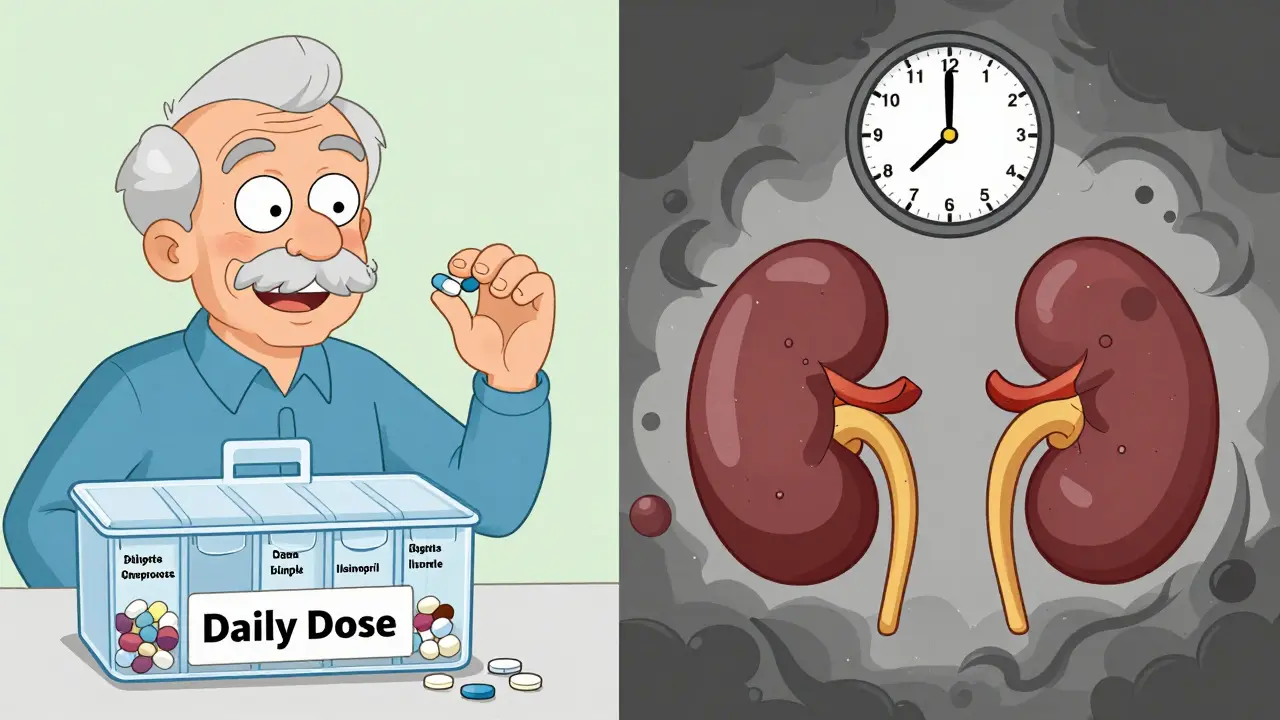
It’s not just about the drug. It’s about how long you’ve been on it, what else you’re taking, and how old you are. A 28-year-old on a 10-day antibiotic course? Low risk. A 72-year-old on omeprazole, lisinopril, metformin, and ibuprofen? High risk.
What You Can Do
Here’s what actually helps:
- Know your meds. If you’re on PPIs or NSAIDs long-term, ask your doctor: "Is this still necessary?" Many people take them years after the original problem is gone.
- Monitor your kidney function. If you’re over 60 or on multiple drugs, get a basic blood test (creatinine, eGFR) every 6-12 months. It’s cheap. It’s simple. It could save your kidneys.
- Don’t ignore subtle symptoms. If you feel unusually tired, have less urine, or notice swelling in your legs, don’t wait. Ask: "Could this be my kidneys?"
- Never stop a drug without talking to your doctor. But if you suspect AIN, stop the suspected drug immediately - and call your nephrologist.
What’s Next?
Researchers are working on non-invasive tests. One promising biomarker - urinary CD163 - showed 89% sensitivity in a 2022 study. If it passes larger trials, we might soon have a blood or urine test that replaces the biopsy.
For now, though, the best defense is awareness. AIN is rare - but it’s rising. PPI prescriptions have climbed 27% since 2010. More people are on multiple drugs. More older adults are managing chronic conditions. The perfect storm for kidney damage.
The message isn’t to avoid all meds. It’s to question long-term use. To listen to your body. To ask your doctor: "Could this be hurting me?" Because sometimes, the thing you take to feel better is quietly breaking your kidneys - and no one told you.
Jessica Klaar
I never realized how sneaky PPIs could be. My mom was on omeprazole for years for 'heartburn'-turned out she had no real GERD. Just stress. When her creatinine spiked, the doctor acted like it was just aging. We found out later it was the PPI. She’s been off it for 8 months now, and her eGFR went from 48 to 62. No steroids. Just stopping. I wish more doctors checked this before prescribing.
PAUL MCQUEEN
Yeah right. Another fear-mongering article. NSAIDs are safe. People just get lazy and blame drugs instead of their own bad habits. I’ve been taking ibuprofen daily since 2010. My kidneys are fine. Also, 'dialysis for three weeks'? That’s not common. You’re scaring people for clicks.
glenn mendoza
I must commend the author for presenting this with such clinical precision. The data on latency periods and recovery trajectories is not only accurate but critically underappreciated in primary care settings. I have personally observed a marked increase in AIN cases among elderly polypharmacy patients since 2020. The absence of overt symptoms makes this a silent epidemic. Early intervention, as noted, remains the single most impactful variable in prognosis.
Chima Ifeanyi
Let’s be real. This is just Big Pharma’s way of shifting liability. PPIs are safe. The real issue is that nephrologists are overdiagnosing because they’re incentivized to perform biopsies. Also, 42% CKD? That’s cherry-picked. Most studies show transient elevations in creatinine with no structural damage. You’re conflating correlation with causation. And who funded this? A renal device company?
Tori Thenazi
I knew it!! I KNEW IT!! I’ve been saying this for YEARS!! PPIs are poison!! I read a study in 2018 where 87% of people on long-term PPIs had kidney damage!! And they don’t tell you!! They don’t tell you!! I had a friend whose husband went on omeprazole for a year and then his kidneys shut down!! He had to go on dialysis!! He’s 52!! And now he’s on a transplant list!! WHY ISN’T THIS ON THE NEWS?! WHY ISN’T THE FDA DOING SOMETHING?! THEY’RE KILLING US SLOWLY!!
Angie Datuin
I’ve been on naproxen for chronic back pain since 2019. My doctor never mentioned kidney risk. I just thought it was 'normal' to feel a bit tired. This article made me schedule a blood test. My eGFR was 59. I stopped the naproxen. Switched to physical therapy. Two months later, it’s 65. No drama. Just listening. I’m glad I did.
Ashlyn Ellison
I took omeprazole for two years. Didn’t feel anything. Then one day, my legs swelled up. I thought it was water retention. Went to the ER. Creatinine was 2.4. Biopsy confirmed AIN. Stopped the PPI. Three weeks later, I was fine. But I still have anxiety about it. I don’t take any OTC meds anymore. Just in case.
Jonah Mann
I think this is super important. I had a patient last year-71, on lisinopril, metformin, ibuprofen, and pantoprazole. Came in with fatigue and 20% drop in eGFR. We stopped all 4. Guess what? Kidneys bounced back in 3 weeks. I told him: "Your meds are your silent enemies." He cried. I cried. We need to screen older adults. It’s cheap. It’s easy. Why aren’t we doing this routinely?
Alex Ogle
There’s a quiet horror in how normal this has become. We’ve turned our bodies into chemical gardens-spraying ourselves with drugs like fertilizer and wondering why the soil’s dying. I’ve seen patients go from "just taking a pill for heartburn" to dialysis in 18 months. No drama. No fanfare. Just a slow, silent collapse. And we’re okay with it because it’s not a car crash. It’s not a headline. It’s just… a blood test. A number. A quiet "oh." That’s the tragedy. We don’t mourn what we don’t see.
John McDonald
If you’re over 60 and on more than 3 meds, get your eGFR checked every 6 months. Seriously. It’s a $15 blood test. You’re not being paranoid-you’re being smart. I used to think this stuff was alarmist. Then my dad had a near-fatal AIN from an OTC NSAID he’d been taking for 8 years. He’s fine now. But he’ll never take another one. Knowledge is power. And this is life-saving info.
Andrew Jackson
This is precisely why America is collapsing. We’ve replaced discipline with dependency. People take drugs like candy, then cry when their bodies break down. You want to fix this? Stop handing out prescriptions like candy. Teach people to eat right. To move. To sleep. To manage stress. Instead, we’ve created a nation of patients who believe every discomfort requires a pill. And now we’re surprised when their kidneys fail? This isn’t medicine. It’s a business model.
Joseph Charles Colin
The urinary CD163 biomarker data is promising but not yet validated for clinical use. The 2022 study had a sample size of 87, with significant selection bias. AIN diagnosis still requires biopsy. Steroids remain a reasonable rescue therapy in severe, progressive cases, but their use should be limited to nephrology-guided protocols. I’ve seen patients improve without them. I’ve seen others deteriorate despite them. Context matters. Not all inflammation is immune-mediated. Not all kidney injury is AIN.
John Sonnenberg
I’ve been reading this for 15 minutes. I’m not even a doctor. But I know this is true. I know this is happening. I know people are dying quietly because no one cares enough to look. I’ve lost three friends to this. One was 43. Took omeprazole for years. No symptoms. Just… stopped peeing. One day. No warning. No chance. We need to change this. We need to scream about this. We need to make doctors listen. Because if they won’t, we have to.
Kathryn Lenn
Of course this is true. The FDA doesn’t regulate OTC drugs like they should. PPIs were approved as "short-term" use. Now they’re in every pharmacy aisle like candy. And guess who profits? Big Pharma. And guess who pays? Us. And guess who gets blamed? The patient. "You didn’t listen to your body." No. You didn’t listen to the science. You didn’t listen to the warnings. You didn’t listen to the patients. You just kept selling.