

When a medication triggers anaphylaxis, you have minutes-not hours-to act. This isn’t a slow-burning reaction. It’s a full-system shutdown that can kill in under 10 minutes if ignored. And here’s the scary part: anaphylaxis from medication happens in hospitals, clinics, pharmacies, and even at home. Antibiotics like penicillin, NSAIDs like ibuprofen, contrast dyes for scans, and even muscle relaxants during surgery can set it off. One in every 5,000 to 10,000 doses can cause this. You don’t need a history of allergies. You don’t need to have reacted before. It can happen the first time you take the drug.
What Anaphylaxis Actually Looks Like
Anaphylaxis doesn’t always start with a rash or hives. In fact, up to 20% of cases show no skin symptoms at all. That’s why people delay action-they think, “It’s not that bad.” But the real danger is in the ABCs: Airway, Breathing, Circulation.
- Swelling of the tongue or throat-so tight you can’t swallow or speak
- Noisy, wheezy breathing or a persistent cough
- Hoarse voice or inability to talk
- Dizziness, fainting, or collapse
- Pale, clammy skin-especially in children
- Rapid, weak pulse
If you see any of these after someone takes a new medication, don’t wait. Don’t call the doctor. Don’t text a friend. Don’t wait to see if it gets worse. Act now.
The One Thing That Saves Lives: Epinephrine
Epinephrine is the only treatment that reverses anaphylaxis. Antihistamines like Benadryl? They help with itching, maybe a few hives. But they do nothing for airway swelling or low blood pressure. Steroids? They’re for long-term inflammation, not emergencies. Delaying epinephrine to give those first is deadly.
Epinephrine works in 1 to 5 minutes. It tightens blood vessels, opens airways, and restores heart function. But its effect lasts only 10 to 20 minutes. That’s why you need to call emergency services immediately-even if the person seems better after the shot.
Give it in the outer thigh. Not the arm. Not the buttock. The thigh. Muscle. That’s where it absorbs fastest. Use an auto-injector-EpiPen, Auvi-Q, Adrenaclick. Press firmly against the thigh until you hear a click. Hold for 10 seconds. Then remove. If the person is unconscious, lay them flat. If they’re struggling to breathe, let them sit up with legs out. Pregnant women? Lay them on their left side. Kids? Keep them flat. Never let them stand or walk.
Dosage matters: 0.15 mg for kids 15-30 kg. 0.3 mg for adults and kids over 30 kg. If symptoms don’t improve after 5 minutes, give a second dose. Some protocols say every 10 minutes if needed. Don’t hesitate. The risk of not giving it is death. The risk of giving it? A racing heart, maybe some shakiness. Out of 35,000 doses given in the last decade, only 10 people had serious side effects.
Why People Delay-And Why That’s Deadly
In hospitals, the average time from symptom recognition to epinephrine is over 8 minutes. That’s 3 minutes too long. Nurses and doctors delay because they’re afraid of side effects. Or they think, “Is this really anaphylaxis?” Or they worry about liability. But data doesn’t lie: 70% of fatal anaphylaxis cases involved no epinephrine-or it was given too late.
In the real world, patients themselves delay too. A survey of 2,500 people with known drug allergies found 68% carried epinephrine, but only 41% felt confident using it. One in three admitted hesitating during a real reaction. Common mistakes? Not holding the injector long enough. Injecting into fat instead of muscle. Fumbling with the device under stress.
That’s why training matters. Practice with a trainer pen. Watch the video on the manufacturer’s website. Do it with your family. Make it automatic. If you’re in doubt-give it. The Australian Society of Clinical Immunology says: “IF IN DOUBT, GIVE ADRENALINE.” That’s not a slogan. It’s a life-saving rule based on data from preventable deaths between 2015 and 2020.
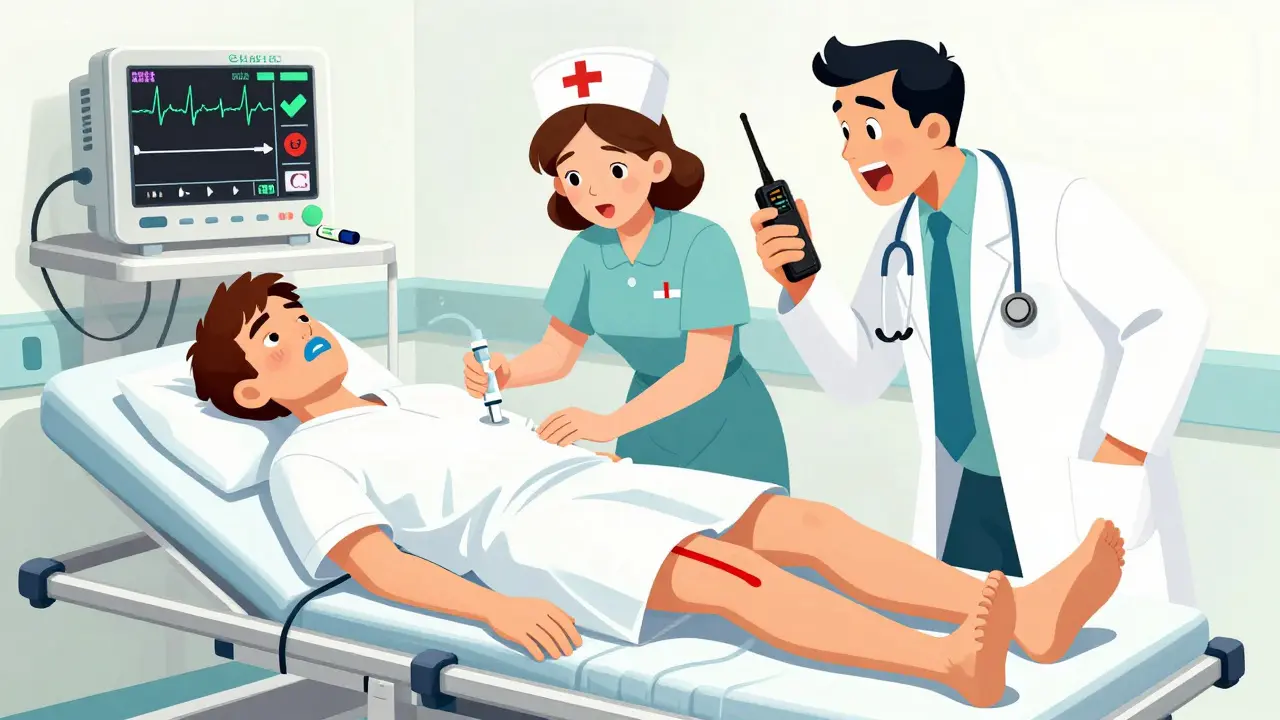
What Happens After the Shot
Even if the person feels fine after epinephrine, they still need to go to the hospital. Why? Because 1 in 5 people have a second wave of symptoms-called a biphasic reaction-up to 72 hours later. It’s unpredictable. It can hit when you’re at home, asleep, or thinking you’re safe.
Hospital guidelines require at least 4 hours of observation. For medication-induced cases, some newer data suggests 6 to 8 hours are safer. That’s because drug-triggered reactions carry a 25% higher risk of biphasic episodes than food-triggered ones. You can’t skip this step.
At the hospital, they’ll give IV fluids-usually 1 to 2 liters of saline-to support blood pressure. They may monitor heart rhythm. They might give oxygen. But they won’t give more epinephrine unless it’s absolutely necessary. IV epinephrine? Only in intensive care, by specialists. It’s risky if done wrong.
Special Considerations: Beta-Blockers and Obesity
If the person is on beta-blockers-for high blood pressure, heart rhythm, or migraines-epinephrine may not work as well. These drugs block the very receptors epinephrine needs to act. In these cases, higher doses may be needed. Some studies show 2 to 3 times the normal dose is required. That’s why doctors now ask: “Are you on any heart meds?” before giving epinephrine.
Obesity is another factor. Standard dosing by weight doesn’t always work well in people with BMI over 30. Early research from the NIH shows dosing based on body mass index gives more consistent results. It’s not standard yet-but it’s coming.
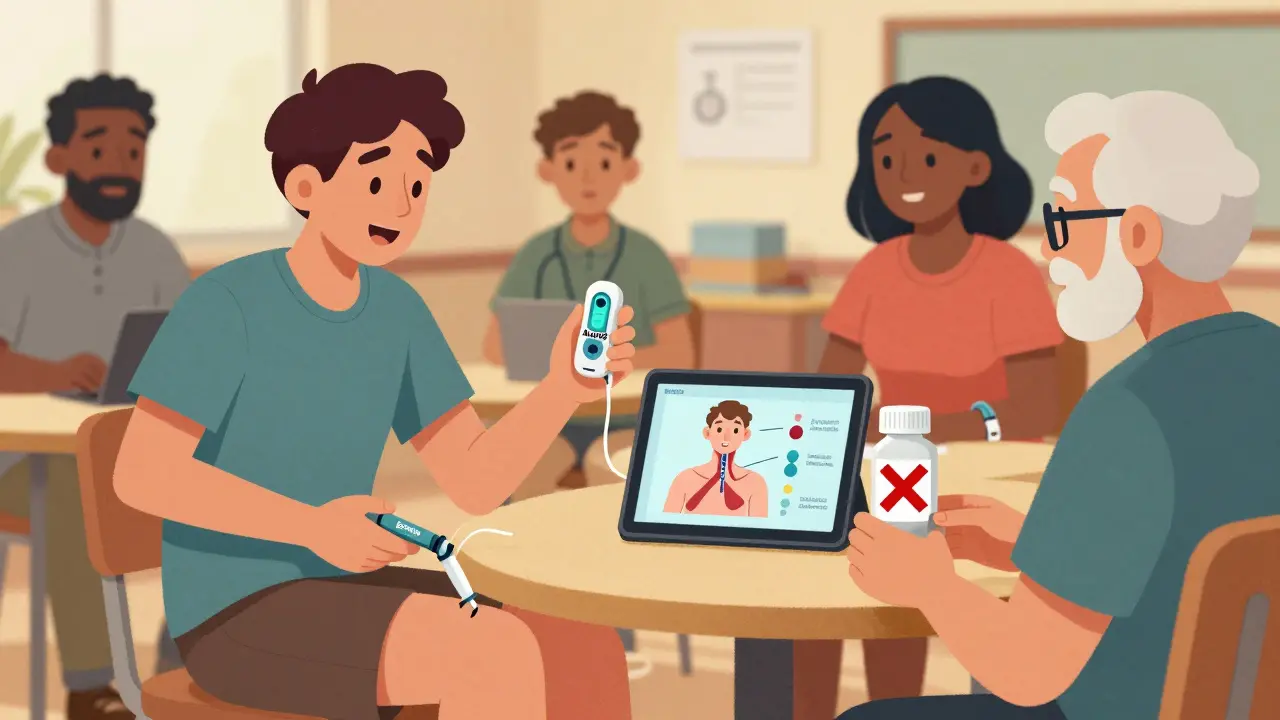
New Tools, Better Outcomes
Technology is helping. The FDA approved the Auvi-Q 4.0 in May 2023-the first auto-injector with voice guidance. It tells you: “Remove cap,” “Press firmly,” “Hold for 10 seconds.” In trials, untrained users got it right 89% of the time-up from 63%. That’s huge.
Some hospitals now use smart alerts in electronic records to flag patients with known drug allergies. Others have rapid-response teams trained to grab epinephrine within 60 seconds of an alarm. These aren’t luxuries. They’re survival tools.
What You Can Do Today
- If you’ve had a reaction to a drug before, get an epinephrine auto-injector. Keep it with you. Check the expiry date every 3 months.
- Teach your family, coworkers, or roommates how to use it. Practice with a trainer pen.
- Wear a medical alert bracelet. List the drug that caused the reaction.
- When a new medication is prescribed, ask: “Could this cause anaphylaxis? What should I do if I react?”
- Never assume you’re safe just because you’ve taken the drug before. Allergies can develop at any time.
Anaphylaxis from medication isn’t rare. It’s predictable. And it’s preventable-if you know what to do. The clock starts the moment the drug enters the body. Your job? Stop it before it stops them.
Can anaphylaxis happen the first time you take a medication?
Yes. You don’t need to have had a prior reaction. The immune system can become sensitized after just one exposure. This is especially common with antibiotics like penicillin, contrast dyes, and some painkillers. Never assume a drug is safe just because you’ve taken it before.
Can I use an epinephrine auto-injector on someone else?
Absolutely. Epinephrine auto-injectors are designed for use by bystanders. There is no legal or medical barrier to giving it to someone having anaphylaxis-even if it’s not your own prescription. In fact, delaying it because you’re unsure who it belongs to can be fatal. If someone is struggling to breathe or collapsing, give the shot. It’s safe, legal, and life-saving.
Why not just give Benadryl instead of epinephrine?
Benadryl only treats skin symptoms like itching or hives. It does nothing for airway swelling, low blood pressure, or shock. In anaphylaxis, these are the life-threatening issues. Giving Benadryl instead of epinephrine delays the only treatment that works. Studies show no reduction in death rates when antihistamines are used alone. Epinephrine is the only medication that reverses the process.
What if I’m not sure it’s anaphylaxis?
If in doubt, give epinephrine. The Australian Society of Clinical Immunology and the Resuscitation Council UK both state that hesitation is the leading cause of preventable death. Epinephrine is safe-even if you’re wrong. Side effects like a racing heart or shaking are temporary. The alternative-waiting to see if it gets worse-can be fatal. Better to give it and be wrong than to wait and be dead wrong.
Do I need to go to the hospital after using epinephrine?
Yes. Always. Even if you feel fine. Up to 20% of people experience a second wave of symptoms-called a biphasic reaction-hours or even days later. This can happen while you’re at home, asleep, or thinking you’re safe. Hospitals monitor for at least 4 hours. For medication-induced cases, 6-8 hours is now recommended. Skipping this step is a major risk.
Can I use an expired epinephrine auto-injector?
If it’s the only option and someone is having anaphylaxis, use it. While potency decreases after expiry, studies show many expired devices still deliver a therapeutic dose. It’s better than nothing. But don’t rely on it. Replace it before it expires. Keep a spare if possible. Check the expiry date every 3 months.
How do I know if I’m giving the injection correctly?
Hold the injector firmly against the outer thigh-through clothing if needed. Press until you hear a click. Keep it in place for 10 seconds. Then remove. The needle goes deep into muscle, not fat. If you’re unsure, practice with a trainer pen (available for free from manufacturers). Watch the instructional video on the device’s website. Many people inject too shallowly or pull away too soon.
Are there alternatives to epinephrine auto-injectors?
No. There are no approved alternatives that work as fast or reliably. Inhalers, nasal sprays, or oral meds won’t stop anaphylaxis. Epinephrine delivered via auto-injector into the thigh is the gold standard. Some newer devices have voice guidance or needle shields-but they still deliver the same drug. Don’t substitute. Don’t experiment. Epinephrine is non-negotiable.
Sajith Shams
Let me cut through the noise: if you're not carrying two EpiPens at all times, you're playing Russian roulette with your life. I've seen three people die because someone 'didn't want to overreact.' One was a 12-year-old after a single dose of amoxicillin. No rash. No warning. Just gone in 7 minutes. Epinephrine isn't optional-it's mandatory. And if your doctor won't prescribe it without a 'history,' find a new doctor.
Glen Arreglo
As someone who's lived in both the US and Australia, I’ve seen how cultural attitudes delay action. In the US, people wait for ‘confirmation.’ In Australia, they act first, ask questions later. And guess what? Australia’s anaphylaxis survival rate is 40% higher. The ‘IF IN DOUBT, GIVE ADRENALINE’ rule isn’t just advice-it’s survival protocol. We need to stop treating this like a debate and start treating it like an emergency.
shivam seo
Wow. Another fear-mongering article. Let’s be real-how many people actually die from medication anaphylaxis? 0.002% of doses. Meanwhile, 300,000 die yearly from statins. But no one’s screaming about statin-induced cardiac arrest. You want to save lives? Stop hyping up rare events and fix the real killers. This is medical theater disguised as education.
benchidelle rivera
It’s not enough to know the steps. You must institutionalize them. Hospitals need mandatory epinephrine drills for all staff. Pharmacies should offer free training sessions with every prescription for high-risk drugs. Schools should include anaphylaxis response in basic first-aid curricula. This isn’t about individual responsibility-it’s about systemic failure. We’ve known this for decades. Why are we still losing people?
Isabel Rábago
You talk about epinephrine like it’s a magic bullet, but you ignore the deeper rot. Why do we live in a society where life-saving medicine is locked behind $300 price tags? Why do people have to beg for prescriptions? Why are auto-injectors still not covered by every insurance plan like insulin? This isn’t a medical problem-it’s a moral one. We treat death like a personal failure instead of a systemic collapse. And until we fix that, no amount of training will save the people who can’t afford to live.
Ashley Bliss
I used to think I was safe because I’d taken penicillin five times before. Then I had my first reaction-no hives, just a whisper of dizziness, then my throat closed like a vise. I didn’t have an EpiPen. My roommate grabbed my neighbor’s-she’d never used one before. She fumbled. Missed the thigh. Injected into my jeans. I was unconscious before the ambulance arrived. They saved me. But I carry two now. And I make everyone I know practice with trainer pens. Because if you’re not prepared, you’re not living-you’re just waiting for your name to be in the next obituary.
Dev Sawner
It is imperative to note that the administration of epinephrine via intramuscular injection into the lateral thigh is the only evidence-based intervention proven to mitigate mortality in anaphylactic shock. Alternative routes, including subcutaneous or intravenous, are contraindicated in non-specialized settings due to the risk of arrhythmia and hypertension. Furthermore, the dosage regimen must be strictly adhered to per body weight parameters, as deviations have been associated with both under-treatment and iatrogenic complications. The Australian Society of Clinical Immunology and Allergy (ASCIA) guidelines, updated 2023, remain the gold standard. Non-compliance constitutes a breach of clinical best practice.
Moses Odumbe
Just got my new Auvi-Q 4.0. It literally says ‘PRESS’ and then ‘HOLD’ in a calm voice. I practiced with my 8-year-old. She did it right on the first try. 🙌 My mom’s on beta-blockers. We’re getting her a 0.3mg dose. No more guessing. No more panic. This tech is a game-changer. If you’re still using a 2018 EpiPen? You’re living in the Stone Age. Upgrade. Now.
Meenakshi Jaiswal
My sister is a nurse in Mumbai. She told me about a man who died in the ER after they waited 12 minutes to give epinephrine because they thought it was a ‘mild allergic reaction.’ He had no history. Just took a painkiller. I made a video in Hindi showing how to use the injector. Got 200k views. People are scared, but they’re also willing to learn. We need more of this-simple, local, real. Not just Western guidelines. Teach it in village clinics. In pharmacies. In schools. Knowledge saves lives. And it’s not expensive.
bhushan telavane
My uncle died in India from anaphylaxis after a tetanus shot. No one knew what to do. No one even had epinephrine in the clinic. We’re not talking about rich countries here. In rural areas, people still use cold compresses and holy water. This post? It’s a lifeline. I’m translating it to Hindi and sharing it in every WhatsApp group I’m in. Someone’s life might depend on it.
holly Sinclair
What fascinates me is the paradox of medical modernity: we have life-saving technology that works in seconds, yet we still operate on fear, bureaucracy, and ignorance. Epinephrine is a molecule. It doesn’t care about your insurance, your race, your nationality, or your belief system. It responds to chemistry, not culture. And yet, we’ve built entire systems that delay its delivery-not because of science, but because of human hesitation, institutional inertia, and the quiet, pervasive lie that ‘it won’t happen to me.’ Anaphylaxis is the ultimate equalizer. It doesn’t discriminate. But our response does. And that’s the tragedy-not the reaction, but the refusal to act until it’s too late.
Gloria Parraz
I used to think I was fine until I watched my best friend die in my arms because I was too scared to use her EpiPen. I didn’t know how. I thought I’d hurt her. I thought I’d break the law. I thought I’d be blamed. I was wrong on every level. Now I carry three injectors. I teach every new friend how to use them. I leave one at my gym, one at my kid’s school, one in my purse. I don’t care if you think I’m dramatic. I care that no one else has to bury someone because they were too afraid to press a button.