

What Benzodiazepines Do to Your Memory
Benzo’s aren’t just calming pills. They mess with how your brain makes new memories. If you’ve ever taken a benzodiazepine and later realized you couldn’t remember parts of the evening - like where you put your keys or what you ate for dinner - you weren’t imagining it. This is called anterograde amnesia, and it’s a well-documented side effect of all benzodiazepines, from diazepam to alprazolam.
It’s not just about forgetting small things. Studies show these drugs interfere with the hippocampus, the part of your brain responsible for turning short-term experiences into lasting memories. Even a single dose can make it harder to learn new information. The more you take, the worse it gets. Complex tasks - like following a conversation, remembering instructions, or navigating a new route - are hit hardest.
And here’s the catch: this isn’t just temporary. A 2023 meta-analysis of 19 studies found that long-term users (average 10 years) showed clear, measurable declines in memory, attention, processing speed, and even language skills. Some people lost up to 15 IQ points. That’s not normal aging. That’s drug-induced brain fog.
The Fall Risk Is Real - Especially After 65
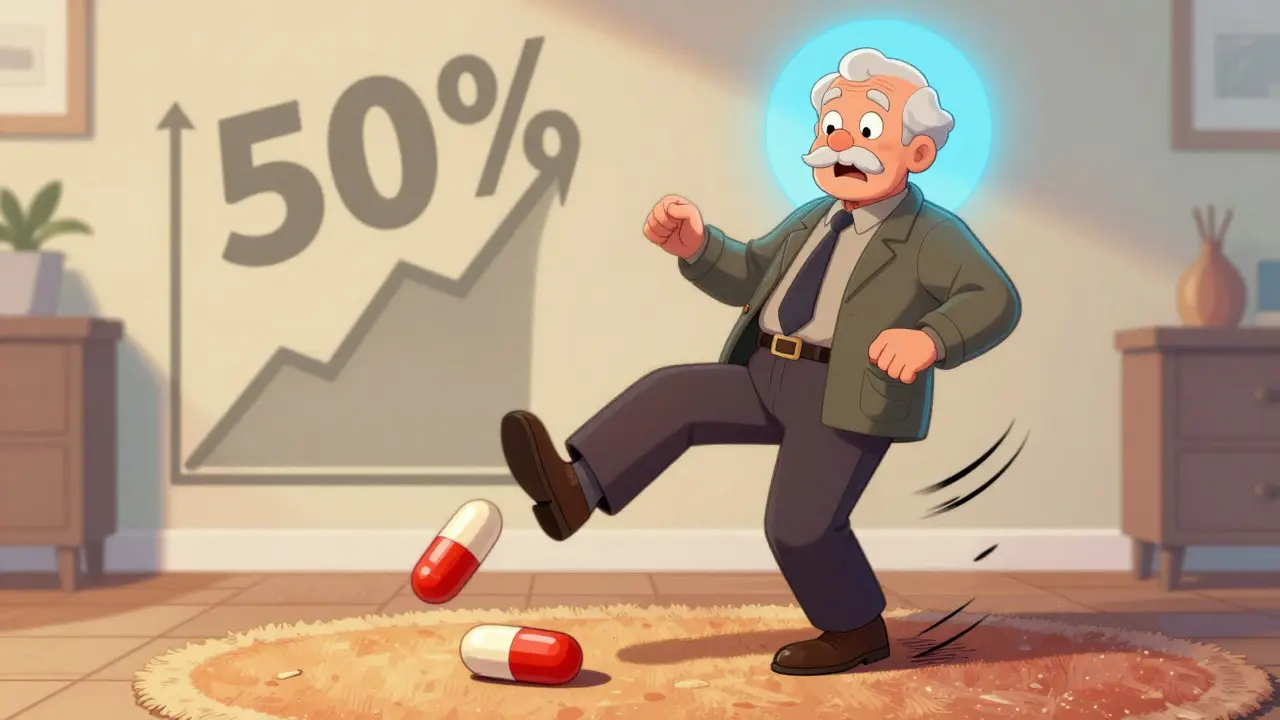
If you’re over 65 and taking a benzodiazepine, you’re at a 50% higher risk of falling. That’s not a small number. It’s not a "maybe." It’s backed by data from over a million people. And falls aren’t just scary - they’re dangerous. The same studies show a 70% higher chance of breaking a hip, which can end your independence.
Why? Benzodiazepines slow your reactions, blur your balance, and make your muscles feel heavy. You might not feel dizzy, but your body’s coordination is off. One study found that older adults on these drugs had 30-40% worse balance control and 25-35% slower reaction times. That’s enough to miss a step, slip on a rug, or stumble getting out of bed.
High-potency benzos like lorazepam and alprazolam are worse than low-potency ones like diazepam. But none are safe for long-term use in older adults. That’s why the American Geriatrics Society has listed them as "potentially inappropriate" for seniors since 2012. And it’s not just a suggestion - it’s a warning.
Tapering Isn’t Optional - It’s Necessary
Stopping benzodiazepines cold turkey is dangerous. Seizures, panic attacks, hallucinations - these aren’t myths. They’re real risks. That’s why tapering isn’t just recommended. It’s the only safe way out.
The gold standard is the Ashton Protocol. Developed by Professor C. Heather Ashton in the 1980s, it’s simple in theory: reduce your dose by 5-10% every 1-2 weeks. For people who’ve been on benzos for years, that means slowing down even more - sometimes just 2-5% per month.
Why diazepam? Because it has a long half-life. That means it leaves your system slowly, which smooths out withdrawal symptoms. Many doctors switch patients from short-acting benzos like Xanax to diazepam before tapering. It’s not about replacing one drug with another - it’s about making the exit smoother.
A 2021 trial with 312 long-term users found that using this method, nearly 70% successfully quit within six months. Those who stuck with it saw their memory and focus start to improve within four weeks. By eight weeks, many reported clearer thinking and better concentration.
What Happens After You Stop?
Some people think once you stop, your brain bounces back. It doesn’t always. A 10-month follow-up study found only 45% of former users returned to normal cognitive function. The rest still struggled with memory, attention, and mental speed.
That doesn’t mean all hope is lost. It means healing takes time - often 6 to 12 months. People on withdrawal forums talk about "brain fog" lasting for months. But the same users also report gradual improvement. One common thread: those who tapered slowly had better outcomes than those who rushed.
Neuroimaging shows no permanent brain damage. That’s good news. It means your brain has the ability to recover. But recovery isn’t automatic. It needs time, rest, and patience.
How to Know If You Should Taper
Not everyone needs to quit. But if you’ve been on benzodiazepines for more than a few months, you should ask yourself a few questions:
- Do you feel foggy most days?
- Have you had any near-falls or unexplained bumps?
- Do you rely on the pill to get through the day, not just sleep or calm anxiety?
- Has your doctor checked your memory or cognitive function in the last six months?
Doctors should be screening for this. The Mini-Mental State Exam (MMSE) and Montreal Cognitive Assessment (MoCA) are simple, quick tests that can catch early decline. If your score drops by 2 points on MMSE or 3 on MoCA, it’s a red flag.
Current guidelines say: if you’re over 65, your daily dose should never exceed 5 mg of diazepam equivalent. For younger adults, it’s 10 mg. But even that’s too high for most. The lowest dose that works is the only dose you should be on.

What to Do Next
If you’re on benzodiazepines and want to stop:
- Don’t quit cold. Talk to your doctor about switching to diazepam if you’re on a short-acting benzo.
- Ask for a taper plan - 5-10% every 1-2 weeks is the starting point.
- Track your symptoms. Use a journal or app like BrainBaseline to note changes in memory, mood, or energy.
- Give yourself time. Improvement takes months, not weeks.
- Support your brain. Sleep, hydration, walking, and reducing caffeine help recovery.
And if your doctor says, "It’s fine to stay on this" - ask for the evidence. The American Psychiatric Association says benzos shouldn’t be used for anxiety beyond 4 weeks. That’s not a suggestion. That’s the guideline.
There’s Hope Beyond the Pill
Research is moving forward. New drugs are being tested that target anxiety without affecting memory. Early trials show promise - drugs that calm the mind without dulling the brain. But those aren’t available yet.
Until then, the best option is to step off the benzo train, slowly and safely. The road is hard, but thousands have walked it. Their stories aren’t perfect. But they’re real. And they show one thing: your brain can heal. You just have to give it time.
mark shortus
I took Xanax for 3 years. One day I forgot my own birthday. Not a joke. I had to ask my sister. Then I realized I hadn’t remembered my dog’s name for 3 weeks. I cried in the grocery store. No one noticed. That’s the real horror story. I tapered with diazepam. Took 11 months. My brain’s still fuzzy but I can spell my name again. 🤕
Emily P
I’m curious about the 15 IQ point decline mentioned. Is that from the same cohort measured pre/post, or is it comparing long-term users to controls? I’ve seen studies where baseline cognitive function wasn’t accounted for.
Jedidiah Massey
The Ashton Protocol is the only evidence-based approach, but it’s rarely implemented due to systemic pharmaceutical inertia. The pharmacokinetic profile of diazepam (t1/2 = 20–100h) permits steady-state plasma concentrations, minimizing GABA receptor supersensitivity during titration. Most clinicians lack the patience or training to execute this properly.
Kitt Eliz
I’m a nurse who’s helped 87 people taper. You’re not weak for needing help. You’re brave for wanting your brain back. Start with 5% reductions. Sleep like your life depends on it (because it does). Walk outside daily. No caffeine after noon. You WILL feel better. I promise. 💪🧠
Mahammad Muradov
This is why India banned all benzos without psychiatric consultation. People here take them like candy. My uncle forgot his wedding anniversary. Then he forgot he had a wife. Then he forgot he had children. Now he’s in a nursing home. This isn’t medicine. It’s slow suicide with a prescription.
Lynsey Tyson
I’ve been off benzos for 14 months. Some days are still rough. But I can read a book now without rereading the same paragraph 5 times. I can remember where I put my phone. I didn’t know how much I’d lost until I got it back. It’s not perfect. But it’s enough.
Allison Pannabekcer
To anyone reading this: if you’re scared to taper, you’re not alone. I was terrified. I thought I’d lose my mind. But your mind is already losing itself - slowly, quietly. Tapering isn’t giving up. It’s choosing yourself. One percent at a time. You’re not broken. You’re healing.
Sarah McQuillan
This is why Americans are so weak. In Russia, we just quit cold turkey. No drama. No diazepam swap. You feel bad for a week, then you’re fine. This whole tapering thing is just a capitalist scam to sell more meds and therapy sessions. Stop overmedicalizing normal anxiety.
Edington Renwick
The fact that people still take benzos past 4 weeks shows how lazy doctors are. And how desperate patients are. If you’re still on it after 3 months, you’re not managing anxiety - you’re addicted. And if your doctor says it’s fine, find a new one. This isn’t debate. It’s negligence.
Kathryn Featherstone
I tapered for 10 months. The worst part wasn’t the anxiety. It was the guilt. I felt like I was failing because I couldn’t just "snap out of it." But recovery isn’t linear. Some days I cried over spilled coffee. Other days I danced in the kitchen. Both were progress.
Gloria Parraz
I started writing down one good thing every day. Not big stuff. Just "I remembered my keys." Or "I made tea without burning it." After 3 months, I had a list of 92 tiny wins. That’s how I knew I was getting better. You don’t need a miracle. Just consistency.
Sahil jassy
I quit benzos after my mom fell and broke her hip. She was on 10mg diazepam. Doctor said it was fine. She’s in a wheelchair now. I didn’t cry. I just deleted my script. Took 8 months. My hands don’t shake anymore. I can hold my daughter without fear. That’s all that matters.
Nicole Rutherford
I’ve read every study. You’re not special. Your brain isn’t magically healing. You’re just getting used to being foggy. Most people who say they recovered are lying to themselves. The damage is permanent. Stop pretending.
bhushan telavane
In my village in Bihar, we use ashwagandha and yoga. No pills. My grandfather lived to 98. Never took a benzo. Never forgot his grandkids' names. Maybe the real problem isn’t the drug - it’s how we’ve forgotten how to live without it.
Vicki Belcher
I tapered. It took 14 months. I cried every week. But I just remembered my mom’s birthday. For the first time in 5 years. I called her. She cried too. I didn’t say much. Just "I’m here." And for once, I meant it. 🥹❤️