
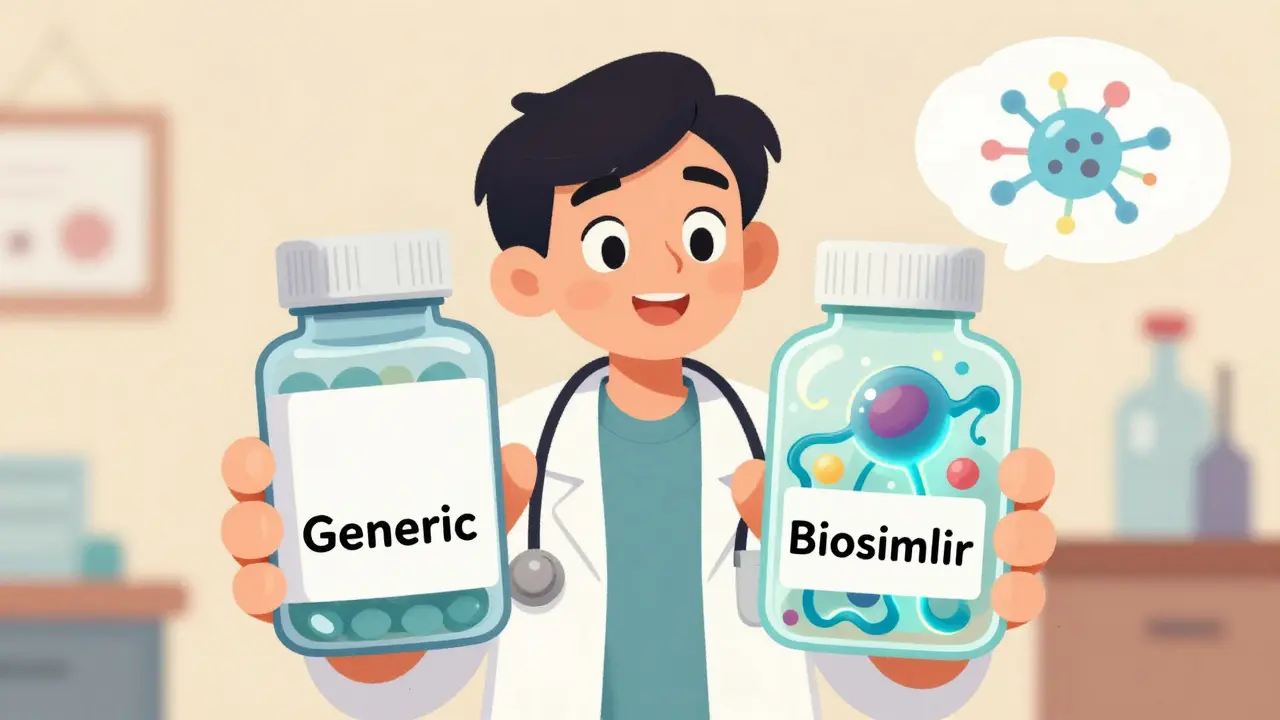
When your doctor says you need a new medication, you might hear two words: biosimilar or generic. Both sound like cheaper versions of expensive brand-name drugs-and they are. But they’re not the same thing. Confusing them can lead to misunderstandings, unnecessary anxiety, or even treatment delays. If you’re paying out of pocket, dealing with insurance hurdles, or just trying to make sense of your prescription, knowing the difference matters. It’s not just about price-it’s about safety, how the drug works in your body, and what to expect when you switch.
What’s the Real Difference Between Biosimilars and Generics?
Think of generics like photocopies. If the original drug is a small molecule-say, the cholesterol-lowering pill atorvastatin (Lipitor)-a generic is chemically identical. Same atoms. Same structure. Same way it’s made. It’s produced in a lab using precise chemical reactions, and regulators require proof that it behaves exactly the same in your body. That’s called bioequivalence: the drug must reach the same levels in your bloodstream, at the same speed, as the brand-name version. The FDA approves over 11,000 of these. They’re simple, reliable, and cost 80-85% less. Biosimilars? They’re more like hand-painted replicas of a complex sculpture. These are made from living cells-usually Chinese hamster ovary cells grown in giant bioreactors. The result is a large protein molecule, often over 10,000 times heavier than a generic drug. Think of drugs like adalimumab (Humira) for rheumatoid arthritis or trastuzumab (Herceptin) for breast cancer. No two biosimilars are exactly alike. Even tiny differences in how the cells are grown, purified, or stored can change the molecule’s shape slightly. That’s why regulators don’t call them “identical.” They call them “highly similar.” And they require far more testing to prove they work the same way in patients.Cost Savings: Why Generics Are Cheaper Than Biosimilars
If you’re looking to save money, generics win by a landslide. A generic version of a brand-name pill can cost you $5 instead of $200. That’s because making a small molecule is like baking a cake from a recipe-you just need the right ingredients and a clean lab. Development costs? Around $2-3 million. It takes 3-4 years. Biosimilars? They’re like cloning a live animal. The process is messy, unpredictable, and expensive. You need sterile facilities, specialized equipment, and years of testing to prove your version doesn’t cause unexpected immune reactions or lose effectiveness. Development costs? $100-250 million. And it takes 8-10 years. So even though biosimilars are cheaper than the original biologic, the savings are smaller-typically 15-20%. That’s still meaningful. For a drug like Humira, which can cost $2,500 per month, a 20% drop means $500 saved every 30 days.How Are They Approved? It’s Not the Same Process
Generics get approved under the Hatch-Waxman Act of 1984. All they need to show is bioequivalence: your blood levels after taking the generic match those after taking the brand. No new clinical trials on thousands of patients. Just lab tests and a few hundred volunteers. Biosimilars follow the BPCIA of 2010. They need a full package: detailed molecular analysis using advanced tools like mass spectrometry, animal studies, and at least one clinical trial comparing safety and effectiveness to the original. But here’s the catch: they don’t need to repeat every single trial the original did. Regulators use a “totality of evidence” approach. If the molecule looks the same, acts the same in lab tests, and performs the same in a well-designed trial, they approve it. The FDA approved its first biosimilar in 2015. By 2023, there were 46 on the U.S. market.Can Pharmacists Switch You Automatically?
With generics, yes. In 49 states, pharmacists can swap a brand-name drug for a generic without asking your doctor-unless your doctor wrote “dispense as written.” It’s automatic. You probably don’t even notice. Biosimilars? Not so simple. Only those labeled “interchangeable” can be swapped at the pharmacy without the prescriber’s approval. And even then, 28 states require the pharmacist to notify your doctor within 72 hours. As of early 2024, only a handful of biosimilars have been approved as interchangeable: insulin glargine (Semglee) and adalimumab (Cyltezo) are the big ones. Most others still require your doctor to specifically prescribe the biosimilar. That’s because switching back and forth between a reference biologic and a biosimilar could, in theory, trigger immune responses. The science says it’s safe-but regulators want extra caution.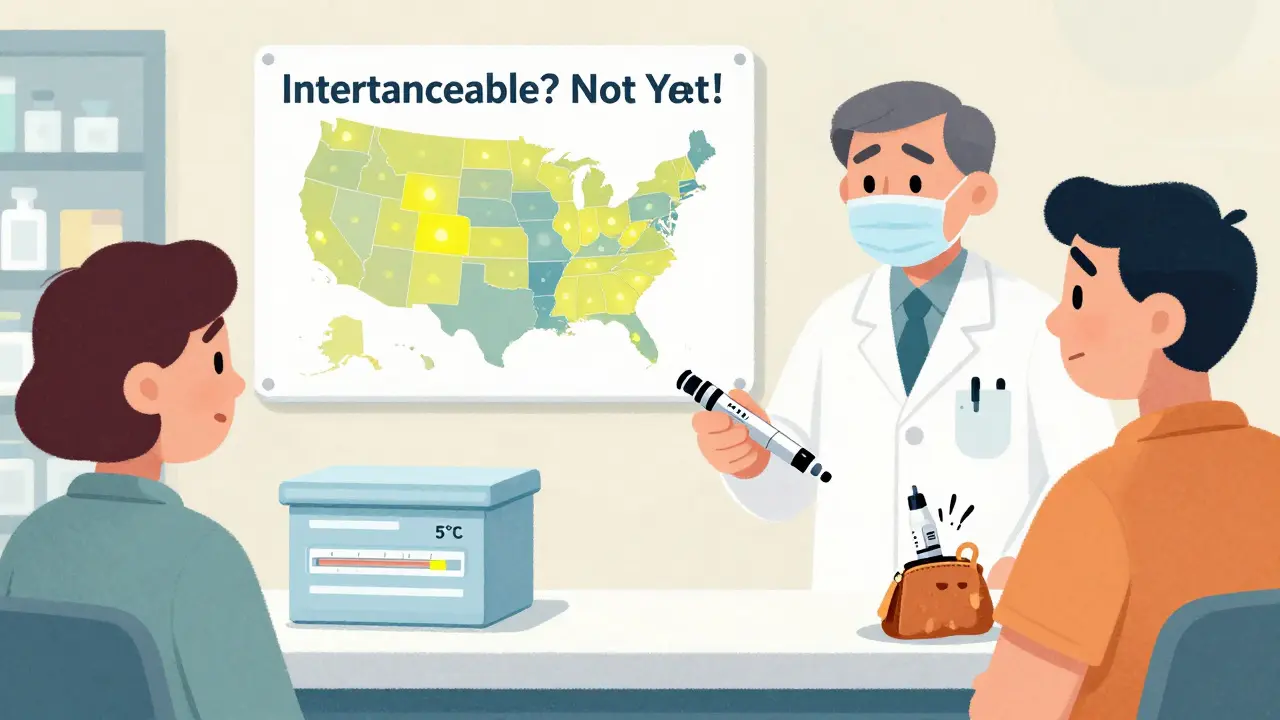
Real-World Evidence: Do They Work as Well?
For generics, the answer is clear. A landmark 2019 JAMA study looked at 47 trials involving over 100,000 patients taking generic versions of heart drugs. No difference in heart attacks, strokes, or deaths. The results were statistically identical. For biosimilars, the data is newer but just as reassuring. A 2022 review of 128 studies involving nearly 40,000 patients with rheumatoid arthritis found no meaningful difference in effectiveness or safety between the original infliximab and its biosimilar. Cancer patients switching to biosimilar trastuzumab for HER2+ breast cancer saw the same tumor shrinkage rates. A 2023 study in Patient Preference and Adherence found that even when patients were anxious about switching, their disease activity didn’t worsen. Still, some concerns linger. In inflammatory bowel disease, where even small changes in drug levels can matter, a few patients report feeling “off” after switching-even though blood tests show no change in inflammation. That’s often psychological, but it’s real to them. That’s why education matters.Who’s Prescribing What-and Why?
Most doctors are comfortable prescribing generics. In fact, 89% of physicians feel very confident doing so, according to a 2023 AMA survey. But biosimilars? Only 58% of non-specialists feel the same. Why? Because the science is newer. The paperwork is more complex. Insurance prior authorizations take longer. And many haven’t had training on how to explain it to patients. Specialists-oncologists, rheumatologists, gastroenterologists-are leading the charge. The American College of Rheumatology now recommends biosimilars as first-line treatment for rheumatoid arthritis. The American Society of Clinical Oncology says they’re safe and cost-saving in cancer care. But outside these fields, uptake is slower. And patients? A 2022 National Psoriasis Foundation survey found that 42% were worried biosimilars wouldn’t work. One in four refused to switch. But when patients got clear explanations-like “This is the same drug, made differently, but proven just as safe”-over 80% agreed to try it.Storage, Handling, and Logistics Matter Too
Generics? Most sit on your shelf at room temperature. No special handling. You can carry them in your purse. Biosimilars? Most need refrigeration. Between 2°C and 8°C. If they get too warm during shipping or storage, the protein can break down. That’s why hospitals and specialty pharmacies have strict cold-chain protocols. If you’re getting an injection at home, you need to know how to store it. A 2023 Reddit post from a pharmacy tech noted: “Some elderly patients mix up their insulin pens because the biosimilar looks different. They accidentally use the wrong one.” Simple design changes can cause real errors.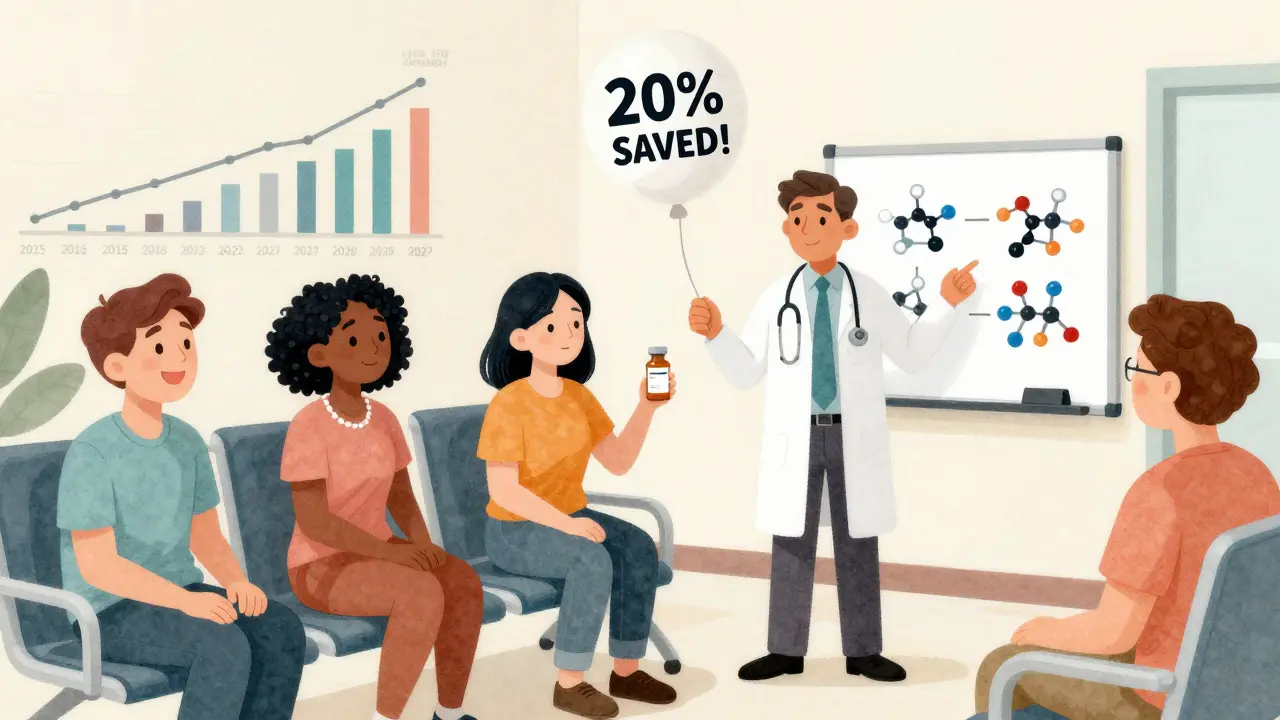
What’s Changing in 2024 and Beyond?
The Inflation Reduction Act of 2022 removed a financial penalty for doctors who used biosimilars in Medicare Part B. That’s a big deal. It means providers now get paid the same whether they give the original or the biosimilar. No disincentive to switch. KFF estimates this will boost biosimilar use by 25%. The first interchangeable biosimilar for Stelara (ustekinumab) is expected in late 2024. That’s a blockbuster drug-used for psoriasis and Crohn’s disease. If it hits the market, it could save the U.S. system over $5 billion a year. Meanwhile, biosimilar adoption in Europe is already at 65% for eligible drugs. In the U.S., it’s around 35%. But it’s accelerating. Hospital systems are using group purchasing organizations to lock in lower prices. Express Scripts predicts biosimilars will make up 45% of all biologic prescriptions by 2027.What Should You Do?
If your doctor prescribes a generic: no worries. It’s been around for decades. Safe. Effective. Cheap. If they suggest a biosimilar: ask questions. Not out of fear-but out of clarity. Ask: Is this biosimilar interchangeable? (If yes, the pharmacist can switch it without calling your doctor.) Ask: Has this been used by other patients with my condition? Ask: Will I need to change how I store or take it? Ask: What’s the cost difference? (Some insurance plans cover the biosimilar at the same copay as the brand-name drug.) And if you’re nervous? Talk to your pharmacist. They’re trained on this stuff now. Many offer free counseling sessions.Final Thought: It’s Not About Cheaper-It’s About Access
Biosimilars aren’t just about saving money. They’re about making life-saving drugs available to more people. A drug that costs $2,000 a month is out of reach for many. A biosimilar at $1,600? That’s still expensive-but it’s within reach. And for patients who’ve waited years for treatment, that difference matters more than the label. The science is solid. The data is growing. The system is catching up. You don’t have to choose between safety and savings. With the right information, you can have both.Are biosimilars as safe as the original biologic drugs?
Yes. The FDA requires biosimilars to show no clinically meaningful differences in safety, purity, or potency compared to the original. Thousands of patients have used biosimilars for years-with no increase in side effects or treatment failures. Adverse event rates are nearly identical, according to FDA monitoring data.
Can I switch from a brand-name biologic to a biosimilar without my doctor’s approval?
Only if the biosimilar is labeled “interchangeable” and your state allows pharmacy-level substitution. Even then, 28 states require the pharmacist to notify your doctor within 72 hours. Always check your state’s laws and ask your pharmacist before any switch.
Why are biosimilars so much more expensive to develop than generics?
Generics are small molecules made with chemical synthesis-like baking a cake. Biosimilars are large proteins made by living cells-like cloning a cow. The process is far more complex, requires advanced lab equipment, and demands years of testing to prove similarity. Development costs are 50 to 100 times higher.
Do I need to get blood tests after switching to a biosimilar?
Not routinely. If your doctor was already monitoring your condition with blood tests (like for rheumatoid arthritis or Crohn’s disease), they’ll likely continue those checks regardless of whether you’re on the brand or biosimilar. The switch doesn’t change the need for monitoring-it just changes the drug name on your prescription.
Are there any drugs that can’t be replaced with a biosimilar or generic?
Yes. Some drugs are too complex to have a biosimilar yet-like newer biologics still under patent. And some small-molecule drugs have no generic because the patent hasn’t expired or the market is too small. But for most chronic conditions-rheumatoid arthritis, cancer, diabetes, Crohn’s-there are now affordable alternatives.
Will my insurance cover a biosimilar if my doctor prescribes the brand name?
Maybe. Many insurers require prior authorization for brand-name biologics and will only cover the biosimilar if it’s cheaper. Some have stepped up to cover biosimilars at the same copay as the brand to encourage use. Always check your plan’s formulary or call your insurer before filling a prescription.
Can I switch back to the brand-name drug if I don’t feel well on the biosimilar?
Yes. If you experience new side effects or feel your condition is worsening, talk to your doctor. You can switch back. Most insurance plans will allow it, especially if you document the issue. But don’t stop or switch on your own-always work with your healthcare team.
TONY ADAMS
Bro, I switched to a biosimilar for my Humira and didn’t even notice. Saved me $600 a month. My doctor said it’s the same thing, just cheaper. No drama.
Ashley Karanja
The regulatory framework around biosimilars is fundamentally more complex than that of generics due to the inherent heterogeneity of protein-based therapeutics derived from living systems. The structural nuances-glycosylation patterns, folding conformations, post-translational modifications-introduce stochastic variability that chemical synthesis simply doesn’t replicate. This isn’t a matter of cost-cutting; it’s a matter of biological fidelity and immunogenic risk profiling. The FDA’s totality-of-evidence paradigm is scientifically rigorous, even if it’s opaque to the layperson.
Karen Droege
I work in oncology pharmacy. I’ve seen patients cry because they thought switching to a biosimilar meant they were getting ‘second-rate’ medicine. We spend 20 minutes explaining it’s like switching from one brand of running shoe to another-same support, same performance, just a different logo. The real tragedy? People die waiting because they refuse the cheaper option. Education isn’t optional-it’s lifesaving.
Angie Thompson
My mom’s on a biosimilar for RA and she’s been doing great! She was scared at first, but her rheumatologist showed her the studies. Now she tells everyone about it. Also, the pen looks different so she kept mixing it up with her insulin-so we put bright stickers on them 😅
Aurelie L.
Generics are fine. Biosimilars? Still sketchy.
George Rahn
Let’s be clear: America’s pharmaceutical system is a grotesque carnival of profit-driven absurdity. Generics? A triumph of public policy. Biosimilars? A half-measure forced by corporate lobbying, not patient need. We spend $1.2 trillion on healthcare annually while patients ration insulin. The real villain isn’t the biosimilar-it’s a system that lets a single drug cost $2,500 a month in the first place. We need price caps, not clever marketing.
Ashley Porter
Interesting how the FDA’s ‘totality of evidence’ approach mirrors Bayesian inference-updating prior beliefs with new data streams from analytical, preclinical, and clinical domains. Still, the clinical trial requirements for biosimilars remain disproportionately resource-intensive relative to their public health impact.
shivam utkresth
In India, biosimilars are everywhere-cheap, effective, and trusted. We’ve been using them for over a decade. The fear here? Mostly imported from the US media. My uncle switched from Remicade to a biosimilar for Crohn’s and hasn’t looked back. The science isn’t magic-it’s medicine.
Robin Van Emous
I appreciate how the post breaks this down. I used to think generics and biosimilars were the same. Now I get it: one’s a photocopy, the other’s a hand-carved sculpture. Both are valid. Both save lives. Just need better labeling and clearer patient education.
Josh josh
just got my first biosimilar rx and the pharmacist said i could switch anytime. no big deal. also my insurance pays the same for both so why not?
rasna saha
My sister was terrified to switch to a biosimilar for her psoriasis. I sat with her while she read the FDA info and watched a video from her doctor. She cried. Then she switched. Now she’s in remission. It’s not about the drug-it’s about the fear. We need more kindness in these conversations.
Rakesh Kakkad
As a medical professional in India, I have observed that biosimilars are often perceived with skepticism due to misinformation propagated by pharmaceutical marketing. However, the clinical outcomes across multiple peer-reviewed studies from Indian hospitals demonstrate non-inferiority in efficacy and safety profiles. The real barrier is not scientific, but psychological and cultural. Patients must be empowered with accurate, accessible information-not marketing brochures.
Kipper Pickens
The cost differential between biosimilars and originators is not linear-it’s a function of manufacturing scalability, regulatory precedent, and payer negotiation leverage. In markets like the EU, where centralized pricing and bulk procurement dominate, biosimilar penetration exceeds 65%. In the US, fragmented payer systems and entrenched formulary relationships inhibit adoption. The Inflation Reduction Act is a step, but structural reform is required.
Joanna Domżalska
Everyone’s acting like biosimilars are some miracle. But if they’re so identical, why do we need 10 years of testing? Why not just approve them like generics? Something doesn’t add up. Probably just another way for pharma to keep making money under a new label.
TONY ADAMS
^^^ lol you’re the reason people don’t switch. Just trust the science. I’ve been on it for 2 years. Still alive. Still working. Still saving money.