
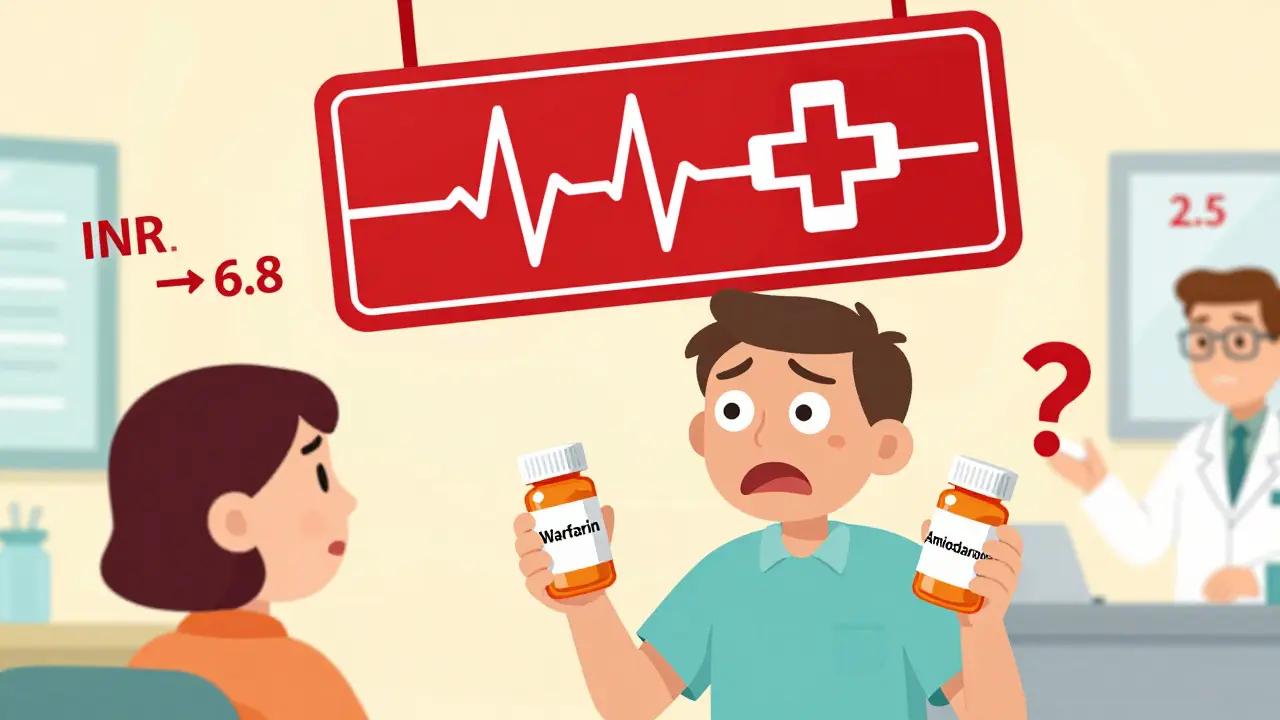
When you're on a combination of NTI drugs, even a tiny change in dosage can send your body into crisis. These aren't your average medications. They're the kind where the line between healing and harm is razor-thin. Think warfarin, lithium, or levothyroxine - drugs that require constant monitoring because a small mistake can mean a stroke, a seizure, or worse. Now imagine taking two of them together in a single pill. That’s a combination NTI therapy. And while generics have flooded the market for most medicines, they’ve barely touched these high-risk combos. Why? Because the science just isn’t there yet.
What Makes NTI Drugs So Dangerous
NTI stands for Narrow Therapeutic Index. That means the difference between a dose that works and one that kills is small - often less than double. For example, warfarin’s effective blood level is between 2 and 3 on the INR scale. Go above 4, and you risk dangerous bleeding. Drop below 2, and a clot could form. There’s no room for error. The FDA lists five key traits of NTI drugs: minimal safety margin, high risk of life-threatening side effects, need for regular blood tests, low variability within the same person, and frequent small dose tweaks. These aren’t just tricky to manage - they’re unforgiving.
Common NTI drugs include digoxin for heart failure, phenytoin for seizures, and carbamazepine for nerve pain. But when two of these are combined - say, warfarin and amiodarone for atrial fibrillation - the risk multiplies. If one drug’s concentration shifts by 10%, you’re in trouble. If both shift? You’re looking at hospitalization.
Why Generic Combos Don’t Exist
Generic versions of single NTI drugs are common. There are 11 approved generic versions of warfarin alone. But not a single fixed-dose combination pill containing two NTI drugs has been approved in the U.S. Why? The bioequivalence standards are impossible to meet.
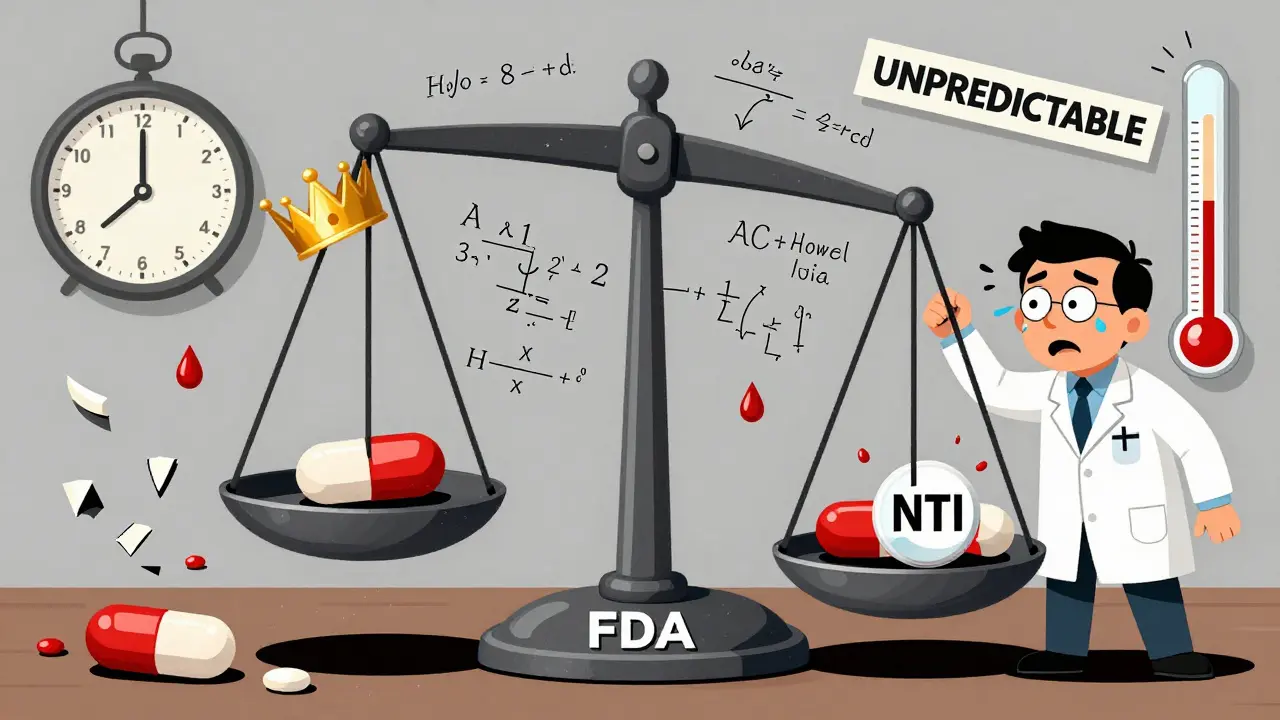
For regular generics, the FDA requires that the generic version delivers between 80% and 125% of the brand’s active ingredient. For NTI drugs, that window tightens to 90%-111% for peak concentration (Cmax) and 90%-112% for total exposure (AUC). That’s already a huge technical hurdle. But when you combine two NTI drugs in one pill, you’re not just matching one drug’s levels - you’re matching two. And each has its own absorption rate, metabolism path, and clearance time. Even if each component meets the tighter standard individually, their combined effect in the body can’t be predicted with current methods.
The FDA’s 2023 draft guidance proposed even stricter limits for combo NTI drugs: 90%-107.69% for Cmax and 90%-110% for AUC. That’s a 17% range for peak levels - barely wider than the natural variation your body experiences from day to day. No manufacturer has yet produced a combo that meets this.
The Real-World Cost of Gaps
Without generic combo options, patients are stuck paying for brand-name pills. A single brand-name NTI combination can cost over $500 a month. Many patients can’t afford that. So they’re forced to take separate pills - sometimes five or six a day - and hope their pharmacist doesn’t switch one of them to a generic without telling them.
That’s where things go wrong. A 2020 JAMA Internal Medicine study found patients on combination therapy with even one NTI drug had a 27% higher chance of adverse events after generic substitution compared to those on non-NTI combos. One patient on Reddit described going from an INR of 2.5 to 6.8 in three days after a pharmacy switched his generic warfarin. He ended up in the ER with internal bleeding. That’s not rare. A 2023 ASHP survey of 856 pharmacists found 78.3% had seen treatment failure after a generic switch in an NTI combo. Over 40% reported serious events - falls, hospitalizations, strokes.
And it’s not just about safety. Monitoring costs skyrocket. Patients on combination NTI therapy spend $1,200 to $2,500 a year on blood tests alone. That’s triple the cost of non-NTI regimens. And it takes 6 to 8 weeks just to stabilize the dose - with an average of 3.2 adjustments needed. For many, that means missed work, repeated visits, and anxiety.
Expert Divides and Patient Voices
Not everyone agrees on whether combo NTI generics are possible. Some manufacturers, like Sandoz and Teva, point to Europe, where generic levothyroxine combinations have been used since 2015 with less than 2% adverse events. They argue modern manufacturing can deliver precision.
But top FDA scientists disagree. Dr. Janet Woodcock, former head of FDA’s drug center, called combination NTI products a "scientific challenge." Dr. Donald Berry, a biostatistician at MD Anderson, put it bluntly: "The 90-111% window still allows 22% total variation - and when you combine two NTI drugs, that’s a 44% swing in overall effect. That’s not safe."
Patients are caught in the middle. A Drugs.com survey of 1,247 people on NTI combinations showed 63.4% had side effects after a generic switch. One wrote: "I’ve been on the same brand for 12 years. My pharmacy switched me without warning. My heart started racing. I thought I was having a heart attack. It was the generic. I had to go back to the brand - and pay $800 a month again."
There are rare exceptions. A few patients on levothyroxine plus selenium have reported success with generics. But these are outliers. FDA data shows less than 15% of combo NTI cases are this forgiving.
Who’s Managing This Risk?
Most community pharmacies don’t have the training. A 2023 ASHP report found pharmacists need over 120 hours of specialized education to safely handle NTI combos. Few get it. Meanwhile, enterprise hospitals - like Mayo Clinic or Johns Hopkins - have NTI clinics with pharmacists who specialize in these regimens. But only 12 of the top 50 academic medical centers in the U.S. have them.
Documentation is another mess. FDA-approved NTI monotherapy labels score an average of 4.2 out of 5 for clarity. Combo products? Just 2.8. Instructions are vague. Warnings are buried. Patients don’t know what to watch for.
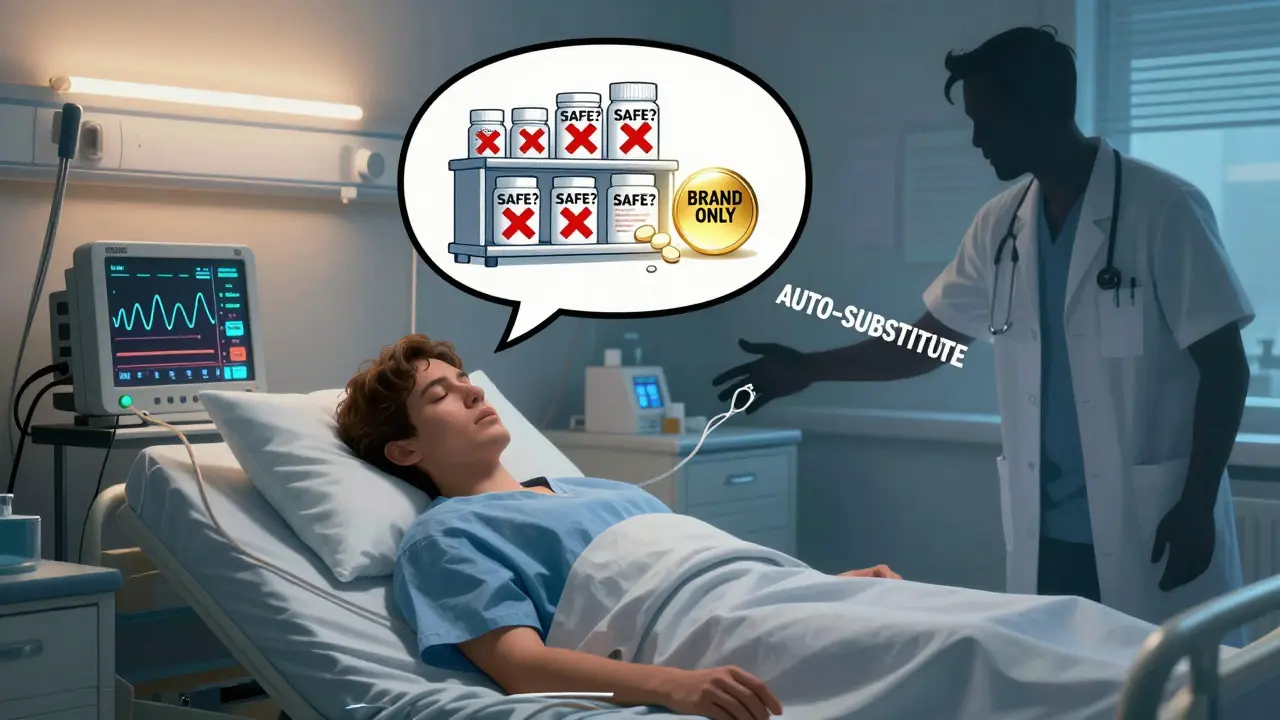
And automatic substitution? It’s still allowed in many states - even for NTI drugs. Pharmacists can swap a brand for a generic without telling the doctor or patient. That’s legal. But it’s not safe. ASHP issued a position statement in 2021 calling automatic substitution of NTI drugs "unacceptable." Yet, enforcement is patchy.
The Future: Can We Fix This?
The FDA is trying. Their 2024 pilot program aims to use pharmacometric modeling - computer simulations of how drugs behave in the body - to predict bioequivalence for combo NTI products. That’s promising. But it’s still experimental. And even if it works, it will take years to implement.
Meanwhile, the market is growing. Global sales of NTI drugs hit $48.7 billion in 2023 and are projected to reach $78.3 billion by 2028. But combo NTI products? They make up less than 0.3% of that market. Experts predict they’ll stay under 1% for the foreseeable future.
Some argue we should just accept the gap. "Combining multiple narrow-window drugs is inherently risky," says Dr. Lewis Nelson of NYU. "We shouldn’t pretend we can make it safe with generics."
Others believe better manufacturing and testing will eventually close the gap. But until then, patients are paying more, monitoring more, and living with more fear.
What You Can Do
If you’re on a combination NTI therapy:
- Ask your doctor or pharmacist: "Is this a fixed-dose combo? Are both drugs NTI?"
- Never let your pharmacy switch a generic without telling you - and never accept it without checking with your prescriber.
- Track your symptoms and lab results closely. If something feels off after a switch, get tested immediately.
- Request brand-name if cost is an issue. Some manufacturers offer patient assistance programs.
- Know your INR, lithium level, or other key blood values. Keep a log.
There’s no easy fix. But awareness saves lives. The system isn’t built for these drugs. You have to be your own advocate.
What exactly is an NTI drug?
An NTI (Narrow Therapeutic Index) drug has a very small difference between the dose that works and the dose that causes harm. For example, warfarin’s safe range is just 2-3 on the INR scale. Go above 4, and you risk bleeding; below 2, and you risk a clot. These drugs require frequent blood tests and careful dosing. Common examples include lithium, digoxin, phenytoin, and levothyroxine.
Why are generic combination NTI drugs so rare?
Because the FDA requires extremely tight bioequivalence standards - 90%-111% for peak levels and 90%-112% for total exposure - for each component. When two NTI drugs are combined, their effects interact in unpredictable ways. Even if each drug meets the standard alone, their combined effect in the body can’t be reliably proven to match the brand. No manufacturer has yet produced a combo that meets the proposed 2023 standards.
Can I switch to a generic version of my NTI combo?
If your combo is two separate pills, your pharmacist might switch one to a generic without telling you - and that’s dangerous. Never allow a switch without consulting your doctor. If your combo is a single pill, no generic version exists in the U.S. If you’re being switched to separate generics, ask your prescriber to write "Dispense as Written" on the prescription.
What should I do if I feel worse after a generic switch?
Contact your doctor immediately. Get your blood levels tested - INR, lithium, or whatever’s relevant. Document your symptoms and the date of the switch. Report it to your pharmacist and ask for the brand to be restored. If you’re hospitalized, report the incident to the FDA’s MedWatch program. These events are underreported but critical for change.
Are there any safe generic NTI combos available?
In the U.S., no fixed-dose combination containing two NTI drugs is approved. A few patients report success with generic levothyroxine plus selenium, but this is rare and not representative of most NTI combos. The FDA and ASHP warn against assuming safety. Most NTI combos involve high-risk drugs like warfarin, amiodarone, or phenytoin - where even small changes can be life-threatening.
How can I reduce the cost of my NTI combo therapy?
Ask your doctor for a brand-name prescription with "Dispense as Written". Many manufacturers offer patient assistance programs. Some nonprofits provide coupons or free samples. You can also ask your pharmacy if they offer a cash discount - sometimes paying out-of-pocket is cheaper than insurance co-pays. Avoid automatic substitutions. Staying on brand may cost more upfront, but it prevents expensive ER visits and hospitalizations down the line.
Connor Hale
The real tragedy isn't the lack of generics-it's that we've built a system that treats human bodies like interchangeable parts. These drugs aren't widgets. You can't just swap out a component and expect the machine to keep running. The FDA's standards are cautious for a reason, but the cost of inaction is measured in ER visits and broken lives. We need better science, yes-but also better empathy.
Roshan Aryal
Let me tell you something-India makes generic NTI combos every day and people don't drop dead. You think American regulators are smarter? They're just scared of lawsuits. We've got patients on generic warfarin-lithium combos in Mumbai since 2018. No mass casualties. Just people who can afford to live. Stop pretending this is about safety-it's about profit margins and patent extensions.
Jack Wernet
While I appreciate the thoroughness of this analysis, I must emphasize the ethical imperative at play. The current regulatory framework, while scientifically rigorous, inadvertently perpetuates health inequity. Patients who cannot afford brand-name combination therapies are being forced into a precarious balancing act between financial survival and physiological stability. This is not merely a pharmacological challenge-it is a moral one.
Charlotte N
I’ve been on levothyroxine for 8 years and my pharmacist switched me to a generic last year without telling me… I didn’t notice until my heart started fluttering at 3am… then I checked my labs and my TSH was off by 40%… I called my doctor and they said "oh that happens"… I just want to know why no one seems to care enough to fix this…
Vicki Yuan
It’s not just about bioequivalence-it’s about consistency. When you’re taking two NTI drugs separately, at least you know which pill changed. With a combo, you don’t even know which component is causing the spike or drop. And pharmacists? They’re not trained to spot this. We need mandatory NTI-specific training for every pharmacist who handles prescriptions. Not optional. Not nice-to-have. Mandatory. Lives depend on it.
Abhishek Mondal
Oh please. You're all acting like the FDA is some sacred temple of science. The truth? They're terrified of being sued by Big Pharma if a generic combo causes even one death. Meanwhile, patients are dying because they can't afford the $600/month brand-name pills. If Europe can do it, why can't we? Because American regulators are more concerned with liability than with life. And don't give me that "scientific challenge" nonsense-this is corporate cowardice dressed up as caution.
Terri Gladden
So I just got switched to a generic for my warfarin and now I'm having nightmares about bleeding out in my sleep?? Like what even IS this?? I'm 32 and I didn't sign up for this. My pharmacist said "it's the same thing" but my body says otherwise. I'm crying right now because I can't afford the brand and my insurance won't cover it unless I "prove" I'm in danger. How do you prove you're about to die??
Jennifer Glass
I’ve worked in a clinic for 15 years and I’ve seen this play out too many times. One patient went from stable INR 2.3 to 7.1 after a pharmacy switch. He didn’t even know it happened until he showed up with black stools. We had to call 911. The worst part? He told us he’d been saving up for months to afford the brand-and he thought the generic was cheaper. He didn’t know it was a different drug entirely. We need labeling. We need warnings. We need a system that doesn’t assume patients are pharmacologists.
Joseph Snow
Let’s be honest: this entire NTI generic debate is a distraction. The real issue is that pharmaceutical companies have engineered a system where patients are trapped between unaffordable brand-name drugs and dangerous generics. The FDA isn’t protecting us-they’re protecting the monopoly. The 90-111% window? It’s a loophole. The "scientific challenge" is manufactured. There’s a reason no generic combo exists-because the companies that own the patents don’t want one to exist. This isn’t science. It’s capitalism.
Akshaya Gandra _ Student - EastCaryMS
wait so if i take two separate generics and my doc says its fine then its ok right?? i mean like if theyre both approved generics then why cant i just take them together??
en Max
From a pharmacometric standpoint, the complexity of dual NTI drug interactions defies conventional bioequivalence paradigms. The additive and synergistic variability in Cmax and AUC across two distinct metabolic pathways-particularly when CYP450 isoenzymes are involved-creates a combinatorial explosion of potential pharmacokinetic profiles. Current modeling frameworks lack the resolution to account for inter-individual variability in absorption kinetics, hepatic first-pass metabolism, and renal clearance dynamics when two NTI agents are co-administered in a fixed-dose formulation. Until high-fidelity PBPK (physiologically based pharmacokinetic) models are validated against longitudinal clinical data across diverse populations, the FDA’s conservative stance remains not merely prudent, but ethically non-negotiable. The risk of catastrophic therapeutic failure outweighs the economic benefit of generic substitution. Patient safety must precede market expansion.