
Statin Interaction Checker
Check Your Statin Safety
Select your statin and other medications to see potential interaction risks and recommendations.
Interaction Results
Not all statins are the same when it comes to drug interactions. If you're taking a statin and another medication, the risk of muscle damage, liver issues, or even rhabdomyolysis - a rare but serious condition - depends heavily on which statin you're using. It's not just about the dose. It's about how your body breaks it down. And that varies wildly between statins.
Why Some Statins Are Riskier Than Others
Statins lower LDL cholesterol by blocking HMG-CoA reductase, an enzyme your liver needs to make cholesterol. But how your body processes each statin determines whether it will clash with other drugs you're taking. Five statins - atorvastatin, simvastatin, lovastatin, fluvastatin, and the withdrawn cerivastatin - rely on the CYP3A4 and CYP2C9 liver enzymes to break them down. That makes them vulnerable to drugs that block or slow those enzymes.Simvastatin and lovastatin are the most problematic. When taken with common antibiotics like clarithromycin or antivirals used for HIV, their levels can spike by 10 to 16 times. That’s not a small bump - it’s a dangerous surge. Even common heart medications like diltiazem and verapamil can increase simvastatin levels by 3 to 8 times, raising the risk of muscle breakdown.
Atorvastatin is less risky but still needs caution. A single dose of clarithromycin can push atorvastatin levels up by 4 times. That’s why doctors often reduce the dose if you're on both.
The Statins That Play Nice
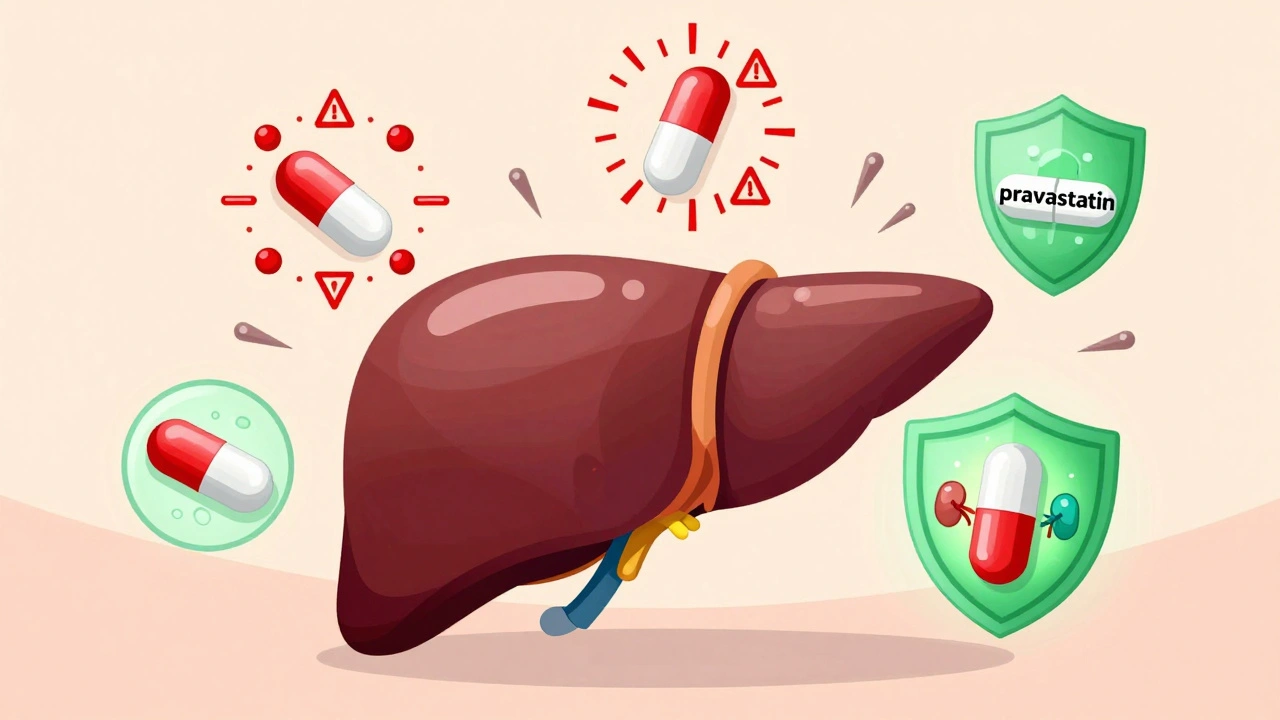
Then there are the statins that barely touch the CYP system at all. Pravastatin, rosuvastatin, and pitavastatin are metabolized differently - mostly through transporters in the liver or by glucuronidation. That makes them far less likely to interact with common medications.Pravastatin is the quietest player. It’s water-soluble, mostly cleared by the kidneys, and doesn’t rely on CYP enzymes. That’s why it’s often the go-to choice for people on multiple medications, especially those with HIV or who take immunosuppressants after a transplant. The FDA even allows pravastatin at 40 mg daily with cyclosporine, while banning other statins entirely with that drug.
Rosuvastatin is another safe bet. It’s not metabolized much by CYP2C9, so common CYP inhibitors like fluconazole or amiodarone won’t spike its levels. But here’s the catch: it’s heavily dependent on the OATP1B1 transporter. If you’re taking cyclosporine, that transporter gets blocked - and rosuvastatin levels can jump by 7.1 times. That’s why you still need to be careful, even with the "safer" statins.
The Cyclosporine Problem
Cyclosporine - a drug used by transplant patients to prevent organ rejection - is one of the worst offenders when it comes to statin interactions. It blocks OATP1B1, the main way most statins enter liver cells. When that pathway is shut down, statins pile up in the bloodstream.For simvastatin and lovastatin, cyclosporine is an absolute no-go. The labels say don’t use them together. Pitavastatin is also contraindicated. But pravastatin? It’s okay at 40 mg daily. Rosuvastatin can be used too - but only at low doses (10 mg or less) and with close monitoring.
Patients on cyclosporine are often on other meds too - like everolimus or sirolimus. Those drugs also block OATP1B1. Combine them with simvastatin or pitavastatin, and you’re asking for trouble. Experts say these combinations should be avoided entirely. There’s no gray area here.

Ticagrelor and Other Common Combinations
If you’ve had a heart attack or stent placed, you’re likely on ticagrelor (Brilinta) to prevent clots. That’s fine with atorvastatin. Studies show the interaction is minor - a slight rise in atorvastatin levels, but nothing dangerous. You can use both without changing doses.But with simvastatin and lovastatin? The rules are strict. The American College of Cardiology says never exceed 40 mg daily. Even then, watch for muscle pain or weakness. That’s because ticagrelor slightly inhibits CYP3A4 - enough to push those two statins over the edge if you’re on a high dose.
Colchicine - used for gout - is another common combo. It doesn’t directly block CYP enzymes, but it can increase statin toxicity by reducing how fast your body clears them. Most doctors don’t ban statins here, but they’ll lower the dose and ask you to report any muscle soreness right away.
Fibrates: The Hidden Danger
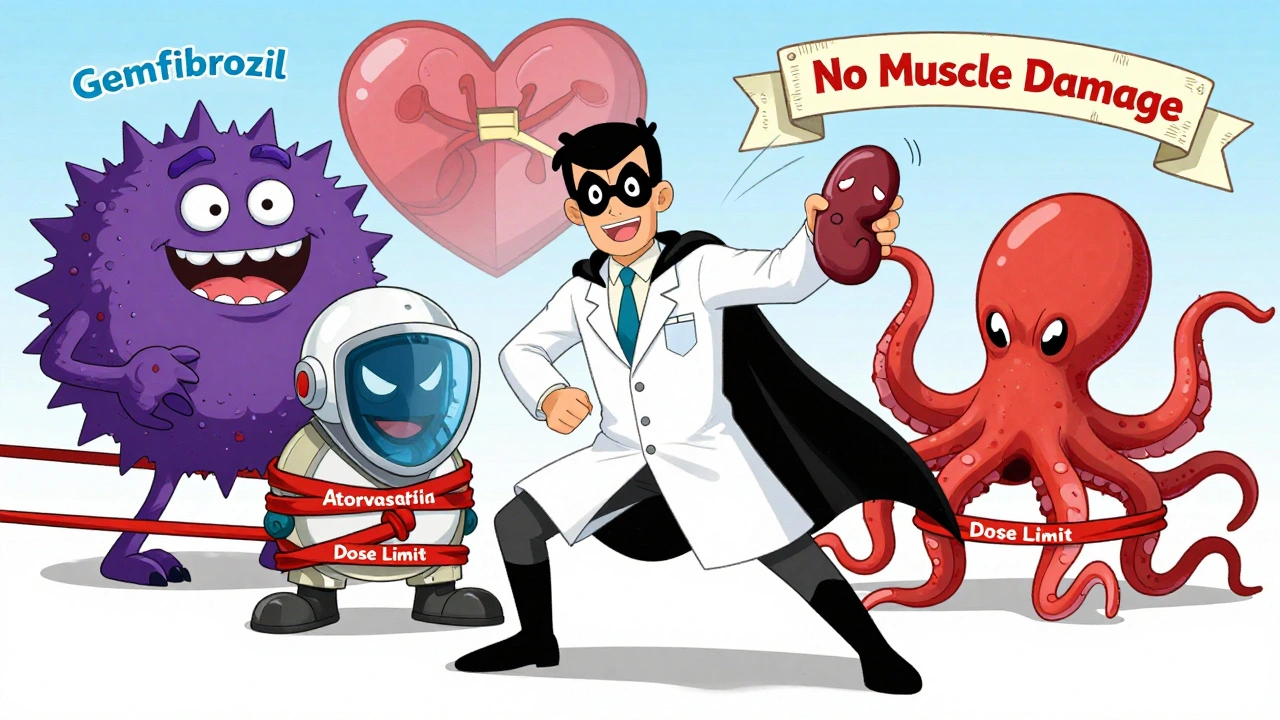
Fibrates like gemfibrozil and fenofibrate are often paired with statins to crush triglycerides. But gemfibrozil is a silent killer in this mix. It doesn’t just inhibit CYP2C8 - it also blocks glucuronidation, a backup pathway some statins use. The result? Statin levels can double, and muscle damage risk skyrockets.Studies show gemfibrozil increases statin levels by up to 200%. That’s why guidelines say: avoid it with every statin except pravastatin. Fenofibrate? It’s much safer. It doesn’t interfere with metabolism the same way. If you need a fibrate, fenofibrate is the clear choice.
Genetics Play a Role Too
Your genes matter. A common variation in the SLCO1B1 gene - called c.521T>C - affects how well your liver takes up statins. If you have this variant, your risk of muscle damage from simvastatin jumps by 4.5 times. That’s why some doctors now test for it before prescribing high-dose simvastatin.It’s not routine yet, but it’s becoming more common in high-risk patients. If you’ve had unexplained muscle pain on a statin, ask if genetic testing could help. It might explain why one person tolerates a drug fine while another ends up in the hospital.
What to Do If You’re on Multiple Meds
If you’re taking a statin and other medications, here’s what you should do:- Know which statin you’re on - and how it’s broken down.
- Check every new prescription or OTC drug for interaction potential. Even common things like St. John’s wort or grapefruit juice can interfere.
- Never start or stop a drug without talking to your doctor or pharmacist.
- Report muscle pain, weakness, or dark urine immediately - even if it seems mild.
- Ask if your statin can be switched to pravastatin or rosuvastatin if you’re on multiple interacting drugs.
There’s no need to stop statins altogether. Their benefits - reducing heart attacks, strokes, and death - far outweigh the risks when used correctly. But you need to be smart about which one you take.
Bottom Line: Pick the Right Statin for Your Meds
If you’re on just one or two other drugs, most statins are fine with careful dosing. But if you’re on multiple medications - especially HIV drugs, immunosuppressants, or fibrates - your choice matters more than you think.Simvastatin and lovastatin? Avoid unless absolutely necessary and only at low doses. Atorvastatin? Use with caution. Rosuvastatin and pravastatin? Often the safest picks. Pitavastatin? Watch out for cyclosporine.
The goal isn’t to scare you off statins. It’s to help you pick the one that works with your body - not against it.
Which statin has the least drug interactions?
Pravastatin has the lowest risk of drug interactions because it doesn’t rely on CYP enzymes for metabolism. It’s mainly cleared by the kidneys and isn’t significantly affected by common inhibitors like cyclosporine or antibiotics. Rosuvastatin is also low-risk for CYP interactions, though it can be affected by OATP1B1 blockers like cyclosporine.
Can I take grapefruit juice with statins?
Grapefruit juice blocks CYP3A4, so it can dangerously raise levels of simvastatin, lovastatin, and atorvastatin. Even one glass can cause a spike that lasts over 24 hours. Avoid grapefruit juice entirely if you take any of these three. Pravastatin, rosuvastatin, and fluvastatin are safe with grapefruit juice.
Is it safe to take statins with antibiotics?
It depends on the antibiotic and the statin. Macrolides like clarithromycin and erythromycin strongly inhibit CYP3A4 and should never be taken with simvastatin or lovastatin. Azithromycin is safer. For atorvastatin, use caution and consider lowering the dose. Pravastatin and rosuvastatin are generally safe with most antibiotics.
Why is simvastatin 80 mg no longer recommended?
The 80 mg dose of simvastatin was found to significantly increase the risk of muscle damage - especially in the first year of use - without offering extra heart protection. The FDA and American Heart Association now recommend avoiding this dose entirely, even for patients who previously took it safely.
What should I do if I start feeling muscle pain on a statin?
Stop the statin and contact your doctor immediately. Muscle pain, weakness, or dark urine could be signs of myopathy or rhabdomyolysis. Your doctor may check your creatine kinase (CK) levels and switch you to a statin with fewer interaction risks, like pravastatin or rosuvastatin.
What’s Next for Statin Safety?
Research is moving toward personalized statin use. The FDA already includes pharmacogenetic info on simvastatin labels, and NIH-funded studies are building tools to predict interactions based on your genes, age, kidney function, and other meds. In the future, your pharmacist might scan your prescription list and instantly tell you if your statin clashes with something else.Until then, the best advice is simple: Know your statin. Know your other meds. Talk to your doctor. And don’t ignore muscle pain - it’s your body’s warning sign.
Willie Onst
Man, I never realized how much your statin choice could make or break your whole med regimen. I’m on simvastatin for my cholesterol and amoxicillin for a sinus thing last month - I just assumed it was fine. Now I’m sweating bullets. Thanks for the wake-up call.
Pravastatin sounds like the chill cousin of statins. I might ask my doc to switch. No need to play Russian roulette with my muscles.
Jennifer Taylor
EVERYTHING IS A CONSPIRACY. Did you know the FDA approved pravastatin with cyclosporine because Big Pharma wants you to stay on expensive drugs longer? They don’t want you to heal naturally - they want you to keep taking pills. And grapefruit juice? That’s a natural statin blocker. They banned it because it’s free. Free = no profit. Wake up, sheeple.
Also, I heard the SLCO1B1 gene test is secretly used by the government to track your meds. They’re building a database. I saw it on a forum. It’s real.
Shelby Ume
Thank you for this incredibly clear and clinically accurate breakdown. As someone who works with transplant patients daily, I can’t stress enough how critical it is to understand statin metabolism.
Pravastatin truly is the gold standard for polypharmacy - especially when cyclosporine or tacrolimus is involved. I’ve seen patients on simvastatin with rhabdo levels so high they needed dialysis. It’s preventable.
And yes - fenofibrate over gemfibrozil, always. The data is unequivocal. Let’s stop pretending this is a gray area. It’s not. Safety first, always.
Harriet Wollaston
My grandma’s on 5 meds and a statin - she’s 78 and still gardening every morning. Her doctor switched her to pravastatin last year after she got a bad reaction to atorvastatin with her blood pressure med.
She says, ‘If it doesn’t hurt, it’s probably fine.’ And honestly? That’s the best advice I’ve heard all week. Don’t overthink it. Talk to your pharmacist. They’re the real MVPs.
Also - grapefruit juice is fine with her. She loves it. And she’s still here. So maybe the rules aren’t as scary as they sound? Just listen to your body.
Lauren Scrima
Oh wow. So the statin you’re on is basically a lottery ticket… and you didn’t even know you bought one? 😏
Let me guess - you’re on simvastatin and you thought ‘80mg is just a stronger version.’ Nope. It’s a one-way ticket to Muscle Jail. Congrats.
Also, ‘ask your doctor’ - sure, Jan. But they’ve got 8 minutes per patient. Good luck explaining CYP3A4 during a 9am refill.
Constantine Vigderman
THIS IS SO IMPORTANT!! 🙌 I just found out my buddy’s on rosuvastatin and cyclosporine - he didn’t know it could spike his levels by 7x!! We’re gonna drag him to his doc tomorrow. He’s 32, runs marathons, thinks he’s invincible. Nope. Genes + drugs = real life.
Also - if you’re on ticagrelor, atorvastatin is chill. I took both for 2 years. No issues. Just don’t go wild with grapefruit 🍊🚫
PS: I typo’d ‘cyclosporine’ 3 times while typing this. Sorry. But you get the point!! 😅
Cole Newman
You guys are overcomplicating this. It’s simple: if you’re on meds, don’t take statins. Period.
Statins cause muscle pain, liver damage, diabetes, and brain fog. I read it on a Reddit thread. My cousin’s ex’s neighbor’s nurse said it. It’s true.
Just stop taking them. Eat kale. Do yoga. Your cholesterol will fix itself. Or at least it won’t kill you as fast.
Also - your doctor doesn’t know what they’re doing. They’re paid by Big Pharma. I know this because I Googled it.
Casey Mellish
Excellent summary - precise, evidence-based, and accessible. As an Australian pharmacist, I see this daily. The myth that ‘all statins are equal’ is dangerously widespread.
Pravastatin and rosuvastatin are underutilized in high-risk polypharmacy cases. In our clinics, we’ve reduced myopathy rates by 68% since switching patients from simvastatin.
And yes - grapefruit juice is a silent killer. We’ve had two ICU admissions this year alone from patients who thought ‘one glass won’t hurt.’ It will.
Knowledge is power. Share this.
Tyrone Marshall
There’s something deeply human about how we treat our bodies like machines - and then get shocked when they break.
We don’t throw random parts into a car and expect it to run. But we’ll stack 12 pills in a cup and hope for the best. Statins are powerful tools - not magic bullets.
The real question isn’t ‘which statin?’ - it’s ‘why are we so disconnected from the consequences of what we put in our bodies?’
Maybe the answer isn’t more drugs. Maybe it’s better conversations. With our doctors. With ourselves.
Tom Zerkoff
While the clinical distinctions between statins are well-documented, the practical application remains inconsistent across primary care settings. The 2022 ACC/AHA guidelines explicitly recommend pharmacogenetic screening for high-dose simvastatin in patients with concomitant CYP3A4 inhibitors - yet fewer than 12% of U.S. primary care providers routinely implement this.
Furthermore, the FDA’s boxed warning for cyclosporine-statin interactions is not routinely communicated to patients due to time constraints and lack of decision support tools in EHRs.
Systemic reform is needed, not just patient education. The burden of safety should not rest solely on the individual.
Webster Bull
Pravastatin = the quiet one who doesn’t cause drama.
Just switch. Done.
Also - grapefruit juice? Nah. Just say no.
And if your muscles hurt? Stop. Talk. Don’t tough it out.
That’s it. You’re welcome.
Scott Butler
Why are we even talking about this? In America, we don’t need to worry about drug interactions - we just get new prescriptions when the old ones stop working.
Also, statins are for weak people. Real men get their cholesterol down by lifting weights and eating steak. This over-medicalized nonsense is why our healthcare system is broken.
Stop listening to doctors. Start listening to your gut. And your dad. He’s been doing this since 1978.