
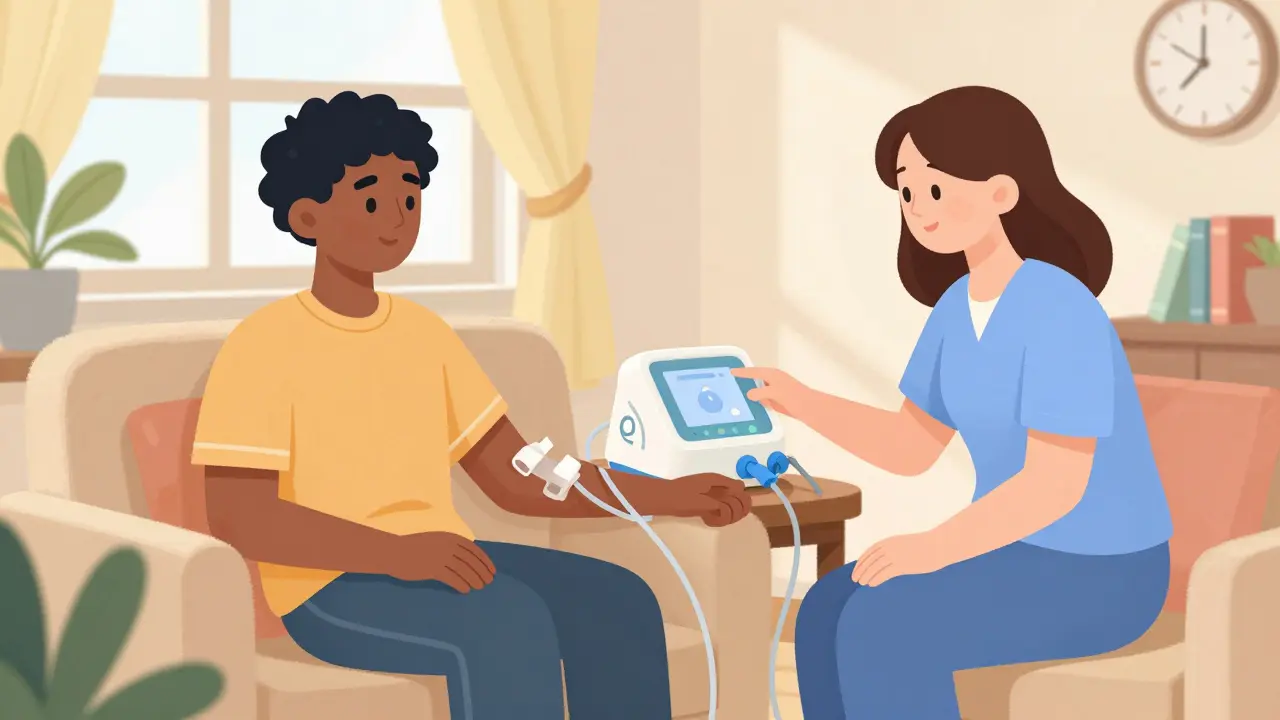
For someone living with end-stage renal disease, the idea of dialysis used to mean three long, exhausting days a week at a clinic-waking up early, traveling there, sitting for hours, then dragging home. But that’s not the only way anymore. Home hemodialysis is changing the game. More people are choosing to do their dialysis in their own living rooms, kitchens, or bedrooms. And it’s not just about convenience. It’s about survival, energy, and reclaiming control over your life.
What Home Hemodialysis Really Means
Home hemodialysis isn’t just in-center dialysis moved to your house. It’s a different approach entirely. Instead of three 4-hour sessions a week, you can choose to do shorter treatments every day-or even longer ones while you sleep. The machines are smaller now, safer, and easier to use. Companies like NxStage and Fresenius have built systems designed for home use, with alarms that guide you through each step and water systems that purify tap water to medical-grade standards. You still need the same core components: a dialysis machine, clean water supply, dialysate solution, vascular access (usually a fistula or graft), and a trained partner. But the freedom? That’s new. You decide when to start. You can dialyze after dinner, before work, or while watching TV. No more rigid clinic schedules dictating your life.Training: It’s Not Just Learning How to Plug In
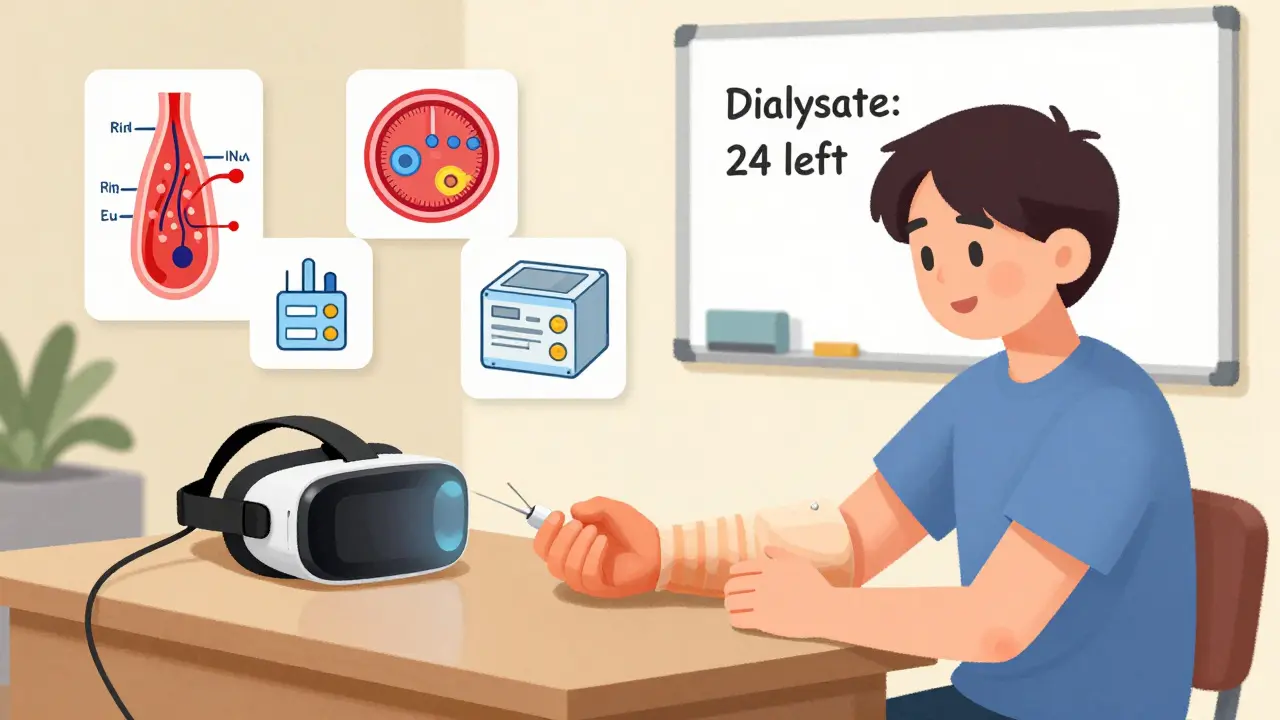
Training for home hemodialysis isn’t a one-week crash course. It’s a serious commitment. Most programs require 3 to 12 weeks of hands-on instruction, with the average falling between 4 and 6 weeks. You’ll spend 3 to 5 hours per session, several times a week, learning everything from how to insert needles into your own arm to troubleshooting a machine alarm at 2 a.m. You don’t just learn the machine. You learn your body. You track your weight before and after each session to calculate how much fluid to remove. You learn how your blood pressure reacts. You memorize the signs of low blood pressure, air bubbles, or a clot forming in your access. You practice cleaning your dialysis area to prevent infection. You learn how to order supplies, store them properly, and keep logs of every treatment. And you’re not alone in this. Your care partner-usually a spouse, adult child, or close friend-goes through the exact same training. In fact, most programs require a partner to be present during every treatment. The Maryland Department of Health and DaVita both state clearly: you cannot dialyze alone. This isn’t a safety precaution-it’s a life-saving rule. If your blood pressure drops or your needle comes loose, your partner needs to know exactly what to do. Some patients train on self-needling before they even start home dialysis. They practice on a fake arm during in-center sessions, using a needle guide. This cuts training time significantly. Programs like the one at the University of Washington Medical Center now use virtual reality simulators to teach needling. Their success rate jumped from 78% to 92% in just two years.Three Main Schedules-Which One Fits You?
There are three common home hemodialysis schedules, each with different benefits:- Conventional home hemodialysis: Three times a week, 3-4 hours per session. This looks like in-center dialysis but happens at home. It’s the easiest transition for people new to dialysis.
- Short daily home hemodialysis: Five to seven times a week, 2-3 hours per session. This is where most of the clinical benefits show up. Studies show patients on this schedule have 28% lower risk of death than those on standard in-center dialysis. Blood pressure improves. Heart strain drops. Fluid buildup doesn’t have time to accumulate.
- Nocturnal home hemodialysis: Three to seven nights a week, 6-10 hours while you sleep. This is the most gentle form. The slow, long sessions remove toxins and fluid gently, mimicking how healthy kidneys work. Patients often report feeling better than ever-more energy, fewer cramps, less need for phosphate binders. One study found these patients reduced their phosphate binder intake by 3.2 tablets per day.
What You Need at Home
Setting up for home hemodialysis isn’t just about buying a machine. You need space, plumbing, and power. You’ll need a dedicated 6-foot by 6-foot area-enough room for the machine, supplies, and your partner to move around safely. Most machines require a dedicated 120-volt, 20-amp electrical circuit. No extension cords. No sharing outlets with other high-power devices. Water is critical. Your home’s tap water must go through a reverse osmosis (RO) system that removes chemicals, minerals, and bacteria. Monthly water tests are required. You’ll need to log chlorine levels, disinfect the RO system regularly, and keep records. If your water quality slips, it can cause serious illness. You’ll also need a dedicated drain line. No more hauling buckets of dirty dialysate. The machine drains directly into your sink or floor drain. And supplies? You’ll get deliveries weekly or biweekly. You’ll need to store them properly-dry, cool, and off the floor. One patient in Perth told me she keeps her dialysate bags on a shelf in her laundry room, labeled with dates. “I treat them like medicine,” she said. “Because they are.”Outcomes: Why This Works Better
The numbers don’t lie. Home hemodialysis patients live longer. They feel better. They spend less time in the hospital. A 2019 review found home dialysis patients scored 37% higher on quality-of-life surveys than those doing in-center treatments. They sleep better. They eat more. They travel more. One man in Ohio started short daily dialysis after years of constant fatigue. Within three months, he was hiking with his grandchildren. “I didn’t realize how tired I’d been,” he said. Survival rates are higher too. The U.S. Renal Data System shows home hemodialysis patients have a 15-20% lower risk of death compared to in-center patients. The benefit is strongest for those doing frequent or nocturnal treatments. Even the financial side improves. Medicare pays for up to 25 training sessions for home hemodialysis-more than for peritoneal dialysis. And starting in 2025, reimbursement will shift from paying per treatment to paying for outcomes. That means clinics will have a financial incentive to push home dialysis, not just center-based care.
The Hidden Challenges
It’s not all easy. The biggest barrier? Finding a care partner. About 30% of people who want to do home dialysis don’t have someone who can commit to training and being present every session. That’s not just a personal issue-it’s a systemic one. Many programs don’t have the staff to train partners properly, or they don’t offer flexible training hours. Then there’s the anxiety. Reddit and AAKP forums are full of stories: “I panicked when the alarm went off.” “I cried the first time I stuck myself.” “My partner got so stressed, we almost quit.” Machine alarms are constant. One patient said she counted 47 alarms in her first month. Most were false-air in the line, a loose connection, a low battery. But each one felt like an emergency. Supply management is another headache. Running out of dialysate bags mid-week? That’s a hospital trip. Forgetting to order? You’re stuck. Some patients use apps to track inventory. Others set calendar reminders. One woman in Arizona keeps a whiteboard on her fridge: “Dialysate: 24 left. Need to order by Friday.” And yes, relationships get strained. One in two home dialysis couples report tension over the constant responsibility. “It’s not just about the needles,” one partner wrote. “It’s about being on call 24/7. It changes everything.”Who Is This For?
Not everyone is a good candidate. You need to be physically able to handle the training. You need mental clarity to follow steps under stress. You need motivation. You need a partner. But if you have those things, home hemodialysis can be life-changing. The American Society of Nephrology now recommends it as a first-line option for eligible patients. Dr. Steven Weisbord from the University of Pittsburgh says the biggest predictor of success isn’t technical skill-it’s psychological readiness. “Can you handle the responsibility? Do you have support? That’s what matters.”The Future Is Here
The U.S. goal was to have 80% of new dialysis patients start at home by 2025. We’re not there yet-only 12% do. But things are moving. New portable machines like the NxStage System One and the WavelinQ endoAVF system are making travel easier. More clinics are offering training. And with Medicare’s new outcome-based payments, home dialysis will become more accessible. The technology is ready. The data is clear. The only thing holding people back is fear-and lack of information. If you’re considering dialysis, ask your nephrologist: “Can I do this at home?” Don’t assume it’s not an option. Ask for a referral. Ask for training materials. Ask what’s possible. Your kidneys may be failing. But your life doesn’t have to stop.Can you do home hemodialysis alone?
In almost all cases, no. Most programs require a trained care partner to be present during every treatment. This is a safety rule, not a suggestion. If your blood pressure drops, your needle comes loose, or the machine alarms, your partner needs to act immediately. Solo home hemodialysis is possible with special equipment and extra training, but it’s rare and not recommended for most patients.
How long does home hemodialysis training take?
Training typically lasts between 3 and 12 weeks, with most patients completing it in 4 to 6 weeks. Sessions are usually 3 to 5 hours long and happen several times a week. The length depends on your learning pace, whether you’ve practiced self-needling before, and your program’s structure. Some centers now use virtual reality simulators to speed up training and improve confidence.
What are the different types of home hemodialysis schedules?
There are three main schedules: conventional (3 times a week, 3-4 hours), short daily (5-7 times a week, 2-3 hours), and nocturnal (3-7 nights a week, 6-10 hours while you sleep). Short daily and nocturnal schedules offer better health outcomes-lower blood pressure, fewer hospital visits, and improved survival rates. Nocturnal dialysis is especially effective at removing phosphorus, reducing the need for phosphate binders.
Do I need special plumbing or electricity at home?
Yes. You’ll need a dedicated 120-volt, 20-amp electrical circuit, a dedicated drain line for wastewater, and a reverse osmosis (RO) water purification system. Your tap water must be tested monthly and meet strict AAMI standards. The RO system requires regular maintenance and disinfection logs. Most homes can be adapted for this, but it requires a plumber and electrician.
Is home hemodialysis covered by Medicare?
Yes. Medicare covers the cost of the machine, supplies, training, water treatment systems, and all related care. Since 2011, Medicare has paid for up to 25 training sessions for home hemodialysis-more than for peritoneal dialysis. Starting in 2025, reimbursement will shift to focus on patient outcomes, which is expected to increase access and support for home dialysis programs.
Can I travel with a home hemodialysis machine?
It depends on the machine. Standard home dialysis machines are not portable. But systems like the NxStage System One are designed for travel. You can take them on trips if you plan ahead-arrange for water purification at your destination, bring extra supplies, and schedule dialysis at a clinic if needed. Some patients ship dialysate ahead or use portable RO units. Always coordinate with your care team before traveling.
What are the most common problems people face with home hemodialysis?
The top issues are machine alarms (67% of users), supply management (58%), and care partner stress (52%). Many patients feel overwhelmed at first by the responsibility. Self-needling is the hardest skill-about 45% of trainees struggle with it. Anxiety about emergencies is common, but most people adapt within a few months. Keeping logs, ordering supplies on time, and maintaining a clean space are ongoing challenges.
How does home hemodialysis compare to peritoneal dialysis?
Home hemodialysis removes waste and fluid more efficiently than peritoneal dialysis because it uses a machine and artificial kidney filter instead of the peritoneal membrane. Hemodialysis allows for more flexible scheduling and better control over fluid removal. Peritoneal dialysis is done daily, often overnight, and requires a catheter in the abdomen. Hemodialysis requires vascular access (fistula or graft) and is generally better for patients with higher toxin levels or fluid overload. Training for hemodialysis takes longer-4-6 weeks versus 1-2 weeks for peritoneal dialysis.
Paul Huppert
This is life-changing info. I didn’t realize how much better home dialysis could feel.
Jenny Salmingo
I’m so glad someone finally wrote this clearly. My mom started home dialysis last year and she’s got her energy back. She’s gardening again. 🌱
Frank SSS
Yeah but let’s be real-most people can’t handle the anxiety. I’ve seen two friends quit because they couldn’t sleep at night worrying about alarms. It’s not for everyone.
Brandon Boyd
Don’t let the fear scare you off. I trained my wife and we did it together. First week was rough-alarms everywhere, me sweating bullets-but now? We watch Netflix during treatments. It’s just part of life now. You got this.
John Chapman
YES!!! 🙌 I did nocturnal for 2 years. Woke up refreshed. No more cramps. My doc said my heart’s stronger than most 40-year-olds. 🏥💪
Sara Stinnett
Of course it’s better-it’s *medicalized domesticity*. You turn your home into a sterile clinic because the system failed you. How progressive. How noble. The real tragedy isn’t the dialysis-it’s that we’ve normalized this as ‘empowerment’ when it’s just survival with extra steps.
Branden Temew
So we’re celebrating the fact that people now have to become medical technicians to stay alive? How’s that for ‘progress’? Next they’ll make us install our own IV drips during Zoom calls.
Brady K.
Let’s not romanticize this. Home hemodialysis requires a 120V dedicated circuit, an RO system, 24/7 partner availability, and emotional resilience. That’s not ‘freedom’-that’s a full-time job with zero PTO. And don’t get me started on supply logistics. It’s a logistical nightmare dressed up as empowerment.
Robb Rice
Training took me five weeks. I practiced needling on a silicone arm for hours. Now I do it blindfolded. The key is repetition. And yes, you need a partner. No exceptions. I’ve seen too many people try to go solo and end up in the ER.
Kayla Kliphardt
Did anyone mention the cost of replacement parts? My RO membrane cost $400. And it’s not covered. Just saying.
Branden Temew
And yet, somehow, we still think this is a ‘choice.’ Like we’re not just shifting the burden from hospitals to living rooms. What a system.
anggit marga
In Nigeria we dont even have dialysis centers in most cities so you think this is hard imagine not having a machine at all
Urvi Patel
Interesting how Western medicine turns patients into engineers while ignoring the social cost