
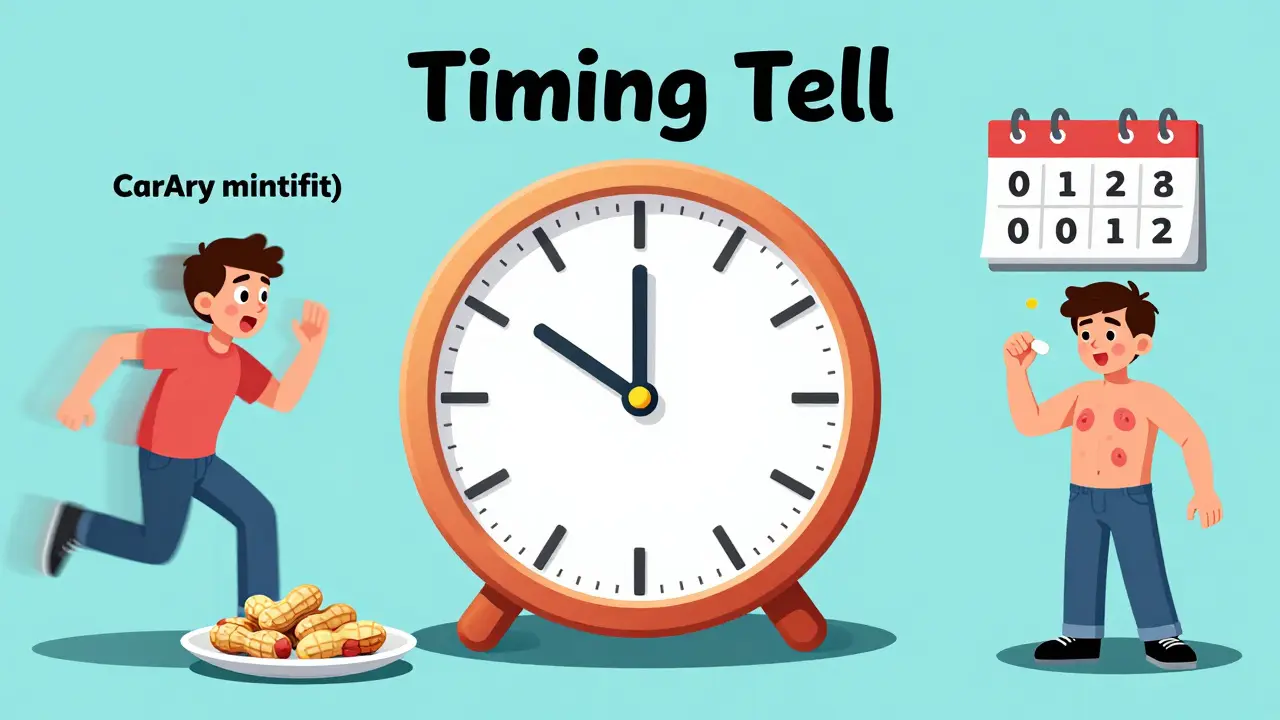
The Timing Tell: When Do Symptoms Hit?
If you're trying to figure out what happened, look at the clock. Timing is one of the biggest clues. With food allergies, the reaction is usually fast. About 95% of these reactions happen within two hours of eating the trigger, and for most people, it's as quick as 20 minutes. If you eat a shrimp cocktail and your throat starts itching while you're still at the table, that's a classic food allergy pattern. Medication reactions are a bit more unpredictable. You have "immediate" reactions that hit within an hour, but you also have "delayed" responses. Some drug reactions don't show up for 48 to 72 hours, and some rare, severe syndromes-like DRESS syndrome-might not peak until two to six weeks after you started the medicine. If you developed a rash ten days after finishing a course of antibiotics, it's far more likely to be a drug reaction than something you ate.Symptom Spotting: Beyond the Hives
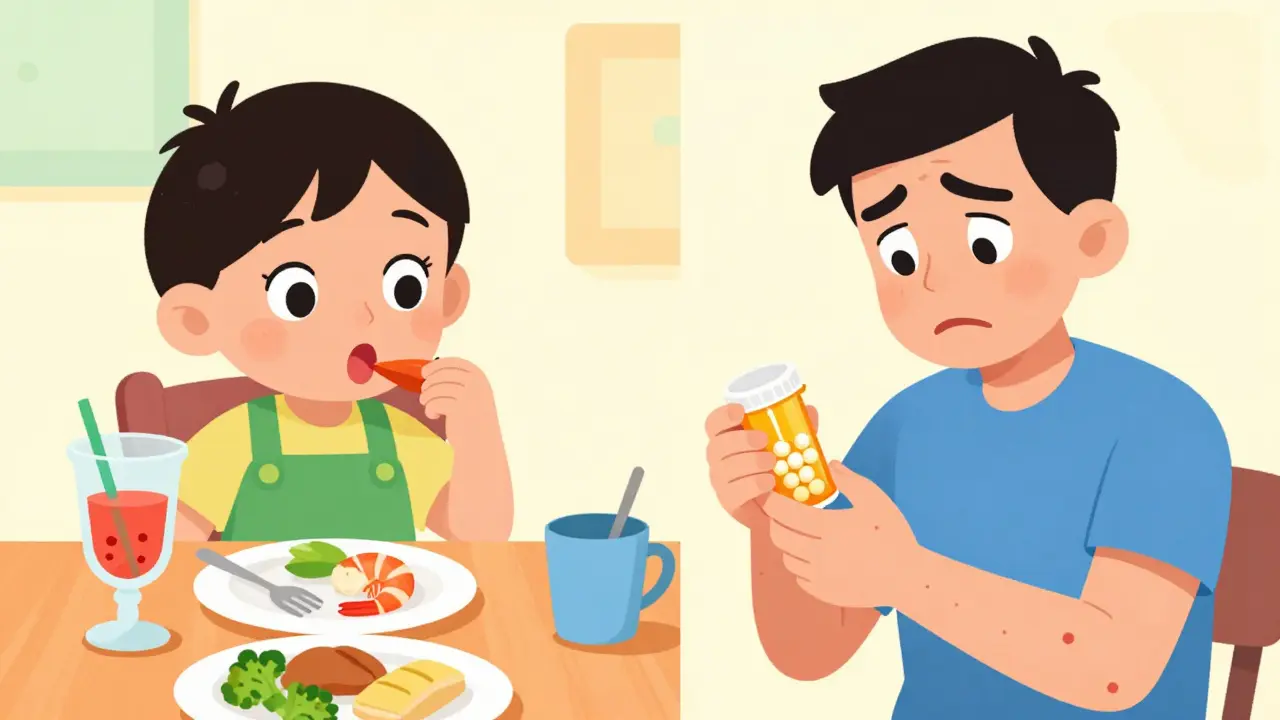
Both types of allergies can cause the dreaded hives, but if you look closer, the "signature" of the reaction changes. Food allergies often start in the mouth and gut. You might notice your lips or tongue swelling (known as oral allergy syndrome) or experience sudden vomiting and diarrhea. In kids, gastrointestinal distress is a major red flag. Medication allergies tend to be more systemic. While hives happen, you're more likely to see a maculopapular rash-those flat, red spots that spread across the torso. You're also more likely to run a fever or experience wheezing in your chest. A key difference is that medication allergies rarely cause the same intense stomach-churning symptoms that a food allergy does, unless it's a very severe systemic reaction.| Feature | Food Allergy | Medication Allergy |
|---|---|---|
| Typical Onset Age | Early childhood (often < 5 years) | Any age (median around 42) |
| Reaction Window | Usually within 2 hours | Minutes to several weeks |
| Common Primary Symptom | Swelling of lips/mouth, vomiting | Widespread skin rash, fever |
| Immune Driver | Primarily IgE-mediated | IgE and T-cell mediated |
| Key Risk | Accidental ingestion in social settings | Medical treatment complications |
The Danger of the "Self-Diagnosis" Trap
Many of us remember a time we took an antibiotic and got a rash, and we've been telling every doctor we've seen for twenty years, "I'm allergic to penicillin." But here's a shocking fact: up to 90% of people who think they're allergic to penicillin actually aren't. Often, they were reacting to the viral infection itself, or perhaps a filler in the pill, rather than the drug. This leads to a dangerous cycle. When doctors believe you have a drug allergy, they switch you to alternative antibiotics. These alternatives are often more expensive and can be less effective, increasing the risk of complications like Clostridium difficile infections. On the other hand, mistaking a food allergy for a simple "intolerance" (like lactose intolerance) can be fatal. An intolerance makes you bloated and uncomfortable; an allergy can trigger anaphylaxis, which shuts down your airways. If you're just treating it as indigestion, you might not carry the epinephrine you need to save your life.How Doctors Actually Figure It Out
If you're unsure, you need an allergist. They don't just take your word for it; they use specific tools to prove what's happening. For food allergies, they often start with skin prick tests. If those are positive, the "gold standard" is an oral food challenge, where you eat a tiny bit of the food under strict medical supervision to see if you react. This is how they determine if you've actually outgrown an allergy-which about 80% of kids do with milk and eggs by age five. Medication testing is trickier. You can't always just "try" a chemotherapy drug to see if it works. For things like penicillin, they use sequential skin testing or specific blood tests like the ImmunoCAP to see if your body has the specific antibodies. For delayed reactions, they might use a lymphocyte transformation test to check how your T-cells react to the drug in a lab setting.
Practical Steps for Your Next Doctor's Visit
To get an accurate diagnosis, you have to be your own detective. Doctors often only have a couple of minutes to record your history, so give them the raw data they need.- Keep a Symptom Diary: If you suspect food, record exactly what you ate, how it was prepared, and the exact minute the symptoms started.
- Detail the Medication: Don't just say "the blue pill." Find the exact name of the drug, the dosage, and whether it was a liquid, tablet, or injection.
- Note the Context: Were you sick with a fever when the rash appeared? Were you taking other meds? This helps doctors distinguish between a true allergy and a side effect of an illness.
- Ask for "Delabeling": If you've been avoiding a drug for years based on a childhood rash, ask your doctor about a drug challenge to see if you can safely use it again.
Looking Ahead: The Future of Allergy Testing
We're moving away from the "guess and check" method. New technology like component-resolved diagnostics (CRD) can now tell the difference between a true peanut allergy and a simple cross-reaction with pollen. This means thousands of people who thought they were allergic to peanuts might actually be fine to eat them. In the world of medicine, we're seeing the rise of pharmacogenetic testing. Soon, a simple genetic screen might tell your doctor exactly which medications your body will reject before they even write the prescription. This will shift the focus from reacting to allergies to preventing them entirely.Can I have both a food allergy and a medication allergy?
Yes, it is entirely possible. While they are different mechanisms, having one type of allergy indicates that your immune system is more prone to hypersensitivity. Many people deal with both, and it's important to keep separate lists of triggers for your healthcare providers.
Is a stomach ache a sign of a medication allergy?
Usually, no. Nausea and stomach upset are very common side effects of many medications (like antibiotics causing nausea), but they aren't typically signs of an allergic reaction. Allergic reactions usually involve the skin, respiratory system, or a systemic inflammatory response.
What is the difference between an allergy and an intolerance?
An allergy involves the immune system (IgE antibodies) and can lead to anaphylaxis. An intolerance is a digestive system issue (like lacking an enzyme to break down lactose) that causes discomfort but is not life-threatening.
Why is penicillin allergy so commonly misdiagnosed?
Many people develop a rash while fighting a viral infection and happen to be taking amoxicillin at the same time. They assume the drug caused the rash, but the virus was actually the culprit. Without formal testing, this "false positive" stays in their medical record for life.
How long does a medication allergy last?
Unlike some food allergies that children outgrow, medication allergies often persist for life. Once your immune system has created the antibodies against a specific drug, it will usually recognize and react to that drug every time you're exposed to it.
Write a comment