
The first step to feeling better is knowing exactly what you're dealing with. Not all hemorrhoids are the same, and treating an internal one like an external one (or vice versa) won't get you the results you want. Whether you're dealing with a sudden flare-up or chronic discomfort, understanding the anatomy of the problem is the key to getting back to your normal routine.
The Difference Between Internal and External Hemorrhoids
To understand why some hemorrhoids hurt and others don't, you have to look at the dentate line. This is the anatomical boundary in your anal canal that separates two different types of tissue.Internal hemorrhoids happen above this line. They are covered by a mucosal lining that doesn't have pain receptors. This is why you might see bright red blood in the bowl but feel absolutely nothing. However, they can sometimes "prolapse," meaning they slide down and poke out of the anal opening, which can cause a feeling of fullness or irritation.
External hemorrhoids, on the other hand, form below the dentate line. They are covered by skin, which is packed with sensitive nerve endings. This is why external hemorrhoids are notorious for itching, swelling, and sharp pain, especially when you sit down. When a blood clot forms inside one of these veins, it's called a thrombosed hemorrhoid. These appear as hard, purple or blue lumps and can be incredibly painful, often requiring immediate medical attention to resolve.
| Feature | Internal Hemorrhoids | External Hemorrhoids |
|---|---|---|
| Location | Inside the rectum (above dentate line) | Under the skin around the anus (below dentate line) |
| Pain Level | Usually painless | Often painful and itchy |
| Primary Symptom | Bright red rectal bleeding | Visible lumps and swelling |
| Visibility | Invisible unless prolapsed | Visible as skin-colored or purple lumps |
Grading Internal Hemorrhoids
Not all internal hemorrhoids are at the same stage. Doctors use a grading system to determine how severe the condition is and what treatment is needed.Grade I involves bleeding but the vein stays tucked away inside. Grade II is when the hemorrhoid pushes out during a bowel movement but slides back in on its own. Grade III is more serious; the hemorrhoid prolapses and you actually have to use your finger to push it back in. Grade IV is the most severe, where the tissue is permanently prolapsed and cannot be pushed back in, often leading to constant irritation and bleeding.
What Actually Causes the Swelling?
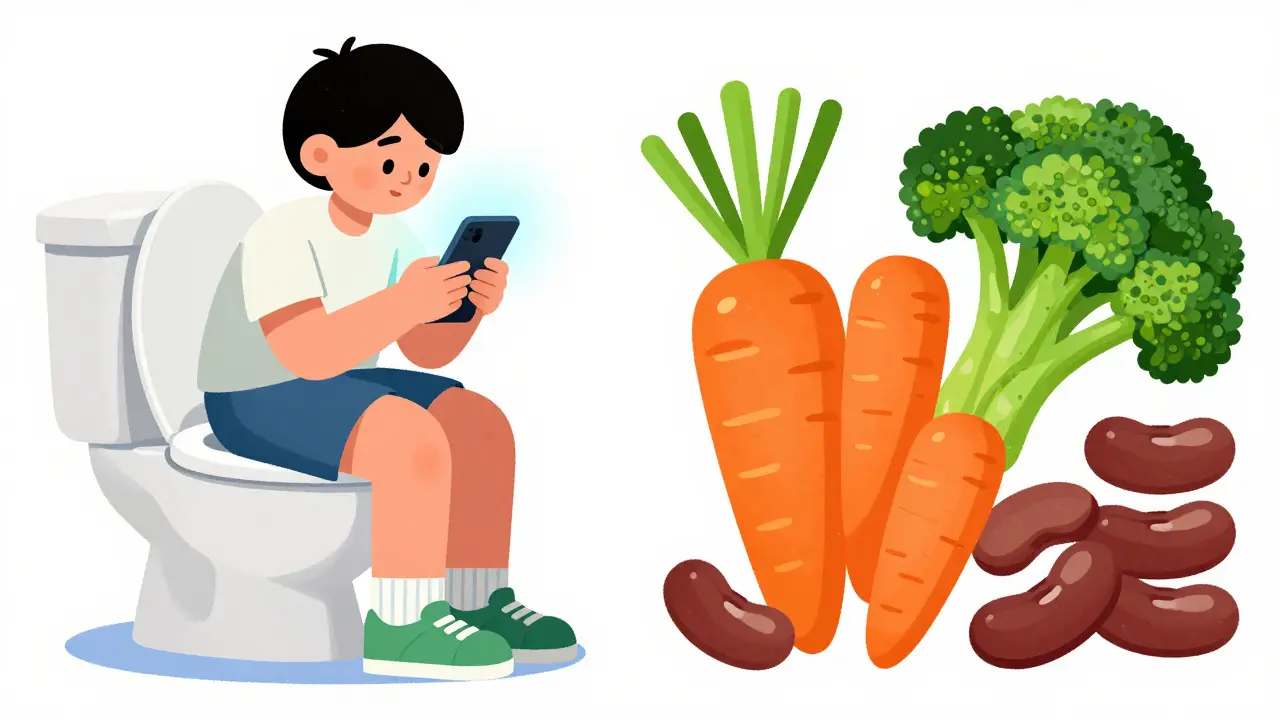
Hemorrhoids are the result of too much pressure on the veins in your pelvic area. Think of these veins like balloons; if you put too much pressure on them, they stretch and eventually swell.Common triggers include chronic constipation or diarrhea, which force you to strain during bowel movements. Interestingly, spending too much time on your phone while sitting on the toilet is a major culprit. Prolonged sitting in that position puts constant gravitational pressure on the rectal veins. Other factors include obesity, heavy lifting, and pregnancy. In fact, about 25-35% of pregnant women develop hemorrhoids due to the pressure of the growing fetus on the pelvic veins.
Home Remedies and Lifestyle Shifts
If your symptoms are mild, you can often manage them without a prescription. The goal is to make your stool softer so it passes without causing friction or requiring you to push.Focus on getting 25-30 grams of fiber daily through beans, whole grains, and vegetables. If you can't get enough from food, a fiber supplement can help. Hydration is just as important-aim for 8-10 glasses of water a day to keep things moving.
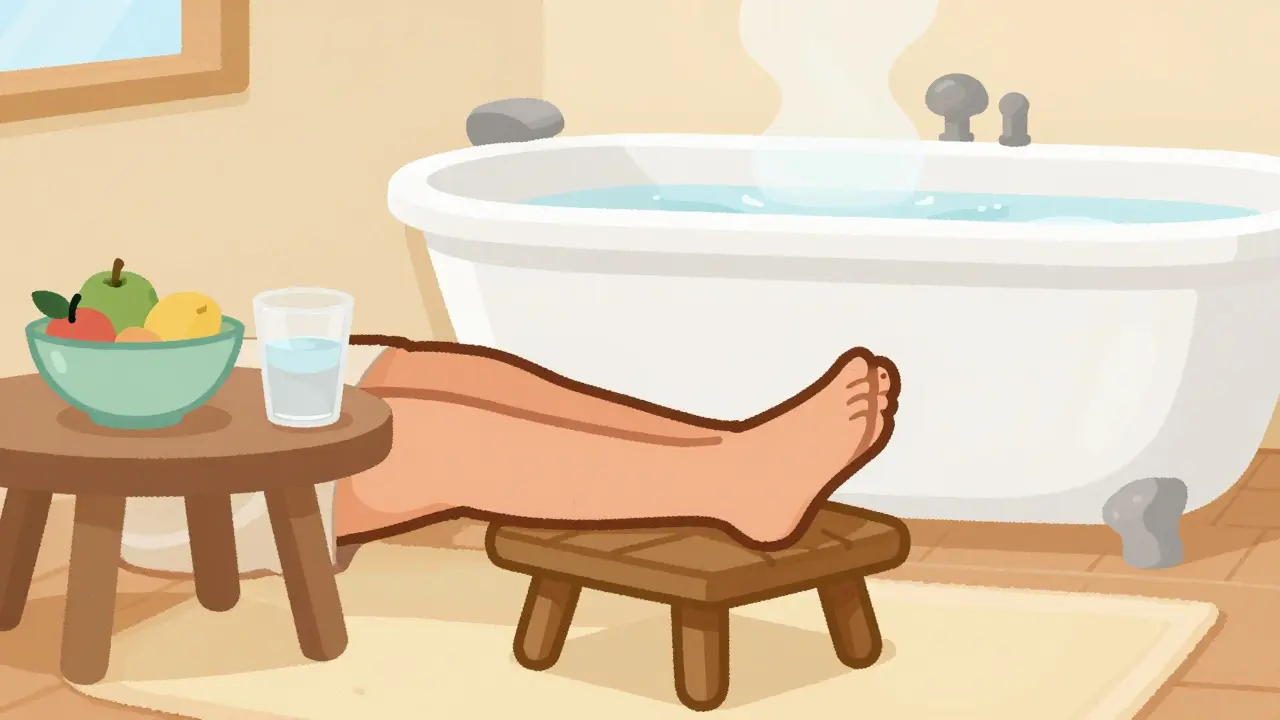
For immediate relief, try a sitz bath. This is just soaking the area in warm water for 15-20 minutes a few times a day to reduce swelling and relax the muscle. Over-the-counter hydrocortisone creams can calm the itching, while witch hazel pads provide a cooling effect to reduce inflammation.
A pro tip for the bathroom: use a small footstool. By lifting your knees above your hips, you change the angle of your rectum, which can reduce the amount of pressure needed to evacuate by roughly 30%. Also, try to limit your toilet time to under 5 minutes. If you aren't "going," get up and try again later.
When Home Care Isn't Enough: Medical Procedures
When lifestyle changes don't work, or the grade of the internal hemorrhoid is too high, you'll need a clinical intervention. Depending on the type, there are several paths you can take.For internal hemorrhoids, rubber band ligation is a favorite among doctors. They place a tiny band around the base of the vein, cutting off blood flow, and the hemorrhoid simply falls off within a few days. It's about 90% effective for Grades I through III. Other options include sclerotherapy, where a chemical solution is injected to shrink the vein, or infrared coagulation using heat to seal the blood vessel.
If you have a thrombosed external hemorrhoid, you might need a quick surgical incision to remove the blood clot. If done within the first 72 hours, this provides almost instant relief from the intense pressure. For the most severe, recurring cases, a hemorrhoidectomy is the gold standard. This is the complete surgical removal of the problematic tissue. While it has a 95% success rate, be prepared for a tougher recovery-usually 2 to 4 weeks-and significant post-op pain.
Knowing When to Worry
It is very easy to assume that any blood in the bathroom is just a hemorrhoid, but that is a dangerous assumption. Rectal bleeding can be a sign of more serious issues like inflammatory bowel disease or colorectal cancer.You should see a doctor immediately if you experience:
- Dizziness or lightheadedness (this suggests significant blood loss)
- A sudden change in your bowel habits (e.g., pencil-thin stools)
- Severe pain that doesn't go away with home treatment
- Bleeding that is dark or mixed in with the stool rather than bright red on the surface
Another common mistake is misdiagnosing a anal fissure as a hemorrhoid. A fissure is a small tear in the lining of the anus. While both cause bleeding, a fissure typically feels like a sharp, glass-like cutting sensation during a bowel movement, whereas hemorrhoids are more about itching and swelling. Treating a fissure with hemorrhoid cream won't fix the tear, which is why a professional diagnosis is non-negotiable.
Do hemorrhoids go away on their own?
Mild hemorrhoids can shrink and resolve with lifestyle changes, such as increasing fiber and water intake. However, advanced internal hemorrhoids (Grade III or IV) and thrombosed external hemorrhoids usually require medical intervention to fully resolve.
Can you have both internal and external hemorrhoids at once?
Yes, it is quite common to have both. In these cases, you might experience a mix of painless bleeding from the internal ones and itching or painful lumps from the external ones.
Is rubber band ligation painful?
Since internal hemorrhoids are in an area without pain receptors, the actual banding is usually painless. However, many patients report a feeling of "pressure" or a dull ache for 24 to 48 hours after the procedure.
What is the best diet to prevent hemorrhoids?
A high-fiber diet is essential. Aim for 25-35 grams of fiber daily from whole grains, legumes, fruits, and vegetables. Pair this with at least 64 ounces of water daily to ensure the fiber works effectively to soften stool.
How do I tell if my rectal bleeding is serious?
Bright red blood on the tissue is often a sign of hemorrhoids. However, if the blood is dark, tarry, or mixed into the stool, or if you have unexplained weight loss and fatigue, you must see a doctor to rule out colorectal cancer or IBD.
Write a comment