
For many women, menopause isn’t just about hot flashes and sleepless nights-it’s a turning point that affects everything from mood to bones to heart health. And when those symptoms hit hard, hormone therapy often comes up as an option. But with conflicting headlines and decades of mixed messaging, it’s no wonder so many women feel confused. Is hormone therapy safe? Does it help more than it hurts? And if you’re considering it, what’s the best way to start?
What Menopause Hormone Therapy Actually Does
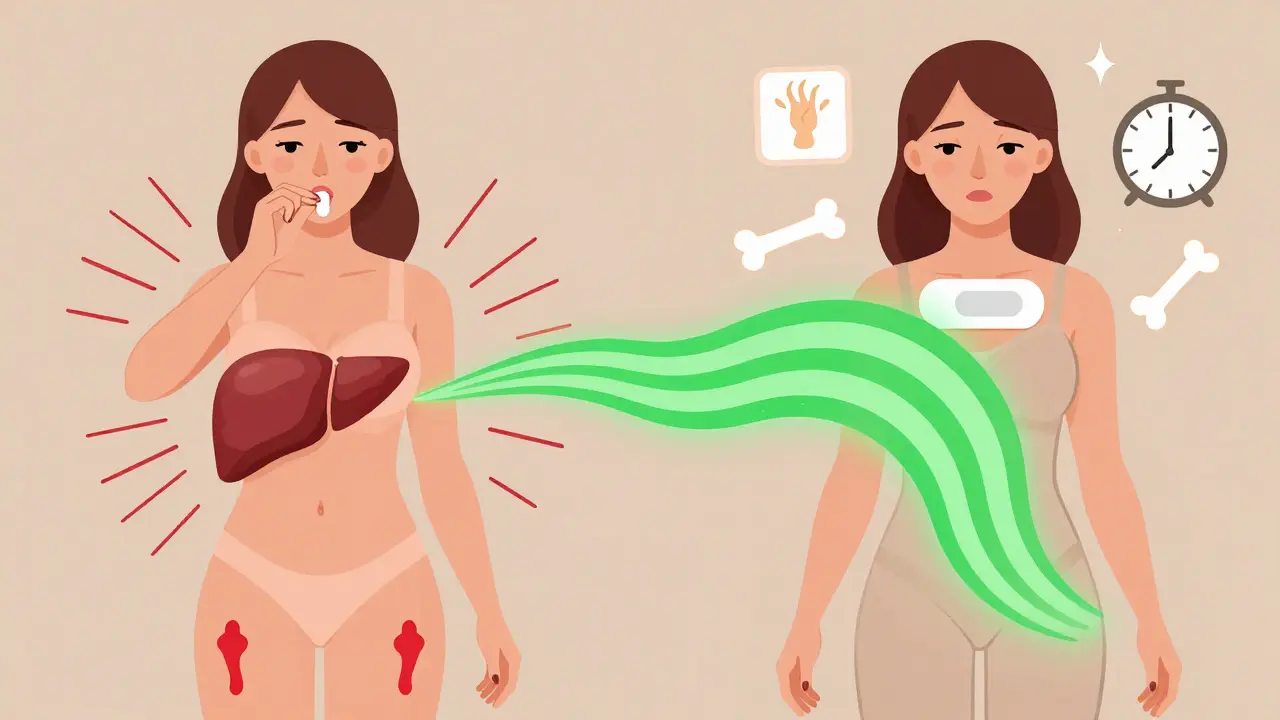
Menopause hormone therapy (MHT), sometimes called hormone replacement therapy or HRT, isn’t one single treatment. It’s a group of options designed to replace the estrogen your body stops making after menopause. For women who still have a uterus, progestogen is added to protect the lining of the uterus from overgrowth-which can lead to cancer. Without it, estrogen alone isn’t safe.The most common forms are pills, patches, gels, sprays, and vaginal creams or rings. Oral estrogen like conjugated equine estrogens (Premarin) or 17-beta estradiol are widely used, but transdermal patches or gels are becoming preferred because they avoid the liver on the way into your bloodstream. That small difference matters: transdermal estrogen carries a lower risk of blood clots and stroke compared to pills.
Why does this matter? Because the goal isn’t to stay on hormones forever. It’s to get through the toughest years-when hot flashes wake you up five times a night, when brain fog makes you forget where you put your keys, when your bones start thinning. For most women under 60 or within 10 years of their last period, the benefits of relief outweigh the risks.
The Clear Benefits: More Than Just Hot Flashes
The strongest evidence for MHT is in treating vasomotor symptoms-hot flashes and night sweats. Studies show it reduces these by 75% or more, compared to about 50% for SSRIs or gabapentin. One woman on Reddit shared: "I went from 15-20 hot flashes a day to 2-3 in 10 days on a 0.05 mg estradiol patch." That’s not anecdotal-it’s backed by clinical data.
It also protects bone density. Estrogen helps slow bone loss. Women who take MHT for a few years during early menopause significantly reduce their risk of hip fractures later on. A woman in a patient forum wrote: "My DEXA scan stayed stable after 8 years on HRT. My sister, who refused it, broke her hip at 62."
For women with severe vaginal dryness or painful sex due to menopause, low-dose vaginal estrogen is highly effective and doesn’t affect the rest of the body much. It’s a targeted fix for a very specific problem.
The Real Risks: What the Data Actually Shows
Let’s be clear: hormone therapy isn’t risk-free. But the risks aren’t the same for everyone. They depend on your age, how long you’ve been in menopause, the type of hormones you take, and your personal health history.
The biggest concern is breast cancer. Combined estrogen-progestogen therapy increases risk by about 29 extra cases per 10,000 women each year. Estrogen-only therapy (for women without a uterus) shows almost no increase-just 9 extra cases per 10,000 women per year. That’s still a risk, but it’s far smaller than many fear.
Another risk is blood clots. Oral estrogen raises the chance of deep vein thrombosis or pulmonary embolism. Transdermal estrogen cuts that risk in half. Stroke risk is also higher with pills, especially in women over 60. But again, if you’re under 60 and starting therapy soon after menopause, that risk stays very low.
And then there’s the heart. Early studies like the Women’s Health Initiative in 2002 scared many women off MHT because they showed a slight increase in heart attacks in older women who started therapy years after menopause. But newer analysis shows that if you start within 10 years of menopause-before age 60-your heart risk doesn’t go up. In fact, some data suggests it might even go down. That’s called the "timing hypothesis," and it’s changed how doctors think about hormone therapy today.
Who Should Avoid It?
Some women shouldn’t take MHT at all. If you’ve had breast cancer, especially estrogen-receptor-positive, it’s usually off the table. The same goes for a history of blood clots, stroke, liver disease, or unexplained vaginal bleeding. If you’re over 60 and haven’t started therapy yet, the risks start to outweigh the benefits for most women.
Family history matters too. If your mother or sister had breast cancer before 50, talk to your doctor about genetic testing and whether MHT is right for you. It’s not a hard no-but it’s a red flag that needs careful weighing.
Alternatives: What Else Works?
Not everyone wants hormones. And that’s okay. There are non-hormonal options, but they’re not as powerful.
- SSRIs like paroxetine can reduce hot flashes by about 50-60%, but they can cause nausea, weight gain, or low sex drive.
- Gabapentin helps about 45% of women, but dizziness and fatigue are common side effects.
- Phytoestrogens-like soy, flaxseed, or red clover-have inconsistent results. A Cochrane review found they reduce hot flashes by less than half a day per day compared to placebo.
- Lifestyle changes: cooling your bedroom, avoiding spicy food and alcohol, practicing mindfulness-these help, but they rarely fix severe symptoms alone.
None of these match the effectiveness of MHT for moderate to severe symptoms. If your hot flashes are wrecking your sleep and your mood, alternatives just aren’t enough.
How to Start Safely
If you’re thinking about MHT, don’t rush. Start with a full check-in with your doctor. They’ll want to know:
- Your personal and family medical history
- Your current blood pressure
- How severe your symptoms are (using a simple scale like the Menopause Rating Scale)
- Whether you still have your uterus
Then, start low. Most doctors begin with the lowest effective dose: 0.5 mg of oral estradiol or a 0.025 mg transdermal patch. You’ll likely feel better in 2-4 weeks. If you’re on combined therapy and get breakthrough bleeding (common in the first 6 months), don’t panic-it often settles down with a tweak in dosage.
Revisit your plan every 6-12 months. Can you lower the dose? Can you switch from a pill to a patch? Are your symptoms improving enough that you might stop in a year or two? MHT isn’t a lifelong commitment for most women. It’s a bridge.
What’s Changing in 2025
The conversation around MHT is shifting fast. In July 2025, the FDA opened a public docket to gather more data on how age, timing, and formulation affect risks. A landmark study of 120 million patient records presented at The Menopause Society’s 2025 meeting showed that starting estrogen during perimenopause-before your periods fully stop-cuts heart disease risk by 18% compared to starting after menopause.
Experts are now talking about a "window of opportunity"-the 10-year period after menopause when therapy is safest and most effective. The 2025 Endocrine Society guidelines are expected to formalize this with clearer age cutoffs.
And the future? Personalized therapy. Researchers are exploring genetic tests to see how your body metabolizes estrogen. Some women break it down quickly and need higher doses. Others process it slowly and are at higher risk for side effects. Within five years, we may be choosing hormone therapy based on your DNA, not just your age.
Final Thoughts: It’s Not All or Nothing
Menopause hormone therapy isn’t a magic bullet. It’s not a cure-all. But for women with severe symptoms who are under 60 or within 10 years of menopause, it’s often the most effective tool we have. The fear around it has been exaggerated by old data and media headlines. The truth is more nuanced.
If you’re struggling with hot flashes, sleep loss, or mood swings that are wrecking your life, talk to your doctor-not your Instagram feed. Ask about transdermal estrogen, low doses, and the timing hypothesis. Ask about your personal risks. And remember: you don’t have to stay on it forever. Many women use it for 3-5 years, then stop. The goal isn’t to be on hormones for life. It’s to get through the hardest part of menopause with your health, energy, and peace of mind intact.
Is hormone therapy safe for women under 60?
Yes, for most healthy women under 60 or within 10 years of menopause, the benefits of hormone therapy for symptom relief and bone protection outweigh the risks. The key is starting early and using the lowest effective dose, preferably transdermal (patch or gel) to reduce blood clot and stroke risks.
Does hormone therapy cause breast cancer?
Combined estrogen-progestogen therapy slightly increases breast cancer risk-about 29 extra cases per 10,000 women per year. Estrogen-only therapy (for women without a uterus) shows almost no increase. Risk rises with longer use, but drops back to normal within a few years after stopping. For most women using it short-term for symptoms, the absolute risk remains low.
What’s the difference between oral and patch hormone therapy?
Oral estrogen passes through the liver first, increasing the risk of blood clots and stroke. Transdermal patches or gels deliver estrogen directly into the bloodstream, avoiding the liver. Studies show transdermal therapy has about half the risk of blood clots and a 30% lower stroke risk compared to pills. For most women, patches are the safer choice.
Can I use hormone therapy if I’ve had a blood clot before?
No. If you’ve had a deep vein thrombosis, pulmonary embolism, or stroke, hormone therapy is generally not recommended. Even transdermal estrogen carries some risk in these cases. Talk to your doctor about non-hormonal alternatives like SSRIs or gabapentin for symptom relief.
How long should I stay on hormone therapy?
There’s no fixed rule. Most women use it for 3-5 years to get through the worst symptoms. Some stay longer if symptoms persist or bone loss is a concern. The goal is to use the lowest dose for the shortest time needed. Revisit your plan yearly with your doctor. Many women taper off successfully after 5 years without a return of severe symptoms.
Are natural remedies like soy or black cohosh effective?
They’re not reliable. Studies show soy, flaxseed, and black cohosh reduce hot flashes by less than half a day per day on average-far less than hormone therapy. Some women report feeling better, but it’s likely due to placebo or lifestyle changes. They’re safe to try, but don’t expect them to replace MHT if your symptoms are severe.
Ryan Riesterer
Transdermal estrogen's pharmacokinetic profile significantly reduces first-pass hepatic metabolism, thereby attenuating the synthesis of clotting factors II, VII, IX, and X. This mechanistic distinction underpins the 40-50% lower VTE risk observed in RCTs comparing patches to oral formulations. The timing hypothesis further contextualizes this: initiating therapy within 10 years of menopause aligns with vascular endothelial resilience, minimizing atherogenic transformation.
Akriti Jain
lol the FDA "public docket"?? 😂 sure, and the pharmaceutical companies just happen to fund all the "landmark studies" too. They want you hooked on hormones forever so they can keep selling you patches. Next they'll say your period was a government conspiracy. 🤡
Mike P
Man, I can't believe we're letting women take hormones like they're candy. Back in my day, women just dealt with it. No pills, no patches, no whining. You want to stop hot flashes? Drink cold water and shut up. This whole thing is just another way the medical industry profits off fear. And don't get me started on soy milk being a "natural remedy"-it's basically estrogen soup. America's gone soft.
Jasmine Bryant
So I read this and was like wait-so if I'm 52 and had my last period at 48, I'm still in the 10-year window? That’s a relief! I’ve been scared to even ask my doc about patches because of the breast cancer stats. But if estrogen-only is almost no increase… maybe I’ll bring it up next visit. Also, anyone know if the 0.025mg patch is covered by Medicare? Mine says no but I think that’s wrong.
Liberty C
How quaint. A 2025 "breakthrough" that merely confirms what was known in 1998. The real scandal isn't the therapy-it's that women are still being gaslit into thinking they need permission to feel human. Your bones, your brain, your libido-they're not optional. The fact that we're still debating this like it's a moral failing, rather than a physiological reality, is the true tragedy. And no, soy won't fix it. Neither will your yoga mat.
shivani acharya
Okay but let’s be real-every study they cite is funded by Big Pharma. Who do you think paid for that "120 million patient records"? The same people who made millions off HRT in the 90s and then panicked when the WHI came out? They just repackaged it with "transdermal" and "timing" to sell it again. My cousin took HRT for 3 years and got breast cancer at 54. Coincidence? I don’t think so. And now they want us to believe it’s "safe" because it’s "low dose"? Low dose doesn’t mean no dose. And what about the long-term epigenetic effects? Nobody talks about that. They just want you to take the patch and shut up.
Sarvesh CK
The philosophical underpinning of this discourse reveals a tension between biomedical reductionism and holistic human experience. Hormone therapy, while pharmacologically efficacious, risks commodifying the natural lifecycle of women's bodies. One might ask: is the alleviation of vasomotor symptoms worth the potential alteration of endogenous hormonal trajectories? And if we accept MHT as a bridge, what then becomes of the dignity of aging without medical intervention? Perhaps the true question lies not in whether we should take hormones, but whether our society has created conditions so hostile to natural aging that we feel compelled to chemically correct it.
Hilary Miller
My mom took patches for 4 years. She said it was like getting her life back. No more 3 a.m. panic sweats. No more crying over spilled coffee. She’s 70 now, bone density’s fine, and she hikes every weekend. Don’t let fear silence your health.
Margaret Khaemba
Wait so if I start a patch now at 55, am I too late? I had my last period at 49 and have been struggling with brain fog and insomnia for years. I feel like I’m slowly fading. Also, does anyone know if the gel is better than the patch? I hate sticky things on my skin lol
Malik Ronquillo
So you're telling me I should just take hormones because I'm under 60? What about the women who had cancer? What about the ones who just want to age naturally? This whole thing feels like pressure to conform. I'm not taking anything. I'll just sweat it out. And if I die early? At least I died free.
Brenda King
Just wanted to say thank you for this post. I'm 53 and was terrified to even ask my doctor about HRT because I thought everyone would judge me. Reading this made me feel seen. I started a 0.025mg patch 3 weeks ago and my sleep is already better. I'm not on it forever-I just need to get through this rough patch. You're not alone. 💛
Keith Helm
Per FDA guidelines, transdermal estrogen is contraindicated in patients with prior venous thromboembolic events regardless of formulation. This is non-negotiable. Consult your physician prior to initiation.
Daphne Mallari - Tolentino
One cannot help but observe the alarming commodification of menopausal distress into a pharmacological solution. The very notion that a woman’s natural biological transition requires chemical correction speaks volumes about the pathologization of femininity in late-stage capitalism. The so-called "window of opportunity" is merely a marketing construct designed to prolong pharmaceutical dependency.
Neil Ellis
This is the kind of clarity we need. Too many women are told "it’s all in your head" or "just meditate more." But when your body’s on fire and you can’t remember your kid’s name, you need real help. Hormone therapy isn’t cheating-it’s science. And patches? Yeah, they’re the real MVP. No more liver drama. Just calm. I’m 57, on it for 5 years, and still feel like me. No regrets.
Alec Amiri
So you're saying it's safe... but only if you're white, rich, and under 60? What about the women of color who get misdiagnosed? Or the ones without insurance? Or the ones who live in rural areas where the doctor doesn't even know what transdermal means? This whole post is just a glossy ad for Big Pharma wrapped in science-speak. Real talk: most women don't get this level of care. So don't act like this is a universal solution. It's a luxury.