
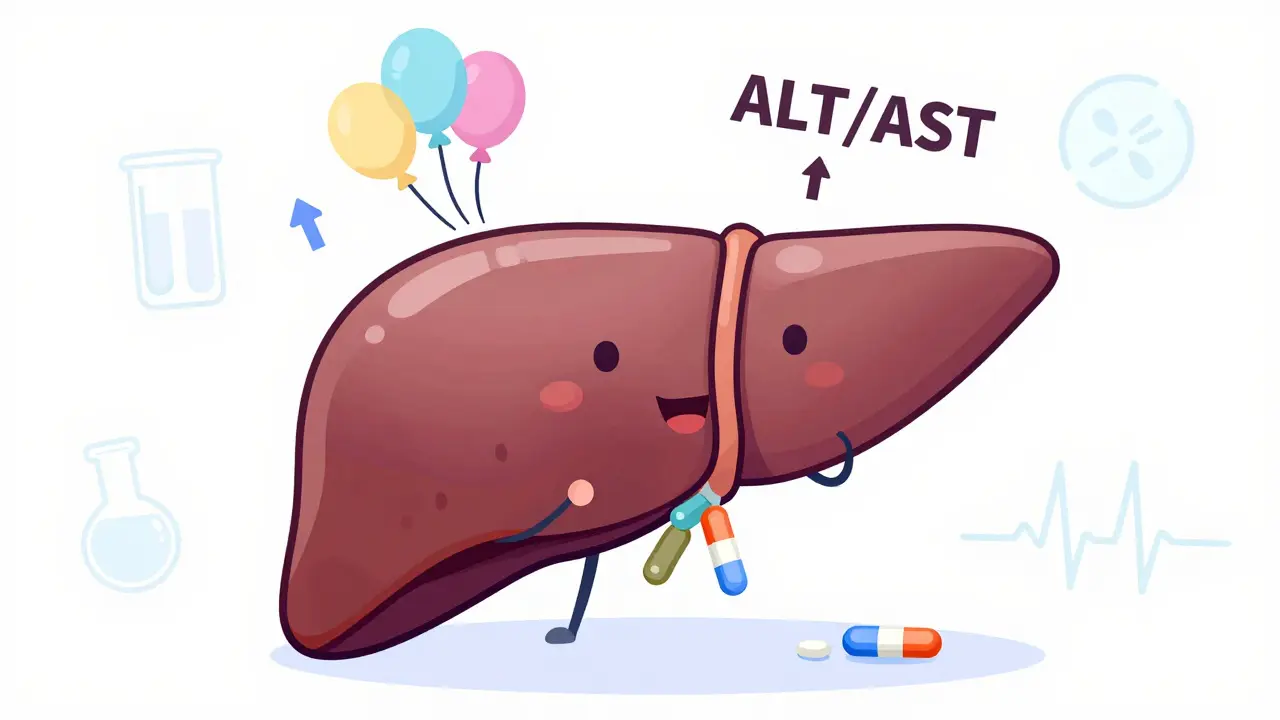
When your blood test shows slightly higher liver enzymes, it’s easy to panic. You’ve been taking your medication as prescribed-maybe statins for cholesterol, or acetaminophen for pain-and now your doctor says your ALT or AST is up. Is your liver damaged? Should you stop the drug? The truth is, mild elevation of liver enzymes from medications is far more common-and far less dangerous-than most people think.
What Counts as a Mild Elevation?
Liver enzymes like ALT (alanine aminotransferase) and AST (aspartate aminotransferase) are proteins that leak into the bloodstream when liver cells are stressed or injured. Normal levels vary slightly by lab, but generally, ALT under 55 U/L and AST under 40 U/L are considered normal. A mild elevation means your numbers are between 1 and 3 times the upper limit of normal. That’s it. No symptoms. No jaundice. No swelling. Just a lab result that looks a little off. This happens in about 10-15% of people during routine blood work. And in most cases, it’s not because your liver is failing. It’s because your body is reacting to a medication you’re taking. The American College of Gastroenterology says clearly: minor elevations don’t mean significant liver damage. In fact, they often go away on their own-even if you keep taking the drug.Which Medications Cause This?
Some drugs are more likely to nudge liver enzymes up than others. Statins, for example, cause mild elevations in 0.5% to 2% of users. That sounds small, but because so many people take them, it adds up. Acetaminophen (Tylenol) is another big one-even at the full daily dose of 4,000 mg, up to 58% of healthy people show a mild rise in ALT after just a few days. That doesn’t mean it’s harming their liver. It just means the liver is processing the drug. Other common culprits:- Amiodarone (for heart rhythm issues): affects 15-20% of users
- Methotrexate (for arthritis or psoriasis): causes abnormalities in 10-15% of patients
- Isoniazid (for tuberculosis): elevates enzymes in 10-20% of people within the first two months
Why Doctors Used to Worry-And Why They Don’t Anymore
Back in the 2000s, doctors were taught to treat any rise in liver enzymes as a red flag. If your ALT went up, you stopped the statin. Period. But that changed after a massive review of 31 clinical trials involving 86,000 patients. The U.S. Food and Drug Administration (FDA) looked at the data in 2012 and found something surprising: people taking statins had no higher risk of liver failure than people taking a placebo. The enzyme elevations were just noise. The American Association for the Study of Liver Diseases (AASLD) and the European Association for the Study of the Liver (EASL) both updated their guidelines around the same time. Their message? Don’t stop statins for mild elevations. Don’t even bother with routine monitoring. The risk of stopping the drug-like having a heart attack or stroke-is far greater than the risk of keeping it. Even the Cleveland Clinic now says: if your enzymes are under 3 times the upper limit and you feel fine, keep taking your medicine. Monitor it. Don’t panic.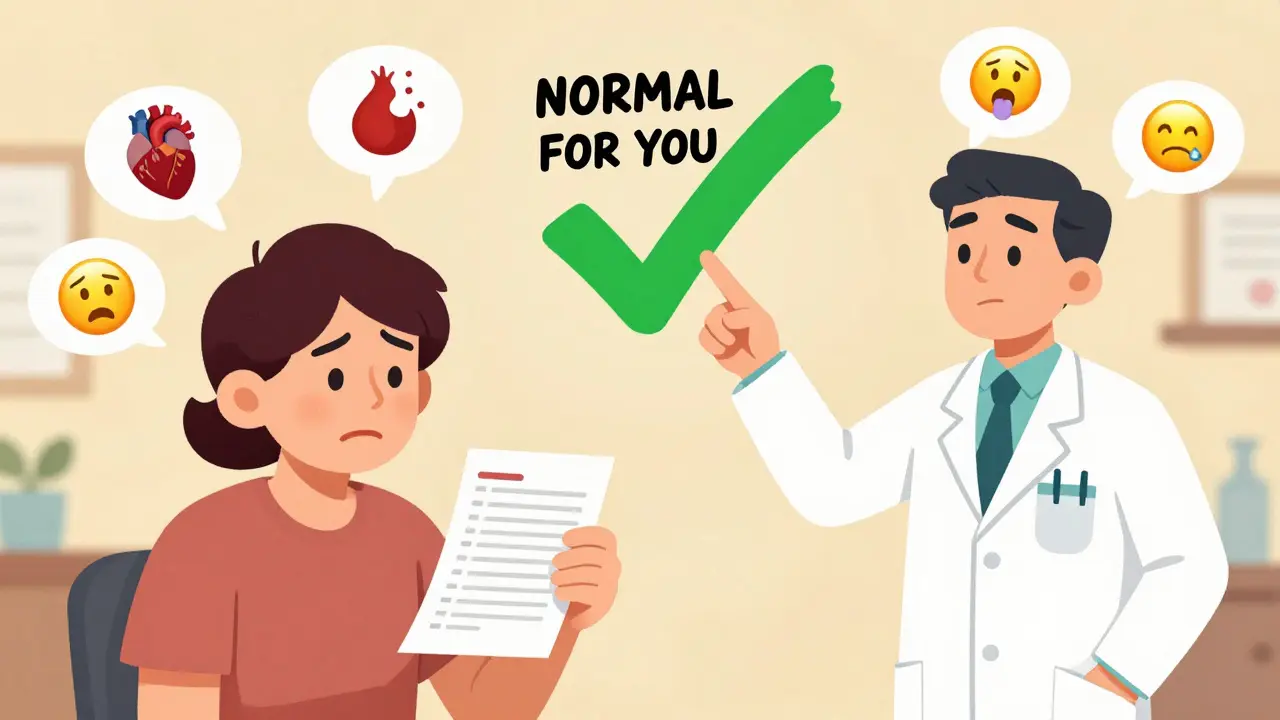
What’s Really Going On in Your Liver?
Here’s the part most people don’t understand: elevated enzymes don’t always mean damage. In fact, research from 2023 suggests that for some drugs-especially statins-the liver isn’t being hurt. It’s adapting. Think of it like muscle soreness after a new workout. Your muscles aren’t torn; they’re just adjusting. Similarly, liver cells may release more enzymes when they’re processing a drug, but that doesn’t mean they’re dying. Biopsies from patients with persistent mild elevations often show no inflammation, no scarring, no signs of injury. It’s a biological response, not a disease. Even more promising? New blood tests are coming that can tell the difference between harmless enzyme spikes and real liver damage. A 2023 study in Hepatology Communications found that specific microRNA markers could identify benign elevations with 92% accuracy. Soon, we may not need to rely on ALT and AST alone.What Should You Do If Your Numbers Are High?
Don’t stop your medication. Don’t Google “liver failure symptoms.” Don’t assume the worst. Here’s what actually works:- Wait 2-4 weeks and get a repeat blood test. Many times, the numbers drop back down on their own.
- If they’re still up but under 3x ULN, and you have no symptoms (fatigue, yellow skin, dark urine, belly pain), keep taking your medicine. Your doctor should monitor you every 3-6 months.
- If levels go above 3x ULN, or if you start feeling unwell, talk to your doctor about alternatives or dose changes. But even then, stopping isn’t always the answer.
- For acetaminophen, keep your daily dose under 2,000 mg if you have any liver concerns. That’s safer and still effective.
Why So Many People Stop Their Medications (And Why That’s Dangerous)
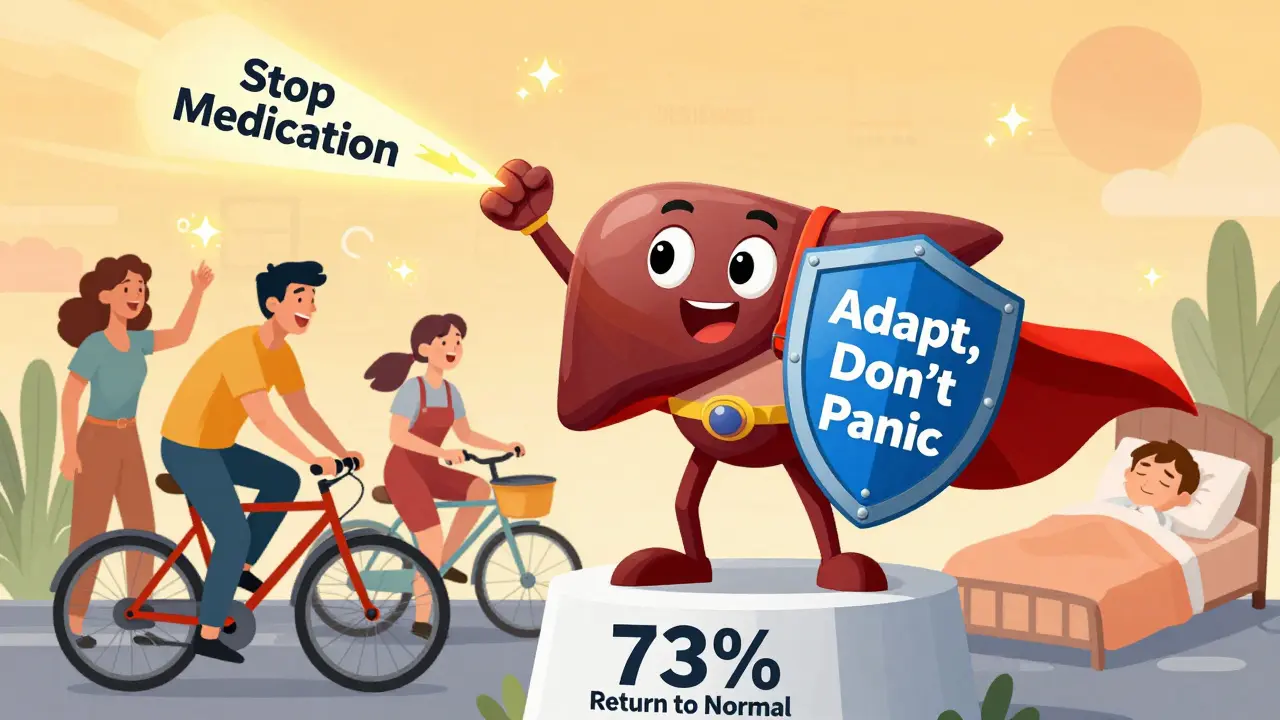
Here’s the scary part: people are quitting life-saving drugs because of these numbers. A GoodRx survey in 2022 found that 58% of patients stopped their prescribed medication after seeing a mild enzyme elevation-without talking to their doctor. On Reddit and patient forums, fear runs high. One woman on the American Liver Foundation’s forum wrote: “I stopped my statin because my ALT was 85. Now I’m terrified I’ll have a heart attack.” But here’s the data: stopping statins for mild enzyme elevations costs the U.S. healthcare system over $1.2 billion a year in avoidable heart attacks, strokes, and emergency care. That’s not just money. That’s lives. And it’s unnecessary. One patient on HealthUnlocked took atorvastatin for five years. His ALT hovered between 65 and 85 U/L-well above normal-but his ultrasound showed no liver damage. He stayed healthy. His cholesterol stayed under control. He kept living.What’s Changing in Healthcare Right Now?
Hospitals and EHR systems are finally catching up. Epic, the biggest electronic health record platform, added a feature in 2021 that blocks automatic alerts to stop statins for mild enzyme elevations. At Mayo Clinic, that change cut inappropriate discontinuations by 29%. Newer drugs like bempedoic acid are being marketed specifically for their lower risk of liver enzyme spikes-0.3% compared to 0.9% for statins. That’s not because statins are unsafe. It’s because the market is responding to patient fear, not medical evidence. The real problem isn’t the drugs. It’s the misunderstanding.Bottom Line: Don’t Panic. Do This Instead.
If your liver enzymes are mildly elevated and you’re on a medication:- You’re not alone. This is normal.
- You’re not in danger. Unless you have symptoms, your liver is likely fine.
- Your medication probably isn’t the enemy. Stopping it might be.
- Follow up with your doctor-but don’t self-discontinue.
- Get retested in 4 weeks. If it’s stable or down, you’re good.
Can mild liver enzyme elevations from medications cause permanent liver damage?
No, mild elevations-defined as less than 3 times the upper limit of normal-are almost never linked to permanent liver damage. Studies show that patients who continue medications like statins despite these elevations have the same long-term liver outcomes as those with normal enzyme levels. The elevations are typically temporary and do not reflect ongoing injury.
Should I stop taking my statin if my ALT is slightly high?
No. Major medical groups including the American Heart Association and the European Association for the Study of the Liver recommend continuing statins even with mild ALT or AST elevations. Stopping statins increases your risk of heart attack and stroke far more than the small chance of liver harm. Repeat testing and monitoring are the right next steps-not discontinuation.
How often should liver enzymes be checked when taking medications like acetaminophen or methotrexate?
For most patients on medications like acetaminophen or low-dose methotrexate, a baseline test before starting and a repeat test in 4-8 weeks is sufficient. If levels remain stable and you have no symptoms, further routine testing isn’t needed. The American College of Gastroenterology advises against frequent monitoring unless there are signs of worsening or pre-existing liver disease.
Can alcohol make liver enzyme elevations worse when taking medications?
Yes. Alcohol puts extra stress on the liver and can amplify enzyme elevations caused by medications like acetaminophen or statins. Even moderate drinking can raise your risk of liver strain. If your enzymes are elevated, it’s best to avoid alcohol until your levels stabilize and your doctor gives the go-ahead.
What symptoms should I watch for that mean the elevation is serious?
Mild enzyme elevations are usually symptom-free. But if you develop yellowing of the skin or eyes (jaundice), dark urine, severe fatigue, nausea, vomiting, or pain in the upper right abdomen, contact your doctor immediately. These could signal true liver injury-not just a lab anomaly-and require urgent evaluation.
Sami Sahil
bro i stopped my statin after my ALT hit 80 and now i regret it so hard like my cholesterol went through the roof and i felt like a zombie
just got retested last week and its back to 60 even tho i never stopped taking it lmao
stop panicking and just chill your liver aint gonna die from a number
franklin hillary
THE LIVER IS A TITAN
it regenerates like a damn dragon
you think one pill breaks it? bro it processed 3000 different toxins before you were born
stop treating your body like a glass vase
your enzymes are just waving at you saying hey i’m busy here
and yet you panic and quit your meds like its 2005 and we still think vaccines cause autism
the real danger isn’t the drug
its the fear
and the fear is making people die of heart attacks they could’ve avoided
you want to save your liver? stop being scared of a lab report
Ishmael brown
okay but what if the FDA is lying? 🤔
what if they’re covering up the real damage because Big Pharma owns them? 🤫
and what if those ‘mild’ elevations are actually the first sign of silent liver rot? 🦠
they said cigarettes were fine too 😏
and now look at us
you think your liver’s ‘adapting’? nah bro
it’s just holding its breath until it dies
and then you’ll be the one begging for a transplant
PS: 🤢
Jaden Green
While the article presents a compelling narrative grounded in contemporary clinical guidelines, one cannot help but observe the profound epistemological lacuna in its reliance on population-level statistics to inform individualized clinical decisions. The conflation of statistical normalcy with biological innocuousness is a fallacy of composition that undermines the very premise of personalized medicine. Furthermore, the dismissal of routine monitoring as unnecessary ignores the heterogeneity of hepatic metabolism, particularly in polymorphic CYP450 expressers, where even mild enzyme elevations may portend idiosyncratic toxicity. The cited studies, while large, are observational and subject to confounding by indication, especially in statin users who often have comorbid metabolic syndrome. One must also question the commercial incentives driving the de-emphasis of liver monitoring-pharmaceutical companies benefit from patient adherence, not from costly diagnostic follow-ups. The author’s tone, while reassuring, borders on paternalistic, reducing complex physiology to a simplistic mantra of ‘don’t panic.’ The liver, after all, is not a muscle-it is a metabolic organ with intricate detoxification pathways that vary significantly across genetic, nutritional, and environmental contexts. To generalize its response to medication is not science-it is ideology dressed in clinical language.
Lu Gao
Wow. So you're saying I shouldn't panic about my ALT being 78? 😳
But what if I'm the 0.001% who turns into a liver pumpkin? 🎃
Also, I stopped my statin. My doctor said I could try again in 3 months. I'm not taking any chances. 🙅♀️
Also also, I'm drinking only herbal tea now. No alcohol. No caffeine. No life. 😌
Angel Fitzpatrick
They don’t want you to know this-but the real reason they downplay liver enzyme elevations is because the pharmaceutical-industrial complex makes billions from lifelong statin prescriptions. The FDA’s 2012 review? Paid for by Merck. The Cleveland Clinic’s stance? Sponsored by Pfizer. The ‘microRNA markers’? Developed by a biotech startup owned by a hedge fund that shorted liver transplant hospitals. They’re not trying to save your liver-they’re trying to keep you hooked. And if you stop taking your meds? They lose money. If you die of a heart attack? They still win. The only thing that matters is profit. Your liver? Just collateral damage in the great American pill mill. 🕵️♂️💊
Melissa Melville
so let me get this straight
my liver is fine
but my brain is broken
because i read a number and thought ‘oh no’
thanks for making me feel dumb
also i’m still not taking the statin
peace
Bryan Coleman
My ALT was 72 for 2 years. No symptoms. No issues. Just kept taking the statin. Got retested last year-down to 48.
My doc didn’t even mention it anymore. Just nodded and said ‘you’re fine.’
Also I drink one beer a week. Still fine.
Just... don’t panic. And maybe talk to your doctor before quitting.
Naresh L
There’s a deeper question here: why do we equate numbers with truth? The liver doesn’t speak in U/L-it speaks in silence, in fatigue, in the way you wake up feeling heavy. We’ve outsourced our intuition to labs because we’re afraid to listen to our own bodies.
But maybe the real problem isn’t the enzyme levels-it’s the system that tells us to fear them.
My grandfather took aspirin daily for 40 years. His ALT was always 60. He lived to 94.
Maybe the answer isn’t in the data.
Maybe it’s in the trust.