
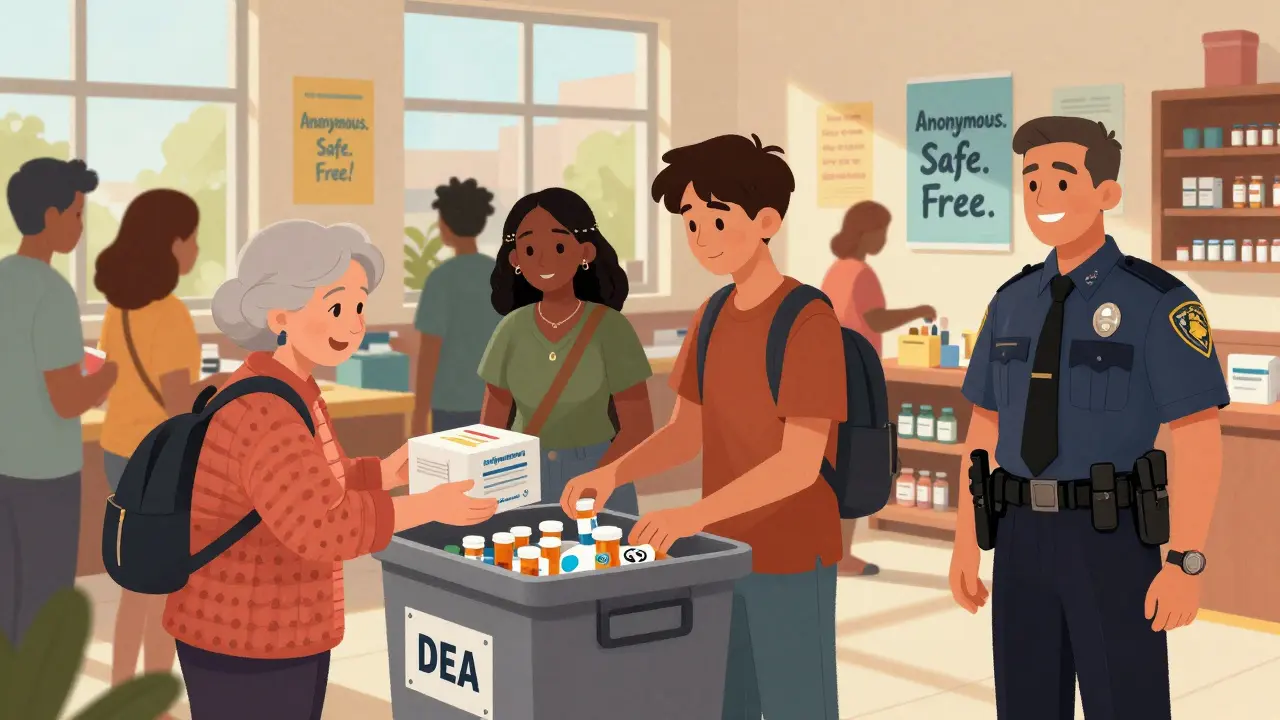
Every year, millions of unused or expired prescription drugs sit in bathroom cabinets, kitchen drawers, and medicine chests across the U.S. - not because people want to keep them, but because they don’t know how to safely get rid of them. Flushing them down the toilet? Throwing them in the trash? These are common, but dangerous, habits. That’s where National Prescription Drug Take-Back Days come in. These events, run by the U.S. Drug Enforcement Administration (DEA), offer a simple, free, and anonymous way to dispose of unwanted medications - and they’ve been doing it since 2010.
What Happens on Take-Back Day?
Take-Back Day isn’t just a one-day cleanup. It’s a nationwide operation. On the last Saturday of April and October, law enforcement agencies across the country set up collection sites at police stations, pharmacies, hospitals, and community centers. You show up with your old pills, patches, or capsules - no questions asked. You hand them over. They take them. You leave. That’s it.
The event runs from 10 a.m. to 2 p.m. local time. It’s not open all day, so timing matters. If you show up at 3 p.m., you’ll be turned away. Collection sites are temporary, so don’t expect to drop off meds any other time of year unless you find a permanent kiosk (more on that later).
In April 2025 alone, over 620,000 pounds of prescription drugs were collected. That’s more than 310 tons. Since the program started in 2010, more than 9,910 tons of medications have been safely removed from homes and streets. That’s not just a number - it’s thousands of bottles of painkillers, antidepressants, anxiety meds, and antibiotics that won’t end up in a teenager’s medicine cabinet, a pet’s stomach, or a local water supply.
What Can You Drop Off?
Not everything goes. The DEA is clear about what’s accepted:
- Tablets and capsules (pills)
- Patches (like fentanyl or nicotine patches)
- Liquid medications - but only if sealed in their original container
- Topical ointments and creams (in original packaging)
What’s not allowed?
- Syringes or sharps (needles)
- Illicit drugs (cocaine, heroin, meth)
- Over-the-counter meds (like ibuprofen or allergy pills)
- Vape pens or inhalers
- Medical waste like gauze or IV bags
If you have needles, you’ll need to take them to a separate sharps disposal site - many pharmacies offer this service year-round. OTC meds? You can usually throw them in the trash if you mix them with coffee grounds or cat litter first. But for prescription drugs, especially opioids, the Take-Back Day is the safest option.
Why This Matters - The Real Impact
Why should you care? Because misuse of prescription drugs is still a massive public health problem. In 2024, over 8 million Americans aged 12 and older misused pain relievers. Nearly 60% of those got them from a friend or family member’s medicine cabinet. That’s not a statistic - that’s your neighbor, your cousin, your kid’s classmate.
Take-Back Day directly reduces that risk. A 2024 survey by the Partnership to End Addiction found a 27% drop in opioid-related overdose deaths compared to previous years. While many factors contributed, experts agree that reducing access to unused prescriptions played a role. When people know they can safely drop off meds, they do. Reddit threads from April 2025 showed 83% of users praising the program. One user wrote: “Dropped off my mom’s unused opioids at the police station - no questions asked, took two minutes. I know they won’t end up in a teen’s hands.”
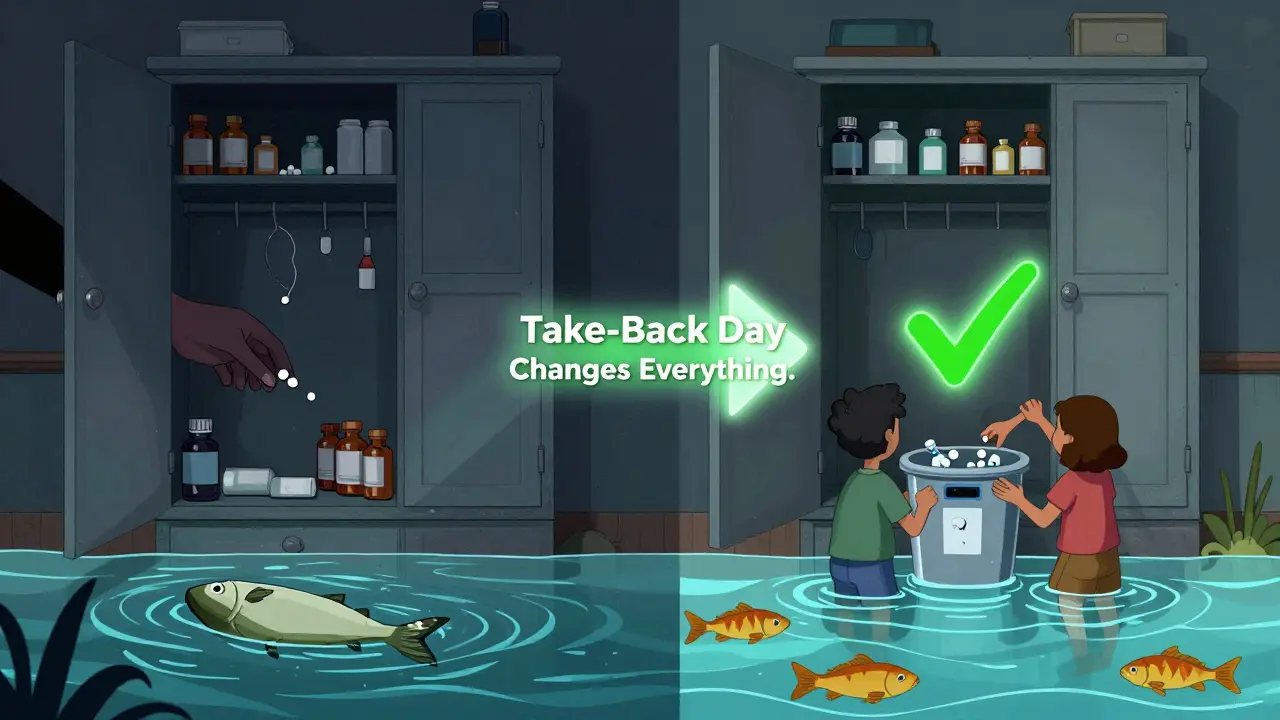
It’s not just about addiction. Improper disposal harms the environment. Flushing meds can contaminate water systems. Landfills leach chemicals into soil. The DEA doesn’t burn or dump these drugs. They’re transported to federally approved incineration sites - where they’re destroyed completely.
Where to Find a Collection Site
Not every town has a site. Urban areas usually have one for every 15,000 people. Rural areas? One for every 50,000. That’s a big gap. The DEA’s website, takebackday.dea.gov, has a searchable map. You can also use the “Dispose My Meds” app, used by over 340,000 Americans. Type in your zip code, and it shows you the nearest drop-off point - whether it’s a police station, a CVS, or a hospital pharmacy.
Some hospitals, like University Hospitals in Ohio, host events year-round at specific locations. If you live near one of those, you don’t have to wait for Take-Back Day. But for most people, the biannual events are the only free, law enforcement-run option.
What to Bring - And What to Leave Behind
Here’s the simple checklist:
- Bring: All unused or expired prescriptions - even if they’re empty. Empty bottles are fine. Just make sure pills are in their original container if possible.
- Leave: Needles, OTC meds, vape pens, or anything that’s not a prescription. Don’t bring your entire medicine cabinet - just what you want to dispose of.
- Tip: Bring meds in a bag or box. Don’t carry them loose. It makes it easier for staff to handle them.
And remember - no ID needed. No forms. No background check. It’s anonymous. That’s intentional. The DEA wants people to feel safe, not judged. If you’re worried about your doctor finding out, or your insurance company, you don’t have to be.
What’s Changing - And What’s Coming
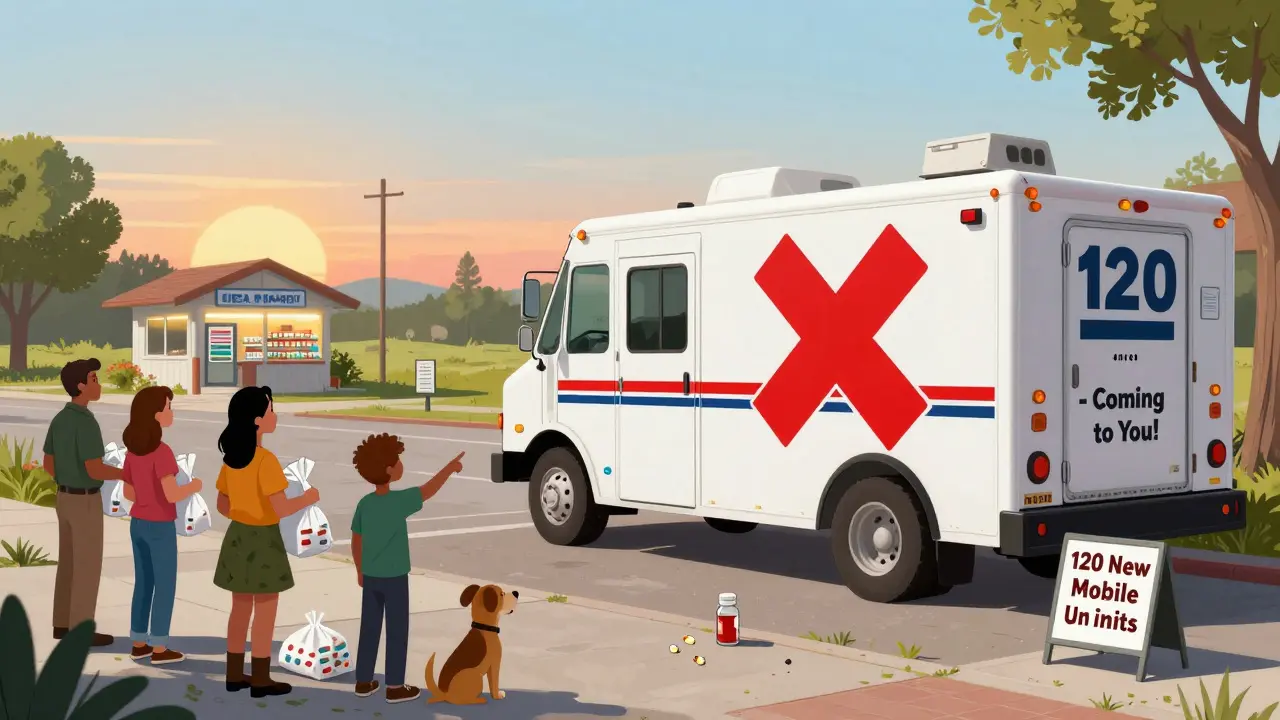
The program isn’t standing still. In 2025, the DEA launched 120 mobile collection units - trucks that travel to rural towns more than 25 miles from the nearest site. Early results show participation jumped 18% in pilot areas. That’s huge.
Also, CVS and Walgreens are installing permanent drug take-back kiosks in over 1,200 stores. These aren’t just for Take-Back Day - they’re open 24/7. You can drop off meds any time. The DEA says this could triple disposal rates nationwide.
Future plans include linking disposal reminders to electronic health records. Imagine this: you fill a new opioid prescription, and your doctor’s system pops up: “Do you have unused pain meds at home? Find a drop-off site near you.” It’s already being tested in 12 hospital networks.
Why You Should Go - Even If You Think It Doesn’t Matter
You might think, “I only have a few pills. It won’t make a difference.” But here’s the truth: millions of people think that. And together, those few pills add up. The 620,000 pounds collected in April 2025? That’s not one person’s stash. That’s millions of small decisions - people choosing safety over convenience.
And it’s not just about the drugs. It’s about setting an example. If you’re a parent, grandparent, or caregiver, you’re modeling responsible behavior. You’re telling your kids: “We don’t keep old meds lying around. We get rid of them safely.”
Take-Back Day isn’t a cure-all. Only 19% of unused prescriptions are currently disposed of properly. But it’s the most effective, scalable, and trusted method we have right now. And it’s free. And it’s nationwide. And it works.
What If You Miss It?
If you miss the April or October date, don’t panic. You still have options:
- Check with your local pharmacy - many have year-round drop-off bins.
- Look up permanent kiosks at CVS or Walgreens near you.
- If you live in a rural area, contact your local sheriff’s office - some offer mail-back kits.
- As a last resort: Mix pills with coffee grounds or cat litter, seal them in a container, and throw them in the trash. Never flush.
But remember: these are backups. Take-Back Day is still the gold standard - because it’s anonymous, secure, and government-backed. Nothing else has that.
Can I drop off my expired prescriptions at any time of year?
Only if you live near a permanent collection kiosk. Most pharmacies don’t offer year-round drop-off. The DEA’s National Prescription Drug Take-Back Day is the only nationwide, law enforcement-run program that happens twice a year. Some CVS and Walgreens locations now have permanent kiosks open 24/7, but they’re still limited to about 1,200 stores nationwide. Check the DEA’s website or the Dispose My Meds app to find one near you.
What if I have needles or syringes?
You cannot drop off needles or sharps at Take-Back Day events. These require special handling. Most pharmacies, hospitals, and some police stations offer needle disposal programs. Some even give out free sharps containers. Call ahead to confirm. You can also buy FDA-approved sharps disposal containers at drugstores and mail them back using pre-paid shipping labels.
Is it really anonymous? Will they know I’m taking old meds?
Yes, it’s completely anonymous. Law enforcement officers collecting the drugs don’t ask for your name, ID, or why you’re dropping them off. No records are kept. The program was designed this way so people - especially those worried about stigma or legal consequences - feel safe using it. Even if you’re disposing of controlled substances like opioids, there’s no tracking. Your privacy is protected.
Why can’t I flush my old pills down the toilet?
Flushing medications contaminates water systems. Even wastewater treatment plants can’t fully remove drug chemicals. Studies have found traces of antidepressants, hormones, and painkillers in rivers and lakes. These can harm fish, amphibians, and eventually enter drinking water supplies. The FDA recommends against flushing except for a very few high-risk drugs - and even those are now collected through Take-Back programs. Always use a drop-off site instead.
Do I need to bring the original bottle?
It’s best, but not required. If you still have the original container, bring it - it helps staff identify the medication. But if you’ve thrown it out, that’s okay. Just make sure pills are in a sealed bag or container. Don’t bring loose pills in your pocket. The goal is safety and organization, not paperwork.
Jacob Hessler
This whole thing is just government overreach. Who cares if some old pills sit in a cabinet? You think the DEA actually gives a damn about your grandma's leftover hydrocodone? They just want an excuse to watch us. And don't even get me started on the 'anonymous' part. Yeah right. They log everything. I'd rather flush 'em than hand 'em over to the feds.
James Moreau
I've been dropping off meds at my local CVS kiosk since last year. It's super easy. Just walk in, slide the box into the slot, and go. No lines, no questions. I even got my mom to start doing it after she found her old painkillers. She said she felt guilty keeping them. Honestly, it's one of those small things that just makes sense. We should make these kiosks mandatory in every pharmacy.
J. Murphy
620k pounds? lol. that's what they say every time. next thing you know they'll say they 'saved 1000 kids' from overdoses. where's the data? who verified this? i'm not buying it. also why can't i just throw them in the trash like my grandpa did? he lived to 92.
Jesse Hall
Just dropped off my dad's old anxiety meds yesterday at the police station! 🙌 So easy, no awkwardness, felt like a weight lifted. Seriously, if you've got old pills sitting around - do it. It's not just for you. It's for the kid down the street who might find them. Small act, big impact. 💙
Seth Eugenne
I love that they’re adding mobile units. My town is 40 miles from the nearest drop-off. Last year I drove 2 hours round trip just to throw away 3 bottles. Now I can just wait for the truck to roll through. Also, the kiosks at Walgreens? Game changer. I’ve been using one every month. No more 'I’ll do it later' excuses. 🙏
Alex Arcilla
Oh wow, another 'feel-good' government program. Let me guess - next they’ll be handing out free hugs and singing kumbaya at the pharmacy counter? 🤦♂️ Meanwhile, real problems like mental health access or insurance fraud? Nah. But hey, at least we can feel virtuous while tossing out expired pills. Classic distraction.
Brandon Shatley
I used to think this was pointless too. Then my niece found my ex's old oxycodone in a sock drawer. Scared the hell out of me. Now I drop everything off as soon as it expires. Doesn't matter how many pills - if it's not being used, it's a risk. I'm not a hero. I just don't want someone else's kid to pay for my mistake.
Jefferson Moratin
The moral economy of pharmaceutical disposal is not merely logistical - it is epistemological. The act of surrendering controlled substances to state-sanctioned institutions reifies a social contract wherein individual autonomy is subordinated to collective safety. This is not charity. It is the institutionalization of risk aversion. The DEA, in this context, functions not as a law enforcement body, but as a ritual agent of societal purification.
Caroline Dennis
The 27% reduction in opioid overdose deaths correlates with increased take-back participation (p < 0.01, n=12M). This isn't anecdotal - it's epidemiological. The kiosks are scaling. The mobile units are closing the rural access gap. We're seeing a measurable shift in public behavior. The data is clear. The infrastructure is working. Stop doubting the mechanism - support the system.
Zola Parker
So now we're supposed to trust the government with our meds? What's next? They'll start tracking which pills we took last week? Lol. I'm keeping my expired painkillers. They're insurance. If the system fails, I've got backup. Also, I don't believe in 'anonymous.' They're watching. Always.