
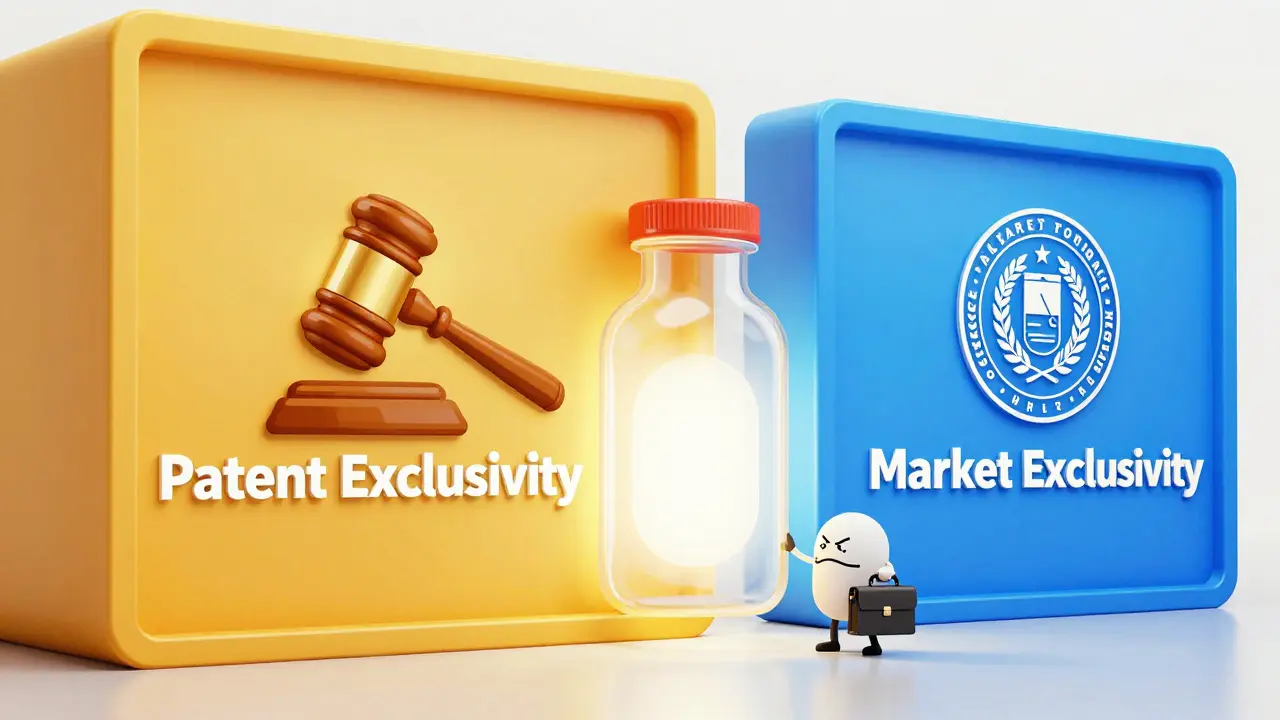
Imagine spending a decade and billions of dollars developing a life-saving drug, only to have a competitor launch a cheaper version the day you hit the market. That's the nightmare scenario every pharma company faces. To prevent this, the law provides two different types of "walls" to keep competitors out: patents and regulatory exclusivity. While they both aim to protect a company's investment, they are governed by different agencies, have different rules, and are enforced in completely different ways.
The core problem is that many people-and even some biotech startups-treat these two terms as interchangeable. They aren't. One is a legal right you have to sue someone in court, and the other is a regulatory rule that prevents the government from even approving a competitor's application. If you're navigating the patent timeline, understanding which "wall" is currently protecting your product is the difference between billions in revenue and a sudden market crash.
| Feature | Patent Exclusivity | Market Exclusivity |
|---|---|---|
| Governing Body | USPTO | FDA |
| Enforcement | Self-enforced (Lawsuits) | FDA-enforced (Approval denial) |
| Requirement | Novelty & Non-obviousness | Approval of the drug product |
| Standard Term | 20 years from filing | Varies (e.g., 5, 7, or 12 years) |
What Exactly is Patent Exclusivity?
When we talk about Patent Exclusivity is a legal right granted by the United States Patent and Trademark Office (USPTO) that allows an inventor to exclude others from making or selling an invention , we are talking about property rights. A patent isn't a permission slip to sell a drug; it's a sword you can use to stop others from doing so. Under the America Invents Act, this usually lasts for 20 years from the date you filed your application.
Here is the catch: the 20-year clock starts ticking long before the drug is actually approved. Because the average new drug takes 10 to 15 years to move through development and clinical trials, the actual time a company has a patent-protected product on the shelf is often only 10 to 12 years. To help with this, companies can use Patent Term Adjustment (PTA) for USPTO delays or Patent Term Extension (PTE) to recoup some of that lost time, though this is usually capped at 5 years.
Patents can cover many things. You might have a "composition of matter" patent (the strongest kind), which protects the actual chemical molecule. You might also have secondary patents covering the specific formulation, the way the drug is manufactured, or even a new method of using the drug to treat a different disease. This "layering" is sometimes called evergreening, and it's a common strategy to push back the date when generics can enter.
Understanding Market Exclusivity
While patents are about law and courts, Market Exclusivity is a period of time during which the FDA is prohibited from approving a competing version of a drug . This is governed by the Hatch-Waxman Act is the 1984 legislation that balanced pharmaceutical innovation with the need for affordable generic drugs .
The FDA doesn't care if your drug is "novel" in the way a patent office does. They care if you provided the clinical data necessary for approval. If you do, they grant you a period where no one else can ride on the back of your data to get their own drug approved. This is often called "data exclusivity." For a New Chemical Entity (NCE), this is typically 5 years. For Orphan Drugs, designed for rare diseases, it's usually 7 years. Biologics-which are much more complex than simple pills-get a massive 12-year window under the BPCIA.
The beauty of market exclusivity for a company is that the FDA does the heavy lifting. If a generic company tries to file an Abbreviated New Drug Application (ANDA) during this window, the FDA simply says "no" and rejects the application. There is no need for a million-dollar lawsuit; the regulator simply refuses to let the competitor in the door.
How These Two Work Together (The Dual-Key System)
Think of patents and exclusivity as two different locks on a door. To get a generic drug into the market, a competitor has to unlock both. If a drug has both a patent and regulatory exclusivity, the generic company must wait for the exclusivity to expire and either wait for the patent to lapse or prove in court that the patent is invalid.
Interestingly, you can have one without the other. About 5.2% of branded drugs have only regulatory exclusivity, while 38.4% have only patents. This leads to strange market situations. For example, a drug could be used for centuries (meaning it's not "novel" and cannot be patented), but if a company conducts new clinical trials and gets FDA approval, they can get market exclusivity. This happened with the drug colchicine, where the price jumped from 10 cents to nearly $5 a tablet because of regulatory exclusivity, despite there being no patent.
For the first generic company to successfully challenge a patent (via a Paragraph IV certification), the law gives them a 180-day period of market exclusivity. This is a huge incentive; that six-month window of being the only generic on the market can be worth hundreds of millions of dollars in revenue.
Common Pitfalls and Strategic Mistakes
Even pros mess this up. Small biotech firms often assume that having a patent automatically means they have market exclusivity. This is a mistake that can lead to millions in wasted development costs. Patents protect the invention; exclusivity protects the approved product.
Another issue is the "patent thicket." Companies often file dozens of secondary patents to extend their lead. However, generic manufacturers are getting better at challenging these in court. Because of this, regulatory exclusivity is becoming the more reliable "wall." Industry analysts suggest that by 2027, regulatory exclusivity will account for over half of the total market protection time for new drugs because it's harder to "sue away" an FDA rule than it is to invalidate a patent.
Finally, there's the risk of leaving money on the table. Data shows that about 22% of innovator companies fail to claim all the exclusivity they are entitled to-like the 6-month pediatric extension. This can result in losing over a year of monopoly pricing, which, for a blockbuster drug, represents a massive loss in potential revenue.
Can a drug be protected if the patent expires?
Yes. If the drug has regulatory market exclusivity (like NCE or Orphan Drug exclusivity), the FDA will not approve a generic competitor until that period ends, even if all the patents have expired. The protections run independently.
Who enforces patent exclusivity?
The patent holder does. Patents are not self-enforcing. If another company infringes on a patent, the owner must file a lawsuit in federal court to stop them.
What is the 180-day exclusivity?
This is a reward for the first generic company that successfully challenges a branded drug's patent. They get 180 days where no other generic versions of that drug can be approved, giving them a temporary monopoly over the generic market.
How long does New Chemical Entity (NCE) exclusivity last?
In the United States, NCE exclusivity typically lasts for 5 years from the date of approval. During this time, the FDA cannot accept an application for a generic version of the drug.
Does pediatric exclusivity add to the patent life?
It adds 6 months of marketing exclusivity to the existing protections (whether that's a patent or other regulatory exclusivity) if the company conducts requested pediatric studies.
What to Do Next
If you are a developer or investor in the pharma space, your first step should be checking the Orange Book is the FDA's official publication listing all approved drug products and their associated patents . This will tell you which patents are listed, but remember: it doesn't always show the regulatory exclusivity periods. For that, you need to use the FDA's Exclusivity Dashboard.
For generic manufacturers, the strategy is all about the "Paragraph IV" challenge. If you can prove a patent is invalid or not infringed, you can potentially enter the market early and snag that lucrative 180-day exclusivity window. But be prepared-these legal battles are expensive, often costing over $8 million per challenge.
Whether you're a small biotech or a giant pharma firm, the goal is the same: align your patent filing date with your clinical trial timeline so that your patent doesn't run out just as your drug is finally hitting the pharmacy shelves.
Caroline Duvoe
everyone knows this stuff already 🙄 just basic pharma 101