

When your doctor prescribes a medication, you might expect to walk out of the office and pick it up at the pharmacy. But sometimes, you’re told to wait-sometimes for days or even weeks-because your insurance company needs to approve it first. This is called prior authorization. It’s not a glitch. It’s not a mistake. It’s a standard step in how most health insurance plans in the U.S. control costs and ensure medications are used correctly.
What Is Prior Authorization?
Prior authorization, sometimes called pre-authorization or pre-certification, is when your health plan requires your doctor to get approval before they will pay for certain medications. It’s not about whether the drug works-it’s about whether your plan thinks it’s the right choice, at the right time, and at the right cost.The goal isn’t to block you from getting medicine. It’s to make sure you’re not prescribed something expensive or risky when a safer, cheaper alternative exists. For example, if you have high blood pressure and your doctor wants to prescribe a brand-name drug, your plan might require you to try a generic version first. If that doesn’t work, then the brand-name drug can be approved.
Medicare Part D calls this process a “coverage determination.” Private insurers like Cigna, Blue Shield, and UnitedHealthcare use the same system. According to the Academy of Managed Care Pharmacy, prior authorization helps ensure medications are “safe, effective for their condition, and provide the greatest value.” That means your plan isn’t just trying to save money-it’s trying to avoid bad outcomes, like dangerous drug interactions or unnecessary side effects.
Which Medications Usually Need Prior Authorization?
Not every prescription needs approval. But certain types of drugs almost always do:- Brand-name drugs with generic versions available - If a cheaper generic exists, your plan will usually require you to try it first.
- High-cost medications - Drugs that cost over $500 a month, like those for cancer, multiple sclerosis, or rare diseases, almost always require prior authorization.
- Drugs with strict usage rules - Some medications can only be used for specific conditions. For example, a drug approved for rheumatoid arthritis might be denied if your doctor prescribes it for back pain without proof it’s medically necessary.
- Drugs with abuse potential - Opioids, benzodiazepines, and certain stimulants are closely monitored to prevent misuse.
- Drugs that interact dangerously - If you’re already taking other medications, your plan may check for harmful combinations before approving a new one.
Some plans even limit who can prescribe certain drugs. For example, chemotherapy medications may only be approved if prescribed by an oncologist-not a general practitioner. This isn’t about gatekeeping; it’s about ensuring the person prescribing the drug has the right expertise to manage its risks.
How Does the Process Work?
The process starts with your doctor. Here’s how it usually goes:- Your doctor writes a prescription for a medication that requires prior authorization.
- They check your insurance’s formulary (the list of covered drugs) to see if prior auth is needed.
- If yes, they fill out a form-either online, by fax, or through an electronic system-with details about your diagnosis, why this drug is needed, and why alternatives won’t work.
- The form goes to your insurance company.
- The insurer reviews it, often within 24 to 72 hours for standard requests, or faster for urgent cases.
- If approved, your pharmacy gets the go-ahead. If denied, your doctor can appeal or suggest another drug.
The whole thing can take anywhere from a couple of days to a few weeks. If you’re in pain or your condition is worsening, your doctor can request an “urgent” review. In those cases, insurers are required to respond within 24 hours.
Once approved, the authorization doesn’t last forever. Most approvals expire after 30 to 90 days. That means if you need refills, your doctor may have to restart the process.
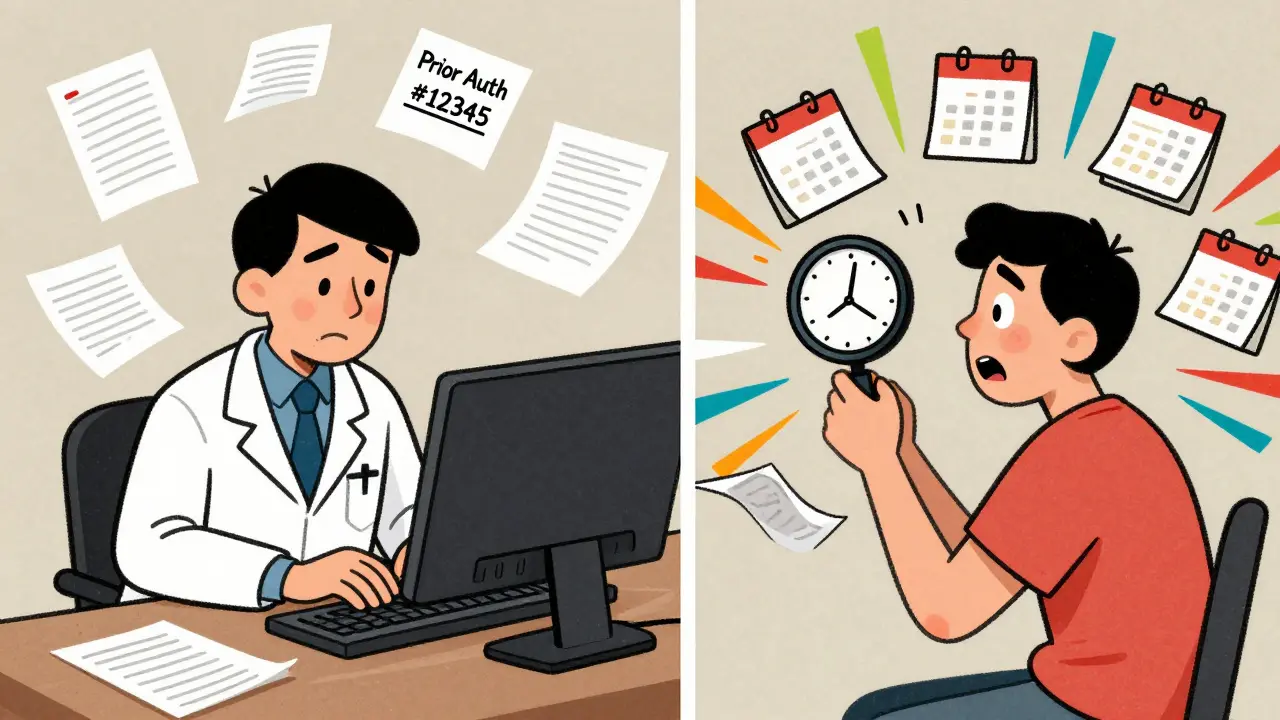
What Happens If It’s Denied?
A denial doesn’t mean you can’t get the drug. It just means your insurance doesn’t think it meets their criteria yet. Your doctor can file an appeal. That means they submit more evidence-lab results, specialist notes, even published studies-to prove the drug is medically necessary.Some patients try to pay out-of-pocket and get reimbursed later. But that’s risky. If the prior auth is denied, you might not get your money back. It’s better to work with your doctor to find a solution before you fill the prescription.
For off-label uses-when a drug is prescribed for a condition it wasn’t officially approved for-the bar is even higher. Your doctor must provide strong clinical evidence. Some plans even assign a pharmacist to review medical literature to support the request.
How Can You Speed Things Up?
You’re not powerless in this process. Here’s what you can do:- Ask your doctor at the appointment - Don’t wait until you get to the pharmacy. Ask: “Does this drug need prior authorization?”
- Check your plan’s formulary - Most insurers have a website where you can search your drug and see if it needs approval. Blue Shield of California, for example, offers a “Price Check My Rx” tool.
- Call your insurance - Use the number on your member card. Ask if the drug is covered, if prior auth is needed, and how long it usually takes.
- Follow up with your doctor’s office - A week after the prescription is sent, call and ask if the request was submitted. Sometimes it gets lost in the mail or delayed in the system.
- Ask about alternatives - If your drug is denied, ask your doctor: “Is there another drug on the formulary that might work just as well?”
Some pharmacies offer cash prices that are cheaper than your insurance copay-especially for brand-name drugs. GoodRx and other price-comparison tools can help you find those deals.
When Is Prior Authorization Not Required?
There are exceptions. If you’re having an emergency, your insurance must cover the medication right away-even if it normally requires prior authorization. The same applies to short-term prescriptions (usually 30 days or less) for acute conditions like infections or pain flares.Also, if you’re already taking a drug that needs prior auth and you’ve been approved before, your plan may auto-renew the authorization for a few months-unless your doctor changes the dose or the reason for the prescription.

Why Do Insurance Companies Use This System?
It’s easy to think prior authorization is just a way for insurers to say no. But the data shows it works. A 2023 study from the American Medical Association found that prior authorization reduces unnecessary prescriptions by up to 30% for high-cost drugs. It also cuts down on dangerous drug combinations and hospitalizations caused by inappropriate use.For example, a patient with depression might be prescribed a brand-name antidepressant that costs $400 a month. But a generic version, at $15, works just as well. Prior authorization ensures the cheaper option is tried first-saving the plan money and the patient from unnecessary costs.
Still, doctors say the system is broken. The American Medical Association reports that physicians spend an average of 15 hours a week on prior authorization paperwork. That’s time they could be spending with patients.
What’s Changing?
There’s growing pressure to fix the system. Some states now require insurers to respond to prior auth requests within 24 hours for urgent cases. Others are pushing for electronic systems that auto-approve drugs with clear clinical guidelines-like generics or standard treatments.Medicare Part D has started allowing automatic approvals for certain drugs if the patient has been on them for over a year. And some insurers are testing AI tools that can auto-approve requests based on real-time data from electronic health records.
But until those changes become widespread, you’ll still need to be proactive. Prior authorization isn’t going away. But you can make it work for you.
What to Do Next
If you’re about to start a new medication:- Ask your doctor if it needs prior authorization.
- Check your insurance website or call customer service.
- Ask if there’s a cheaper alternative that’s covered.
- Keep a copy of the prescription and the prior auth approval number.
- Follow up with your doctor’s office if you haven’t heard back in 3 business days.
Don’t assume your doctor will handle everything. You’re the one taking the medication. You’re the one paying the bill-whether through premiums, copays, or out-of-pocket costs. Be your own advocate.
What happens if my prior authorization is denied?
If your prior authorization is denied, your doctor can file an appeal. They’ll need to submit more medical evidence-like test results or specialist notes-to prove the drug is necessary. You can also ask your insurance for a written explanation of the denial. In some cases, your doctor may switch you to a different drug that’s already approved. Don’t stop taking your medication without talking to your doctor first.
Can I pay out-of-pocket instead of waiting for approval?
Yes, you can pay for the medication yourself and submit a claim for reimbursement after approval. But this carries risk. If the prior auth is denied, you may not get your money back. It’s better to confirm coverage first. Some pharmacies offer cash prices lower than your insurance copay-use tools like GoodRx to compare prices before paying.
How long does prior authorization take?
Standard requests usually take 2 to 5 business days. Urgent requests-like for life-threatening conditions or severe pain-must be reviewed within 24 hours. If you haven’t heard back after 5 days, call your doctor’s office to confirm the request was submitted. Delays often happen because paperwork is missing or the insurer needs more information.
Do all insurance plans require prior authorization?
Most do-especially commercial insurers like Cigna, UnitedHealthcare, and Blue Shield, as well as Medicare Part D. Medicaid plans vary by state. Some small or short-term plans may not use prior authorization, but they’re rare. If your plan covers prescription drugs, it’s likely they use prior auth for some medications.
Can I get prior authorization for an off-label drug use?
Yes, but it’s harder. Off-label use means prescribing a drug for a condition it wasn’t officially approved for by the FDA. Your doctor must provide strong clinical evidence-like peer-reviewed studies or guidelines from medical associations. Some plans even assign a pharmacist to review the medical literature. Approval isn’t guaranteed, but it’s possible with solid documentation.
Does prior authorization apply to emergency medications?
No. If you’re in an emergency, your insurance must cover the medication immediately-even if it normally requires prior authorization. This includes drugs for heart attacks, severe allergic reactions, or acute infections. Coverage details still apply (like network rules), but the prior auth requirement is waived in true emergencies.
Dan Alatepe
Bro. Prior auth is like dating in 2007. You text, they ghost, then you get a 3-page essay on why you’re not ‘aligned’ with their formulary. I waited 11 days for my migraine med. My doctor called it ‘a bureaucratic tango with a spreadsheet.’ I just cried into my GoodRx coupon. 😭
Angela Spagnolo
Okay, so... I just want to say... I’ve been through this... like... six times... and I’m not mad... I’m just... disappointed...? It’s not that I don’t get it... it’s just... why does it have to feel like begging for oxygen? 🤔
Sarah Holmes
Let me be perfectly clear: this system is not ‘cost control.’ It is institutionalized medical malpractice disguised as fiscal responsibility. The fact that physicians are forced to become insurance clerks is a moral failure of the highest order. You are not saving money-you are sacrificing human dignity for quarterly earnings reports. And yes, I am furious.
Jay Ara
my doc told me to ask about generics before he even writes the script. saved me $300 last month. just ask. its not hard. they got cheaper stuff that works just fine. dont stress, its not a conspiracy, just bad system. you got this 💪
Michael Bond
Just ask your doctor if it needs auth. Do it at the appointment. Simple.
Kuldipsinh Rathod
my cousin in delhi had to wait 3 weeks for his insulin. insurance said ‘try metformin first’ but he’s type 1. they didn’t even read his chart. this ain’t just usa problem. broken everywhere.
SHAKTI BHARDWAJ
Oh please. You think this is about ‘safety’? lol. its about profit. if generics were so great why do pharma companies pay insurers to block them? this is corporate greed with a side of bureaucracy. i’ve seen it. i’ve cried. i’ve screamed. no one cares. #priorauthisacrime
Matthew Ingersoll
In Nigeria, prior authorization is handled by a guy with a clipboard and a smile. In the U.S., it’s a 17-step digital labyrinth guarded by AI bots trained on 1998 insurance manuals. We’re not fixing healthcare. We’re automating absurdity.
carissa projo
I remember when my son needed a biologic for his autoimmune condition. The paperwork felt like climbing Everest in flip-flops. But here’s what saved us: we kept a folder. Every email. Every fax confirmation. Every note from the nurse. We didn’t just wait-we documented. And when it was denied, we didn’t beg. We brought evidence. Like a detective. Like warriors. You can do this. You are not alone.
josue robert figueroa salazar
Doctors are lazy. They don’t check formularies. They just write scripts. Then they blame insurance. Wake up. You’re the one who didn’t do your homework. Stop whining.
david jackson
Think about it: every time you get denied, you’re not just fighting insurance-you’re fighting the entire capitalist architecture of American medicine. It’s not a glitch. It’s a feature. Prior authorization is the choke point where profit meets pathology. They don’t want you to get better. They want you to stay alive just long enough to keep paying premiums. I’ve seen the spreadsheets. I’ve seen the algorithms. They don’t care if you’re in pain. They care if the cost-per-outcome ratio dips below 0.87. This isn’t healthcare. It’s actuarial theater. And we’re all extras.
Jody Kennedy
Just got approved for my arthritis med after 14 days! Took a stack of notes, a letter from my rheum, and one very polite but firm email to the insurer’s CEO (yes, I found it on LinkedIn). You think you’re powerless? You’re not. Show up. Speak up. Don’t let them bury you in paperwork.
christian ebongue
My doctor submitted the form. Insurance said ‘missing diagnosis code.’ He resubmitted. They said ‘wrong ICD-10 version.’ He called. They said ‘check your portal.’ Portal says ‘processing.’ It’s been 9 days. I’m just here, waiting for my life to start again. 🤷♂️