
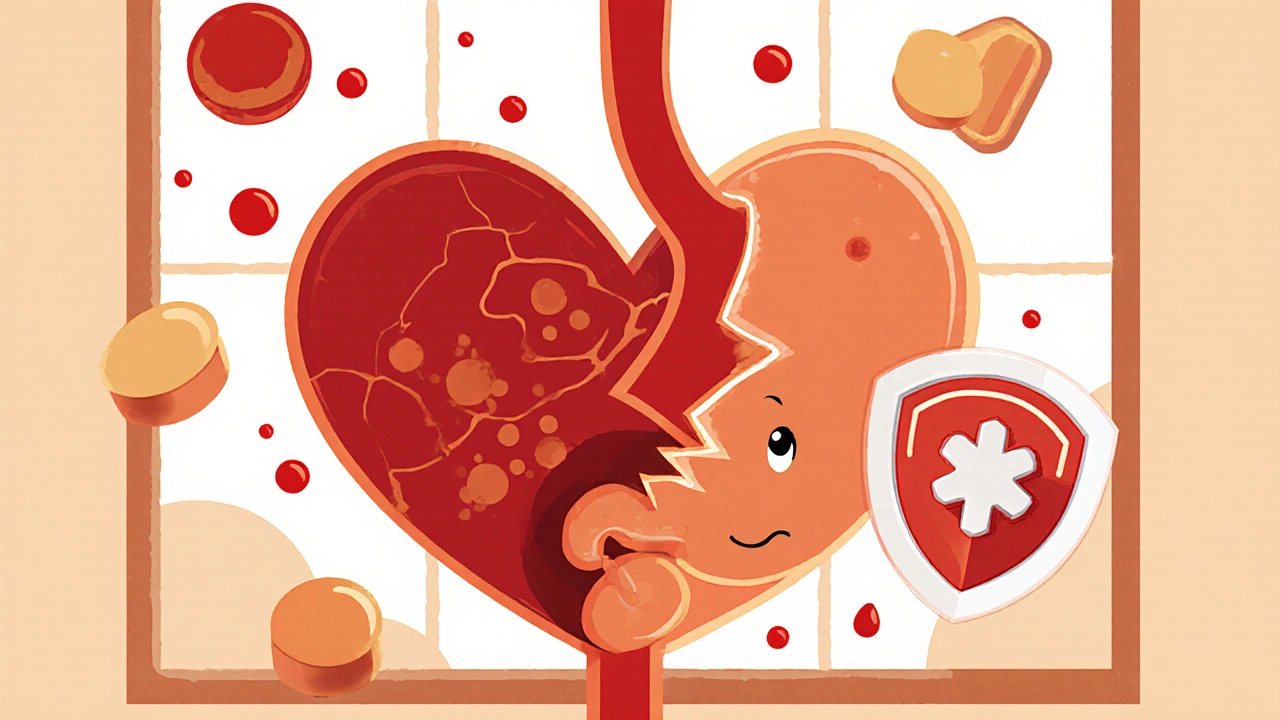
When you’re on dual antiplatelet therapy - usually aspirin plus clopidogrel, prasugrel, or ticagrelor - your blood doesn’t clot as easily. That’s good for preventing heart attacks and strokes. But it also means your stomach lining is more vulnerable. Every year, tens of thousands of people on these drugs suffer gastrointestinal (GI) bleeds. Many don’t even see it coming. The good news? Adding a proton pump inhibitor (PPI) can cut that risk by nearly half. The bad news? Too many doctors either overprescribe or underprescribe them - and patients are caught in the middle.
Why GI Bleeds Happen with Antiplatelets
Aspirin and other antiplatelet drugs don’t just thin your blood. They also weaken the natural defenses of your stomach lining. Your stomach makes acid to digest food, but it also has a thick mucus layer to protect itself. Aspirin disrupts that layer. Add in another antiplatelet like clopidogrel, and the damage multiplies. Studies show that within the first 30 days of starting dual therapy, your risk of a serious GI bleed jumps by 30% to 50%. The older you are, the higher the risk. If you’ve had a bleed before, or if you’re taking NSAIDs like ibuprofen or steroids, your chances go up even more.It’s not rare. In fact, one in every 25 people on dual antiplatelet therapy will have a major GI bleed within a year if they don’t get protective medication. That’s why guidelines now say: if you’re at risk, you need a PPI.
What PPIs Do - and Why They Work
Proton pump inhibitors like omeprazole, esomeprazole, and pantoprazole work by shutting down the acid pumps in your stomach. They don’t just reduce acid - they cut it by 70% to 98%. Less acid means less irritation to your damaged stomach lining. That’s enough to prevent ulcers and bleeds.Multiple large studies confirm this. The COGENT trial, published in JAMA in 2010, found that adding a PPI to aspirin and clopidogrel cut GI bleeding by 34%. More recent data from Korea in 2025 tracked over 96,000 stroke patients on dual therapy. Those taking a PPI had a 37% lower risk of serious GI bleeding over 12 months. The numbers don’t lie: PPIs work.
Not All PPIs Are Created Equal
Here’s where things get tricky. Not every PPI plays nice with your antiplatelet drugs. Omeprazole and esomeprazole are both powerful acid blockers, but omeprazole interferes with clopidogrel. It blocks an enzyme called CYP2C19 that your body needs to turn clopidogrel into its active form. Studies show this can reduce clopidogrel’s effectiveness by up to 30%. That’s dangerous - it could mean a higher risk of heart attack or stroke.Pantoprazole and esomeprazole don’t do this. They barely touch CYP2C19. So if you’re on clopidogrel, pantoprazole is the safest pick. If you’re on ticagrelor or prasugrel - which don’t rely on CYP2C19 - then esomeprazole is fine. Omeprazole? Avoid it unless there’s no other option.
And don’t confuse PPIs with H2 blockers like famotidine. They’re weaker. A 2017 meta-analysis showed PPIs cut GI bleeding risk by 60%, while H2 blockers only managed 30%. If you’re going to protect your stomach, go with the strongest tool.
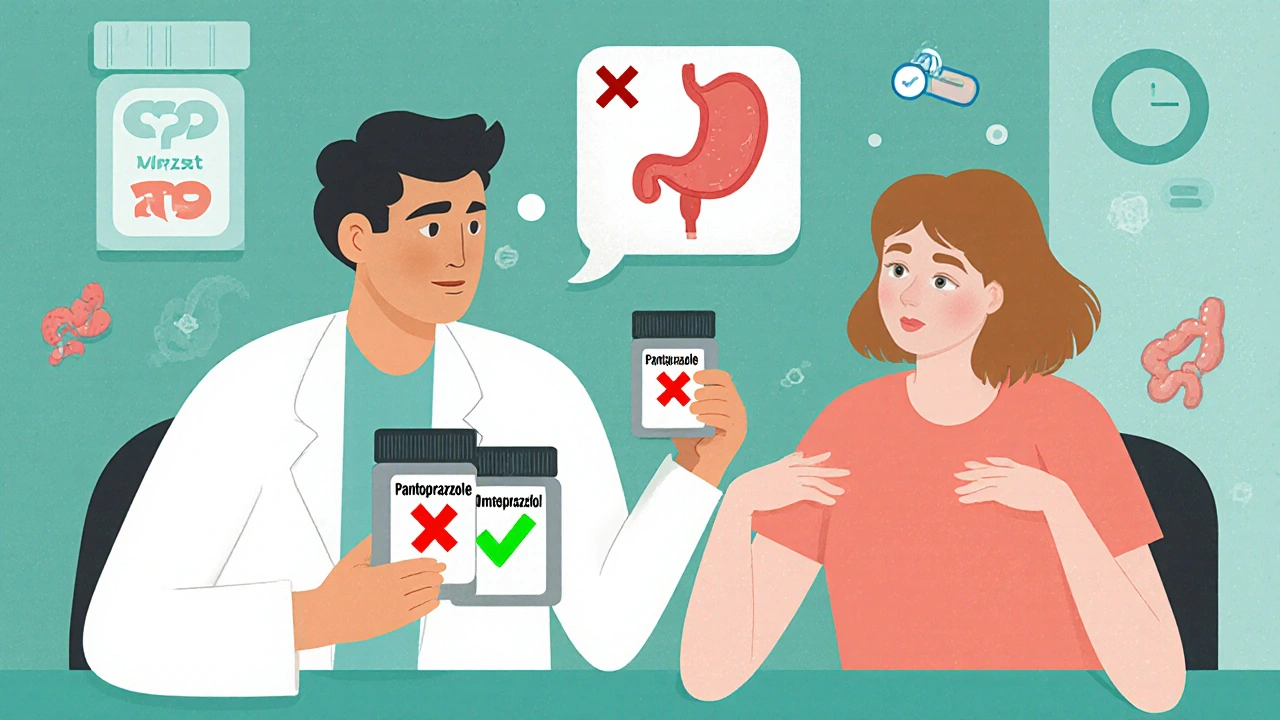
Who Really Needs a PPI?
This isn’t for everyone. The 2023 European Society of Cardiology guidelines say: give PPIs to patients with at least two of these risk factors:- Age 65 or older
- History of GI bleeding or ulcers
- Taking anticoagulants (like warfarin or apixaban)
- Using NSAIDs or steroids
If you’re under 65, have no prior bleeding, and aren’t on other risky meds, you probably don’t need a PPI. Yet, a 2022 study found that 40% of low-risk patients were still getting them. That’s overprescribing - and it comes with its own dangers.
The Hidden Risks of Taking PPIs Too Long
PPIs are safe for short-term use. But if you take them for years without reason, you open yourself up to problems:- C. diff infection: Risk goes up by 0.5%. Not huge, but serious when it hits.
- Community-acquired pneumonia: Risk increases by 0.8%.
- Chronic kidney disease: Long-term use is linked to a 20% higher risk.
- Bone fractures: FDA warns about this with high-dose, long-term use.
And here’s the kicker: a 2024 FDA safety alert flagged a possible link to higher dementia risk with chronic use. But a 2025 JAMA study using genetic data found no causal connection. The truth? We still don’t fully understand the long-term effects. That’s why guidelines say: use the lowest dose for the shortest time needed.
How Long Should You Take a PPI?
Most patients on dual antiplatelet therapy only need PPIs for 6 to 12 months. That’s because the highest risk of GI bleeding is in the first month, and it drops sharply after three months. After that, your stomach often adapts, and the bleeding risk falls back toward baseline.Some patients - like those with a history of severe ulcers or multiple risk factors - may need longer. But there’s no reason to stay on a PPI for five years just because you started one after a stent. Ask your doctor: “Is this still necessary?”
What About Cost and Access?
PPIs are cheap. Pantoprazole and omeprazole generics cost less than $5 a month in most places. Even esomeprazole is affordable. And the cost savings are real: preventing one GI bleed saves an estimated $1,200 per patient per year in hospital bills, tests, and procedures.But here’s the problem: many doctors don’t know the guidelines. A 2022 survey found 45% of cardiologists were unsure who should get a PPI. And patients? They’re scared of taking more pills. One study found 30% of patients stopped their PPI because they thought it was unnecessary - even when they were high risk.
That’s why clear communication matters. If your doctor prescribes a PPI, ask: “Why me? What’s my risk? Which one should I take? How long?”
The Future: Better Tools Coming
A new drug called vonoprazan is on the horizon. It’s not a PPI - it’s a potassium-competitive acid blocker. It works faster, stronger, and doesn’t interfere with clopidogrel at all. It’s already approved in Japan and South Korea. The FDA is reviewing it for U.S. use in late 2025.Meanwhile, researchers are looking at genetic testing. Some people have a CYP2C19 gene variant that makes clopidogrel less effective. If you’re one of them, you might need a different antiplatelet - or a different PPI. By 2027, we could see genotype-guided prescriptions become routine.
What You Should Do Right Now
If you’re on aspirin plus clopidogrel, prasugrel, or ticagrelor:- Ask your doctor if you’re at risk for GI bleeding. Use the two-risk-factor rule: age 65+, prior bleed, anticoagulants, NSAIDs, or steroids.
- If you are at risk, ask for pantoprazole 40 mg daily - not omeprazole.
- If you’re on ticagrelor or prasugrel, esomeprazole is fine.
- Set a reminder to review your PPI use in 6 to 12 months. Don’t just refill it automatically.
- If you’re low risk and on a PPI, ask if you can stop it.
This isn’t about taking more pills. It’s about taking the right ones - at the right time - for the right reason. GI bleeds are scary. But they’re preventable. With the right PPI, you protect your stomach without hurting your heart.
Can I take omeprazole with clopidogrel?
It’s not recommended. Omeprazole blocks the enzyme CYP2C19, which your body needs to activate clopidogrel. This can reduce clopidogrel’s effectiveness by up to 30%, raising your risk of heart attack or stroke. Use pantoprazole or esomeprazole instead if you need a PPI with clopidogrel.
How long should I take a PPI with antiplatelets?
Most patients only need a PPI for 6 to 12 months. The highest risk of GI bleeding is in the first 30 days after starting dual therapy. After that, the risk drops. If you have no history of ulcers or bleeding, ask your doctor about stopping the PPI after a year. Don’t keep taking it just because you started it.
Are PPIs safe for long-term use?
Short-term use (under 12 months) is very safe. Long-term use (over a year) carries small but real risks: increased chance of C. diff infection, pneumonia, kidney disease, and bone fractures. The FDA has flagged possible links to dementia, but recent studies haven’t confirmed a direct cause. Only take PPIs long-term if your doctor confirms you still need them.
Can I use famotidine instead of a PPI?
Famotidine (an H2 blocker) is less effective than PPIs at preventing GI bleeds. Studies show PPIs reduce bleeding risk by 60%, while H2 blockers only cut it by 30%. If you’re at high risk, H2 blockers aren’t enough. Stick with pantoprazole or esomeprazole.
Do I need a PPI if I’m on ticagrelor or prasugrel?
You still need one if you’re at high risk for GI bleeding - but you have more flexibility. Ticagrelor and prasugrel don’t rely on CYP2C19, so omeprazole won’t interfere with them. Still, pantoprazole and esomeprazole are preferred because they’re proven safe and effective. The goal is protection without compromising your heart therapy.
Pranab Daulagupu
PPIs with dual antiplatelets? Classic case of balancing life-saving meds with silent side effects. Pantoprazole over omeprazole for clopidogrel users-CYP2C19 inhibition is real, and it’s not worth the stroke risk. 40mg daily for 6–12 months max. Done.
Barbara McClelland
Love this breakdown! So many people just keep taking PPIs forever like they’re vitamins. 🙌 Seriously, if you’re under 65 and no history of ulcers, ask your doc if you can taper off. I did-and my stomach thanked me. No more bloating, no more ‘is this pill necessary?’ guilt. You got this!
Alexander Levin
Big Pharma’s latest money grab. 😏 PPIs cause kidney failure, dementia, bone loss… but hey, at least your heart won’t stop. They don’t want you to know the real fix: stop aspirin. 🤫
Ady Young
Just had this exact convo with my cardiologist last week. I’m on ticagrelor + aspirin, 58, no prior GI issues. He said I didn’t need a PPI-and I was relieved. But I still asked about pantoprazole just in case. Turns out, if you’re low-risk, the risks of the PPI outweigh the benefits. Good to know.
Travis Freeman
As someone from a country where people still think ‘stomach acid = bad’ and pop antacids like candy, this is gold. 🙏 The fact that PPIs aren’t one-size-fits-all is so important. And the CYP2C19 thing? Mind blown. I’ll be sharing this with my uncle who’s on clopidogrel. Thanks for making this clear.
Sean Slevin
So… we’re told to take a drug to prevent a side effect of another drug… which might cause… other side effects… which may or may not be real… depending on whether the study was funded by a pharma company… and we’re supposed to trust this system? I mean… the fact that we’re even having this conversation… is the problem. 🤔 Maybe we should just… eat less spicy food? And stop taking aspirin? …Wait. No. That’s worse. 😅
Chris Taylor
My dad took omeprazole with clopidogrel for two years. Had a mini-stroke last year. Docs said it might’ve been the interaction. He’s on pantoprazole now. Scary stuff. Don’t assume it’s safe just because it’s over the counter.
Melissa Michaels
Guidelines are clear: two risk factors warrant PPI therapy. The 2023 ESC criteria are evidence-based and practical. Overprescribing leads to unnecessary adverse events. Underprescribing leads to preventable hemorrhage. Precision is key. Patients should be counseled on duration and alternatives. H2 blockers are inadequate for high-risk populations. PPIs remain first-line. Discontinuation should be planned, not accidental.
Nathan Brown
It’s fascinating how we’ve turned medicine into a multi-layered puzzle where every solution creates a new problem. We block acid to protect the stomach, but then we risk kidney disease, pneumonia, even dementia. We choose between bleeding and brain fog. And the real tragedy? Most patients don’t even know they’re choosing. We treat symptoms, not systems. We give pills for pills. Maybe the real question isn’t which PPI to use… but why we’re putting people in this position at all. 🤯