
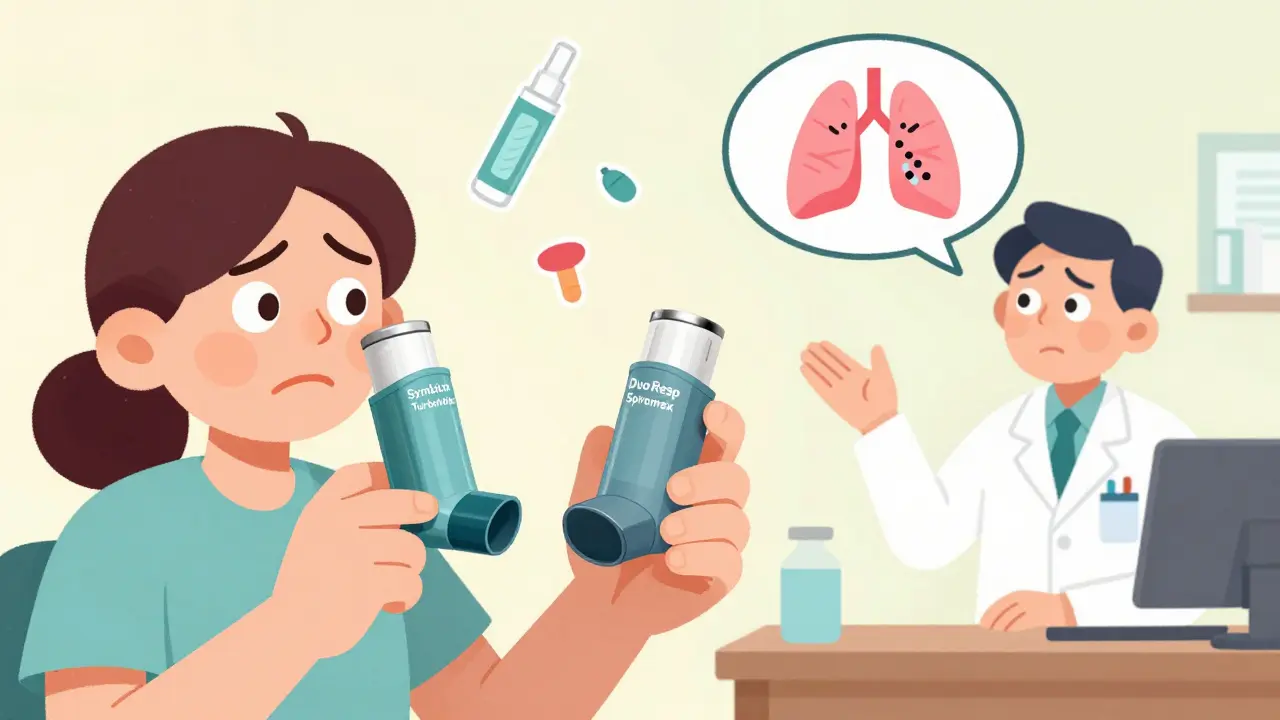
When you're managing asthma or COPD, your inhaler isn't just a tool-it's your lifeline. But what happens when your pharmacy swaps your branded inhaler for a cheaper generic version without warning? It sounds simple: same drugs, lower price. But with respiratory combination inhalers, the device itself is just as important as the medicine inside. And that’s where things get risky.
Why Inhalers Aren't Like Pills
Take a pill. Swallow it. The body absorbs it. Simple. Generic versions of pills work because they contain the same active ingredients in the same amounts. But with inhalers, especially combination ones that deliver both a corticosteroid and a long-acting beta agonist (like budesonide and formoterol), it's not just about what’s inside-it’s about how it gets there.There are three main types of inhalers: pressurized metered-dose inhalers (pMDIs), dry powder inhalers (DPIs), and nebulizers. Each requires a different breathing technique. A pMDI needs perfect timing-you press the canister and breathe in slowly at the same time. A DPI? You have to inhale hard and fast to pull the powder into your lungs. Get it wrong, and you might as well be breathing air.
That’s why switching from a Symbicort Turbohaler to a generic DuoResp Spiromax isn’t like switching from brand-name ibuprofen to store-brand. The Turbohaler uses a twisting motion to load the dose. The Spiromax uses a side slider. One requires a slow, steady breath. The other demands a sharp, forceful one. If you don’t know the difference, you’re not getting your full dose. A 2020 study found that 76% of patients switched without proper training used the new device incorrectly. That’s not a small risk-it’s a public health issue.
The Global Divide in Substitution Rules
Different countries handle this differently-and the differences matter.In the United States, the FDA says if a generic inhaler is approved, it should work the same way as the brand-name version. You shouldn’t need extra training. But that’s not what happens in real life. A 2022 survey found only 28% of U.S. community pharmacies consistently train patients when switching inhalers. Time is tight. Staff are stretched. And patients? They often assume the new inhaler works the same.
Meanwhile, in Europe, regulators are far more cautious. The European Medicines Agency (EMA) requires proof that the generic inhaler delivers the same amount of medicine to the lungs as the original. That means clinical studies-not just chemical tests. They also say the device must be identical in design and operation. Even then, they recommend that substitutions be done with patient consent and proper instruction.
The UK’s NICE guidelines are even clearer: switching inhaler devices without a consultation can worsen asthma control. And they’re not guessing. Studies show patients switched without training had a 22% higher rate of asthma attacks within six months. In Australia, where guidelines follow global best practices, pharmacists are encouraged-but not required-to provide device-specific counseling. That leaves a big gap.
What Patients Are Saying
Real people are feeling the impact.On Reddit’s r/asthma community, 83% of the 82 people who shared their stories said their symptoms got worse after being switched to a generic inhaler without warning. One user wrote: “I didn’t know I had to breathe harder. My inhaler felt broken. I ended up in the ER.”
A 2022 survey by Asthma UK of over 1,200 people found that 57% felt confused after a device switch. One in three had visited an emergency department within three months. On Drugs.com, Symbicort Turbohaler has a 6.2/10 rating from over a thousand reviews. DuoResp Spiromax? Just 4.8/10. Common complaints: “Harder to use,” “Feels less effective,” “No one told me how to use it.”
But here’s the flip side: when patients get proper training, outcomes improve dramatically. One 2022 study showed that 89% of people using generic inhalers correctly had received hands-on instruction from a pharmacist or nurse. That’s the key difference-not the drug. The device. The teaching.

The Hidden Cost of Cheap Substitution
It’s tempting to think generics save money. And they do-at the pharmacy counter.But when patients use inhalers wrong because they weren’t trained, they end up in emergency rooms, hospitals, or needing rescue medications. A 2023 report estimated that inappropriate inhaler substitution costs healthcare systems $1.2 billion a year in avoidable hospital visits and extra treatments. That’s more than the total savings from switching to generics.
And it’s not just about money. It’s about trust. When your asthma flares up after a switch you didn’t agree to, you lose confidence in your treatment. You start doubting your inhaler. Your doctor. The system.
Meanwhile, the market is shifting. By 2027, nearly half of all respiratory combination inhalers will face generic competition. That means more switches. More confusion. More risk-if we don’t fix how we handle them.
What Should You Do?
If you use a combination inhaler, here’s what you need to know:- Ask if your inhaler has changed. Don’t assume. Check the name on the box. If it’s different, ask why.
- Request a demonstration. Ask your pharmacist or nurse to show you how to use the new device. Don’t just watch-do it yourself. Say, “Can I try it?”
- Use the teach-back method. After they show you, explain back how you’ll use it. “So I slide this, then breathe in hard, then hold for five seconds?” If you’re unsure, ask again.
- Track your symptoms. If your breathing gets worse, your rescue inhaler use increases, or you wake up at night coughing, it’s not “just a bad week.” It could be your inhaler technique.
- Speak up about device preference. If your doctor prescribes a specific brand, you have the right to ask why. And if you’re happy with your current device, you can request it stays the same.
Doctors and pharmacists need to do their part too. The American Association for Respiratory Care recommends a “teach-back” method-where patients repeat the steps-to boost correct technique from 35% to 82%. But only 43% of GPs in one study could even demonstrate both Turbuhaler and Spiromax techniques correctly without training. That’s a system failure.

The Way Forward
The good news? Solutions exist.Germany requires pharmacists to give 15 minutes of in-person counseling for first-time inhaler users. Norway has a 62% generic substitution rate-because they pair it with structured education. The Global Asthma Network found that healthcare systems with formal inhaler training programs saw a 41% drop in substitution-related emergencies.
Technology is helping too. Smart inhalers with sensors (like Propeller Health) can track how you use your device and send feedback to your phone. A 2022 study showed that when patients got real-time technique alerts, their asthma exacerbations dropped by 33%.
And guidelines are catching up. GINA’s 2023 update now says: “Device familiarity and correct technique should be prioritized over generic substitution.” The European Respiratory Society recommends prescribing by brand name to avoid confusion. Even the FDA is updating its guidance, requiring more clinical evidence for approval.
This isn’t about resisting generics. It’s about using them safely. Medicine shouldn’t be a guessing game. Your lungs can’t afford it.
Can I switch my respiratory inhaler without telling my doctor?
No, you shouldn’t. Even if your pharmacy switches your inhaler automatically, you should always inform your doctor. Combination inhalers aren’t like pills-changing the device can change how well the medicine works. Your doctor needs to know if your symptoms change after a switch so they can adjust your treatment or retrain you on the new device.
Are generic inhalers less effective than brand-name ones?
Not necessarily-but they can be if you’re not using them right. The active ingredients in generic inhalers are the same. But if the device works differently-like a different loading mechanism or breathing requirement-you might not get the full dose. Studies show patients who switch without training are more likely to have asthma attacks. With proper instruction, generics work just as well.
Why do some inhalers require a hard breath and others a slow one?
It depends on the device type. Dry powder inhalers (DPIs) like Turbuhaler and Spiromax need a fast, strong breath to lift the powder into your lungs. Pressurized metered-dose inhalers (pMDIs) work with a slow, steady breath because the medicine is sprayed as a mist. Mixing up the technique means the medicine lands in your mouth or throat instead of your lungs-where it’s useless and can cause side effects like thrush.
How can I tell if I’m using my inhaler correctly?
There are a few signs. If you’re coughing right after using it, the medicine is hitting your throat. If your symptoms aren’t improving, or you’re using your rescue inhaler more often, your technique may be off. The best way to know? Ask your pharmacist to watch you use it. Or use a smart inhaler with feedback. The teach-back method-where you explain how you’ll use it-is the most reliable way to check.
Is there a legal right to keep my current inhaler brand?
In most places, pharmacists can substitute generic inhalers unless your doctor writes “dispense as written” or “do not substitute” on the prescription. But you have the right to refuse the substitution. You can say, “I’d like to stay on my current device.” If your insurance pushes for a cheaper option, ask your doctor to support your request. Your health comes first.
Charles Barry
This is pure corporate greed disguised as cost-saving. They don't care if you choke on your own breath as long as the stock price goes up. The FDA? A puppet of Big Pharma. They approve these generics based on lab tests while real people are gasping in ERs. It's not a coincidence that the worst outcomes happen in the US - where profit trumps life. Someone's making millions off this, and it's not you.
And don't even get me started on the 'teach-back' nonsense. You think a pharmacist with 3 minutes between customers is gonna show you how to use a device? That's like asking a cashier to teach you how to defuse a bomb. They don't know. They don't care. They just scan the barcode and move on.
They're turning asthma into a lottery. You get lucky? You live. You get the wrong inhaler? You die quietly in your sleep. And the system calls it 'efficiency.'
Wake up. This isn't healthcare. It's a death-by-clipboard experiment.
They'll replace your oxygen mask with a sticker next.
Rosemary O'Shea
Oh, darling, this is exactly why I refuse to let my insurance dictate my treatment. I’ve been on Symbicort since 2018 - same device, same routine. When they tried to switch me to that awful Spiromax monstrosity? I went straight to my pulmonologist and said, 'No.' I have the right to my breath, and I’m not letting some pharmacist with a quota decide what I inhale.
And the fact that Americans think 'FDA-approved' means 'safe'? Honey, that’s not science, that’s marketing. The EMA doesn’t just look at chemical composition - they test how the drug behaves in real lungs. The FDA? They look at a vial and say, 'Looks similar.'
It’s not about generics being bad. It’s about treating a precision medical device like a can of soup. You wouldn’t swap a Ferrari engine for a knockoff and say, 'It’s still petrol.' Why do it with your lungs?
And if your doctor doesn’t know the difference between a Turbohaler and a Spiromax? Find a new one. Your life isn’t a cost center.
Candy Cotton
The American healthcare system is not broken - it is functioning exactly as designed: to maximize efficiency while minimizing liability. The FDA's approval process for generic inhalers is rigorous, science-based, and legally defensible. The problem lies not with regulation, but with implementation - and the failure of frontline providers to educate patients.
Comparing U.S. practices to European models is misleading. The EMA’s requirements are not superior; they are merely more bureaucratic. The U.S. system achieves equivalent therapeutic outcomes with lower administrative overhead - if clinicians do their job.
Blaming pharmaceutical policy for poor patient education is like blaming the manufacturer when a driver crashes because they didn’t read the manual. The solution is not to restrict substitution - it is to mandate continuing education for pharmacists and incentivize adherence counseling.
Stop romanticizing foreign systems. We have the tools. We just need to use them.
Jeremy Hendriks
Here’s the uncomfortable truth no one wants to admit: we’ve outsourced our responsibility to machines and corporations. We treat our bodies like software - upgrade when cheaper, don’t bother reading the changelog.
The inhaler isn’t the problem. The problem is the illusion that health can be commodified without consequence. We’ve turned breathing into a transaction. You pay for a pill, you get a device - no context, no care, no ceremony.
But lungs don’t care about cost-per-unit. They care about rhythm. They care about trust. They care about the quiet, deliberate act of inhaling - something no algorithm, no barcode, no corporate memo can replicate.
When you lose your breath, you don’t lose money. You lose time. You lose control. You lose the sense that your body still belongs to you.
That’s the real cost. Not the $1.2 billion. The silence after the cough. The fear before the next attack. The moment you realize you’ve been handed a tool… and no one taught you how to hold it.
Tarun Sharma
Thank you for this well-researched piece. In India, access to inhalers is limited, and generics are often the only option. However, patient education remains a critical gap. Many patients receive inhalers without any demonstration, leading to poor outcomes. Training programs, even brief ones, can drastically improve adherence and efficacy. I urge healthcare providers to prioritize device instruction, regardless of cost.
Generic substitution is not inherently wrong - but it must be accompanied by responsibility.
Gabriella da Silva Mendes
Okay but like… why is this even a thing?? 😩 I got switched to some random generic and I swear my inhaler felt like it was made of plastic and regret. I was like ‘is this broken?’ and then I found out it’s just… different?? No one told me!! I almost went to the ER because I thought I was dying. Like, I didn’t even know you had to BREATHE HARD for some?? Who designs this??
Also why does the new one look like a toaster?? 🤡
And now my insurance is like ‘oh we saved $20!’ - bro I spent $300 in ER copays and anxiety. Not worth it. 😭
Also my dog started barking at me after I used it. Coincidence? I think not. 🐶💨
Jim Brown
There is a profound metaphysical dimension to this crisis: the inhaler is not merely a medical device - it is a ritual object. The act of inhaling medication is a sacred exchange between body and medicine, mediated by design. When that design changes without ceremony, without reverence, without instruction - we sever a thread of trust that cannot be easily rewoven.
Modern medicine has forgotten that technology is not neutral. A Turbohaler does not merely deliver budesonide - it demands patience. A Spiromax does not just release formoterol - it requires force. These are not interchangeable because they do not speak the same language of breath.
We have reduced healing to a transaction. We have replaced mindfulness with automation. And in doing so, we have turned the most intimate act of survival - breathing - into a gamble.
The solution is not more regulation. It is more humility. To recognize that even the smallest device carries the weight of human dignity.
Sam Black
As someone who’s lived with asthma since childhood and now works as a respiratory educator in Sydney, I’ve seen this play out too many times. The moment a patient says, ‘I just thought it worked the same,’ that’s when things go sideways.
But here’s the hopeful part: when you take 10 minutes to walk someone through their device - really walk them through it, not just show them - outcomes improve dramatically. I’ve had patients who went from needing rescue inhalers 4x a week to once a month after proper training.
It’s not about the brand. It’s about the hand that holds the device. The voice that says, ‘Try again.’ The patience that says, ‘You’ve got this.’
Let’s stop treating inhalers like vending machine snacks. They’re lifelines. And lifelines deserve care.
Tony Du bled
Man, I got switched last month. Didn’t think twice. Just used it. Then my cough got worse. Took me two weeks to realize I was breathing wrong. No one told me. No one even asked.
Went to the pharmacy, showed them. They were like, ‘Oh yeah, that one’s different.’ Like it was no big deal.
Just… don’t assume. Ask. Try it. If it feels off, it probably is.
Art Van Gelder
Let’s talk about the invisible labor here. The patient isn’t just managing asthma - they’re managing bureaucracy. They’re deciphering packaging. They’re Googling device comparisons. They’re calling their doctor’s office three times because the pharmacist ‘forgot’ to explain the slider. They’re second-guessing every wheeze because now they don’t trust the tool they’re supposed to rely on.
This isn’t a pharmacology issue. It’s a psychological one. We’ve made patients into amateur engineers of their own survival.
And the worst part? The people who suffer the most are the ones with the least access to resources - the elderly, the low-income, the non-native English speakers. They’re not just getting a different inhaler. They’re getting a system that assumes they’ll figure it out.
Meanwhile, the pharmaceutical companies are already designing next-gen generics with even more subtle differences - because why make it easy when you can make it profitable?
We need mandatory, standardized training. Not as a suggestion. As a legal requirement. Because your right to breathe shouldn’t depend on how good you are at asking questions.
Vikrant Sura
Why is this even a debate? Generic inhalers are cheaper. Patients who struggle are just bad at following instructions. Blame the user, not the system. If they can’t figure out how to use it, maybe they shouldn’t be on it. Also, the data is mixed - some studies show no difference. This is just fearmongering wrapped in medical jargon.