
Every year, as days grow shorter and sunlight fades, millions of people feel a familiar heaviness settle in - not just from the cold, but from something deeper. This isn't just feeling tired. It's a clinical condition called Seasonal Affective Disorder (a type of depression that follows a seasonal pattern, most often beginning in late fall and continuing through winter). Unlike regular depression, SAD doesn’t come out of nowhere. It shows up predictably, like clockwork, every year. That’s the good news: because it’s predictable, you can stop it before it starts.
Why Winter Makes You Feel Down
Your body runs on light. Not just for seeing, but for regulating your mood, sleep, and energy. When daylight shrinks in fall and winter, your internal clock - the circadian rhythm (the body’s 24-hour cycle that controls sleep, hormone release, and mood) - gets thrown off. This throws off three key systems:
- Serotonin levels drop - the brain chemical that helps you feel calm and focused.
- Melatonin production increases - the sleep hormone that makes you feel sluggish when it’s out of sync.
- Vitamin D synthesis plummets - your skin stops making it when sunlight is weak or blocked.
This combo creates a perfect storm: low energy, trouble waking up, cravings for carbs, social withdrawal, and persistent sadness. It’s not "just being moody." It’s biology. And the good news? You can reverse it.
Light Therapy: The Most Proven Tool
For over 40 years, light therapy (a non-invasive treatment using a special bright light box to mimic natural sunlight) has been the gold standard for preventing and treating SAD. It’s not a fancy gadget - it’s science.
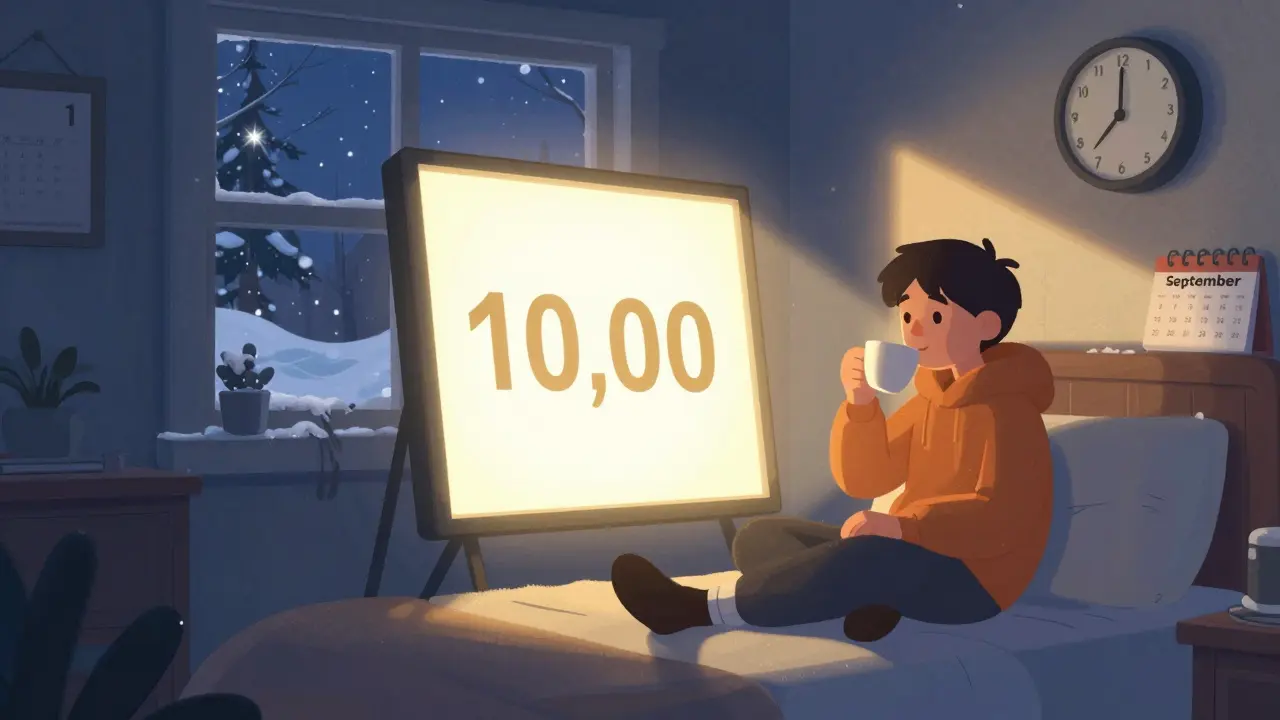
The key is intensity and timing. A 10,000-lux light box (a device that emits bright, UV-free light at the intensity of a clear sunny day) used for 20-30 minutes right after waking is what most studies show works best. You don’t need to stare at it - just sit nearby while you drink coffee, read, or check emails. Position it 16-24 inches from your face, angled slightly to the side.
Timing matters more than duration. If you use it too late in the day, it can mess up your sleep. The goal is to trick your brain into thinking it’s sunrise. Studies from the Center for Environmental Therapeutics (a research group founded by Dr. Michael Terman at Columbia University that specializes in circadian rhythm treatments) show that starting light therapy in early September - before symptoms appear - cuts winter depression severity by 50-60% in people who stick with it.
Not all lights are equal. Avoid tanning beds or regular bright lamps. Effective light boxes filter out harmful UV rays and focus on blue wavelengths (460-480 nm), which are the ones that signal your brain to stop producing melatonin. The Bodyclock Start 10000 (a dawn simulator released in 2025 that mimics a natural sunrise over 90 minutes) is one of the newest tools, designed to wake you up gently by simulating the sunrise of early May - when most SAD sufferers naturally feel better.
Vitamin D: Not a Magic Bullet, But a Critical Piece
You’ve heard it before: "Take vitamin D for depression." But it’s not that simple. Research shows vitamin D helps - but only if you’re deficient.
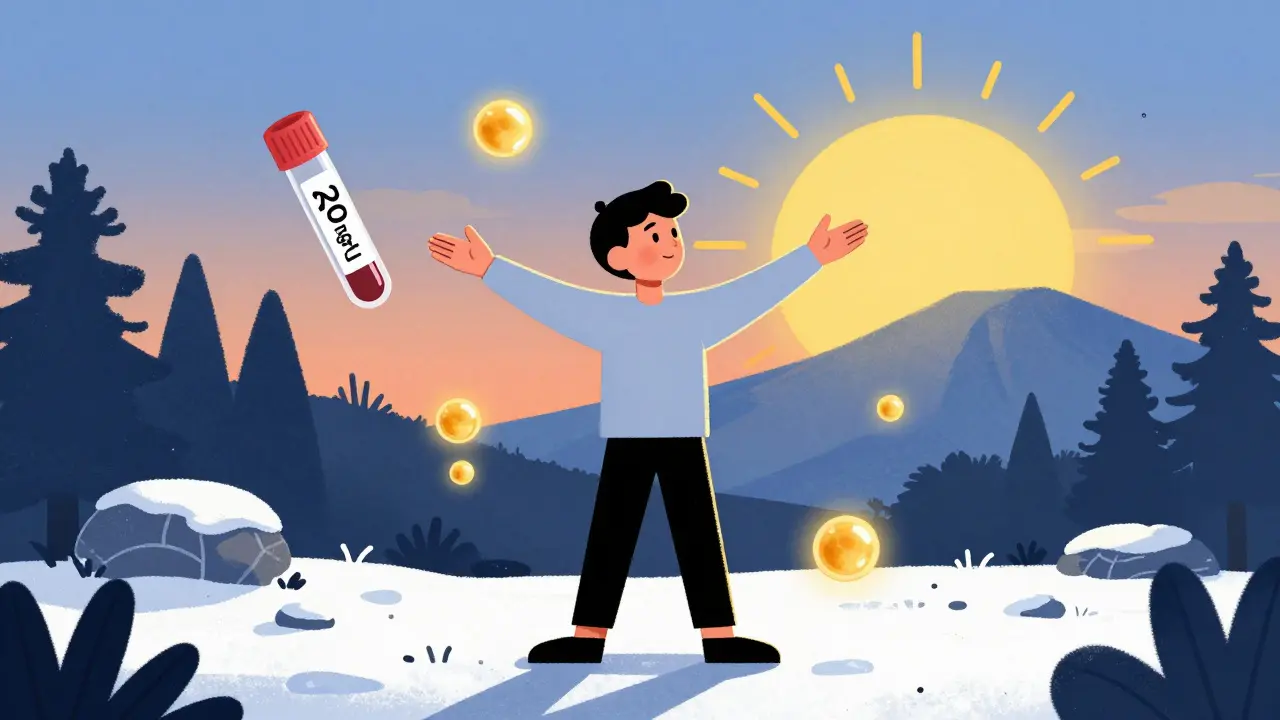
The Endocrine Society (a leading medical organization that sets clinical guidelines for hormone health) recommends 600-2000 IU daily for prevention. But here’s the catch: if your blood level is above 30 ng/mL, extra vitamin D won’t help. If it’s below 20 ng/mL, you’re at higher risk for depression.
A 2020 meta-analysis in the Journal of Affective Disorders (a peer-reviewed scientific journal focused on mood disorders) found that people with low vitamin D levels who took 800-1,200 IU daily saw a 15-20% drop in depressive symptoms. But those with normal levels? No change.
That’s why Cleveland Clinic (a major U.S. healthcare system that recommends testing before supplementing) advises testing your blood first. If your level is under 20 ng/mL, take 5,000 IU daily for three months, then retest. If it’s between 20-30 ng/mL, 2,000 IU is enough.
Don’t forget food. Fatty fish like salmon, eggs, and fortified dairy help. But in winter, sunlight is your main source - and it’s gone. That’s why supplementation becomes essential, not optional.
Routine: The Quiet Hero of Prevention
Light and vitamins are tools. Routine is the foundation. Without structure, even the best light box won’t help.
Here’s what works:
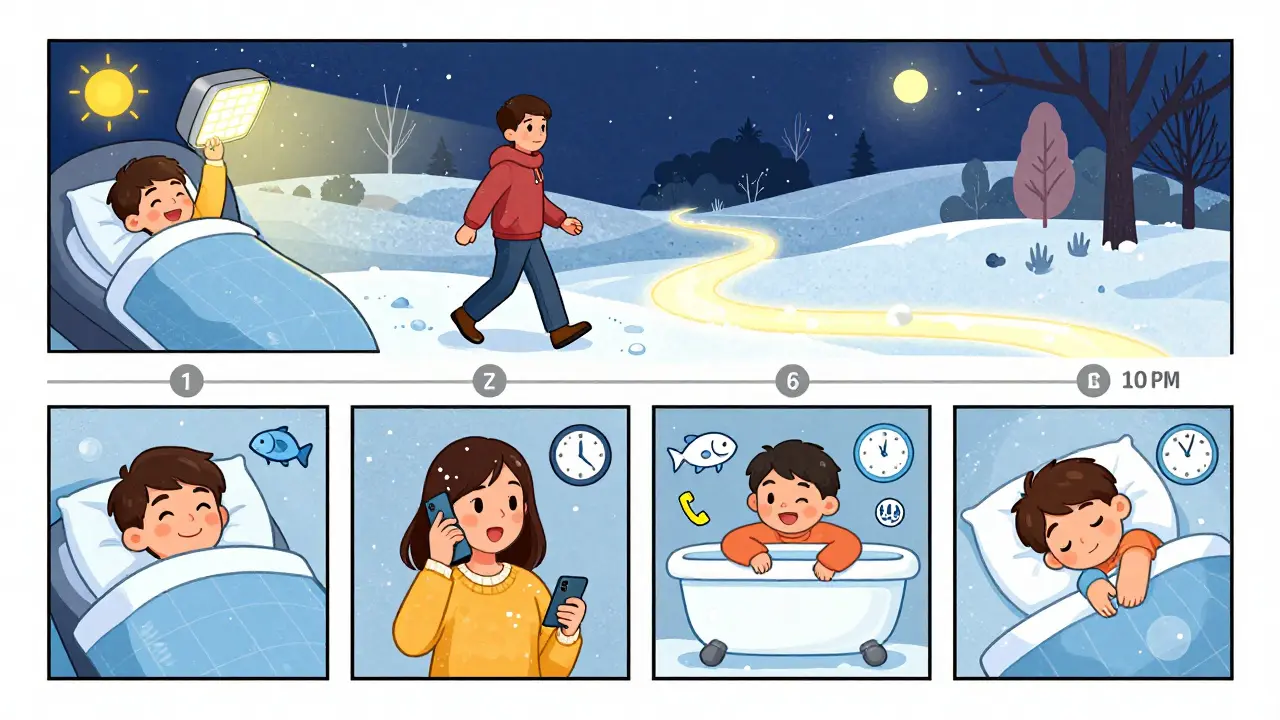
- Wake up at the same time every day - even weekends. Less than 30 minutes of variation. This is more important than bedtime.
- Get natural sunlight within two hours of waking - even if it’s cloudy. 5-10 minutes outside helps reset your rhythm.
- Move daily - 30 minutes of brisk walking, cycling, or even dancing. Exercise boosts serotonin and counters the urge to hibernate.
- Schedule enjoyable activities - not chores. Plan a movie night, a puzzle, a hot bath, or calling a friend. Cognitive Behavioral Therapy for SAD (a specialized form of talk therapy designed to reframe negative thoughts and increase engagement in positive activities) teaches this skill intentionally.
- No naps after 3 p.m. and no sleeping in. Oversleeping tricks your brain into thinking it’s still night.
Studies from Piedmont Healthcare (a U.S. healthcare provider that developed structured SAD prevention protocols) show that people who follow this routine reduce their symptoms by up to 40% - even without light therapy.
And here’s the kicker: routine works better for people with anxiety. Light therapy helps those with sleep delays. Routine helps those who withdraw. Together, they cover more ground.
What the Science Says About Combining Them
Most people think: "Which one is best?" The answer? All three, together.
A 2024 study from Columbia University’s NIH-funded trial (NCT05678901) tested three groups: light only, vitamin D only, and all three together. The combined group had a 73% drop in symptoms. The single-method groups? Only 52-58%.
Why? Because they fix different problems:
- Light therapy resets your internal clock.
- Vitamin D supports brain chemistry.
- Routine builds habits that prevent isolation and inactivity.
Dr. Norman Rosenthal, who first identified SAD in 1984, says: "The predictable nature of SAD makes it one of the few mental health conditions where prevention is not just possible but highly effective when properly timed and implemented."
And it’s working. In Sweden, since 2019, the national health system has given free light boxes to diagnosed patients. Result? A 22% drop in winter antidepressant prescriptions. In the U.S., 37% of Fortune 500 companies now offer light therapy stations and flexible morning hours. These aren’t perks - they’re public health moves.
What Doesn’t Work (And Why)
Don’t waste time on these myths:
- Just "getting out more" - if you’re not getting morning light, a walk at 4 p.m. won’t reset your rhythm.
- Supplementing vitamin D without testing - if you’re not deficient, it does nothing.
- Using a 5,000-lux light box - too weak. You need 10,000 lux to be effective.
- Waiting until you feel awful - prevention starts in early fall, not December.
And don’t assume it’s just you. Only 68% of people diagnosed with SAD actually show strong seasonal patterns. The rest? Their depression looks year-round. That’s why so many cases get misdiagnosed as chronic depression. If your mood dips every year at the same time - even mildly - it’s worth investigating.
Getting Started: Your 7-Day Plan
Here’s how to begin, right now:
- Day 1: Buy a 10,000-lux light box (look for UV-free, 460-480 nm blue light). Set your alarm to wake up 30 minutes earlier than usual.
- Day 2: Use the light box for 20 minutes after waking. Sit in natural sunlight for 10 minutes after.
- Day 3: Get your vitamin D level tested. Order supplements based on results.
- Day 4: Schedule three non-negotiable activities: a walk, a call with a friend, and a small pleasure (tea, music, bath).
- Day 5: Set phone alarms: one for light therapy, one for bedtime, one for your morning walk.
- Day 6: Drink 2 liters of water. Dehydration worsens fatigue and brain fog.
- Day 7: Review. Did you do it? If yes, you’ve built the foundation. If not, tweak one thing. Start small.
You don’t need perfection. You need consistency. One week of this can change your whole winter.
What Comes Next
The future of SAD prevention is personalized. In 2025, the FDA approved the first digital therapy app, SeasonWell (a prescription digital therapeutic app that delivers CBT-SAD through guided sessions), with 78% adherence in trials. New research shows climate change may increase SAD cases by 12% by 2030 - making prevention tools more vital than ever.
But you don’t need to wait for tech. The tools you need are simple: light, vitamin D, and routine. They’re cheap, safe, and backed by decades of science. Start before the dark sets in. Because winter doesn’t have to steal your mood - you can take it back.
Haley DeWitt
Okay, I tried the light box last year and it was a GAME CHANGER. Seriously. I was sobbing in my kitchen in November and now I’m just… fine. I use mine while making coffee, and I swear my brain forgets it’s winter. Also, I set a reminder to get 10 mins of sun right after waking-even if it’s gray. It’s not magic, but it’s like giving your soul a warm hug. 🌞💛
John Haberstroh
Man, this post reads like a TED Talk written by a caffeinated neuroscientist who also moonlights as a yoga instructor. But honestly? It’s spot-on. I used to think SAD was just ‘winter laziness’ until I started tracking my mood like a lab rat. Turns out, my brain’s a total light junkie. Now I’ve got a 10k lux box on my desk, vitamin D tabs in my pocket like candy, and I wake up at 6:30 like I’m training for the Olympics. No more hibernating like a bear with anxiety.
Brenda K. Wolfgram Moore
Stop waiting until you're in a spiral. Start now. Seriously. Day 1 of your 7-day plan? Do it today. Not tomorrow. Not next week. Today. Your future self will thank you. No excuses. Light therapy isn't optional. Vitamin D isn't a supplement-it's insurance. Routine isn't discipline-it's survival. And if you're still sitting there wondering if this is real? It is. Your biology doesn't lie.
Linda Franchock
Oh honey, you’re telling me I need to wake up earlier AND get sunlight AND take pills AND not nap after 3? And I thought winter was just for binge-watching Netflix in pajamas? 😏 Well, fine. I’ll do it. But only because I’m tired of crying over soup. Also, I bought a fancy light box shaped like a flamingo. It’s ridiculous. It works. So shut up and buy one.
Agnes Miller
I’ve been using a 10k lux box for 3 years now. One thing no one mentions: the angle matters. If it’s too high or too low, it doesn’t hit your retinas right. I learned this the hard way. Also, hydration. People forget how much water affects mood. I drink 2L every day now, even if I’m not thirsty. And I don’t do the morning walk if it’s below 10F. No shame. Just do what works. Also, vitamin D levels? Get tested. Don’t guess. I was 18 ng/mL. Took 5k IU. Now I’m 42. Life changed.
Tony Shuman
Wow. So we’re supposed to believe that a $200 light box and a $10 vitamin pill can fix what capitalism, climate change, and modern life did to our mental health? You’re telling me we can’t fix the fact that we’re stuck indoors all day, staring at screens, while the sun barely peeks through? This isn’t prevention. It’s Band-Aid capitalism. You want to fix SAD? Give people paid time off in winter. Make workplaces have windows. Stop pretending individual hacks fix systemic rot.
Logan Hawker
Let’s be honest-this is just biohacking for the middle-class suburbanite. You’ve got your 10,000-lux box, your serum vitamin D levels, your 7-day plan… but what about the 80% of people who can’t afford this? Or live in apartments with no windows? Or work two jobs? This reads like a Bloomberg article written by someone who’s never missed a meal. You’re not preventing SAD-you’re monetizing it. Also, ‘SeasonWell’? That’s not a real app. It’s a marketing pitch.
James Lloyd
Excellent breakdown. The science is clear: circadian entrainment via morning light exposure is the most potent non-pharmacological intervention for SAD. The 10,000-lux threshold is empirically validated across meta-analyses (e.g., Golden et al., 2005; Terman & Terman, 2005). Vitamin D supplementation only benefits those with baseline deficiency (<20 ng/mL), as confirmed by randomized controlled trials (e.g., Pilz et al., 2020). The routine component-especially fixed wake times and morning sunlight-is critical for phase-shifting the suprachiasmatic nucleus. The 73% reduction in symptom severity with multimodal intervention aligns with the Columbia trial (NCT05678901). Practical, evidence-based, and actionable. Well done.