
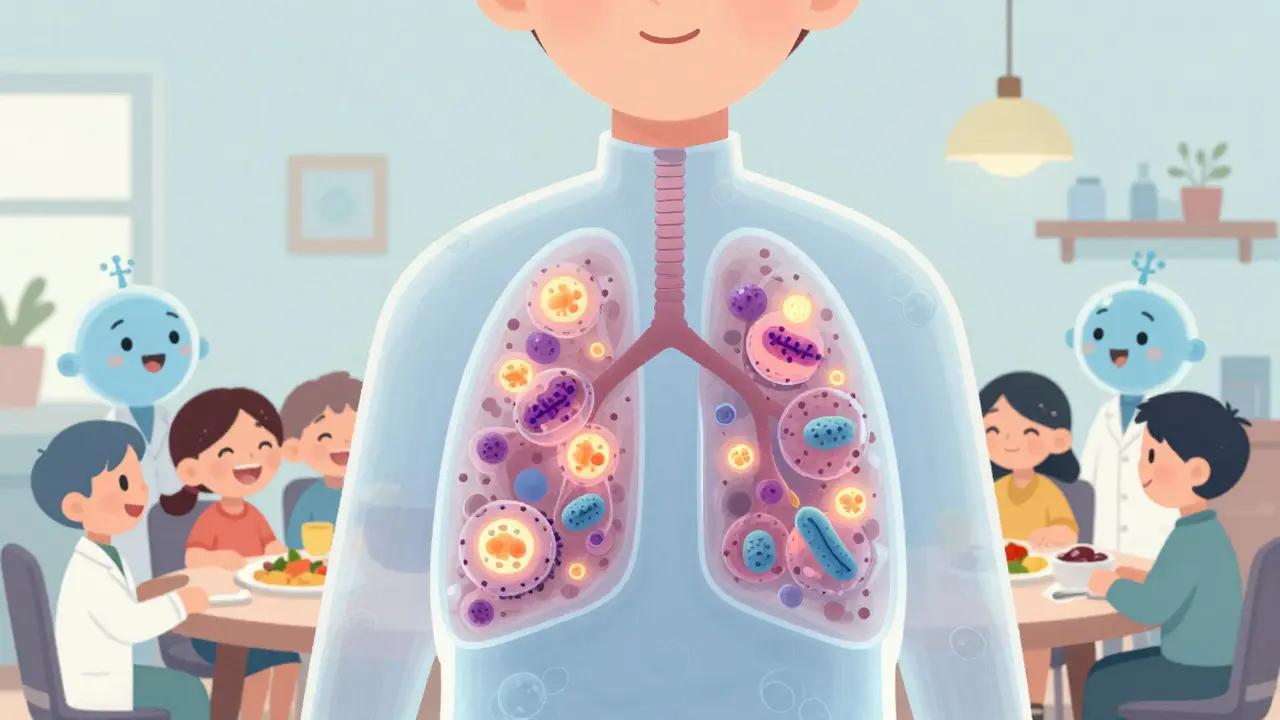
Most people think of tuberculosis as a disease you catch and immediately get sick. But that’s not how it usually works. In fact, tuberculosis often hides in your body for years-sometimes decades-without you ever knowing. You feel fine. You don’t cough. You don’t lose weight. You’re not contagious. And yet, the bacteria are still there, waiting. This is latent tuberculosis infection, or LTBI. It’s not the same as active TB disease, but it’s the reason TB never truly goes away.
What Is Latent TB Infection?
Latent TB means the bacteria that cause tuberculosis, Mycobacterium tuberculosis, are alive in your body but completely shut down. Your immune system has locked them inside tiny clusters of cells called granulomas. These are like biological prisons. The bacteria can’t multiply. They can’t spread. And you don’t feel anything.You won’t have a cough. No night sweats. No fever. No weight loss. Your chest X-ray looks normal. You’re not infectious. You can go to work, hug your kids, share a meal-no risk to anyone.
How do you even know you have it? Only through testing. A tuberculin skin test (TST) or an interferon-gamma release assay (IGRA) will come back positive. That’s it. No symptoms. No damage. Just a quiet, dormant infection.
About 30% of people exposed to TB will test positive for latent infection. But here’s the catch: only 5 to 10% of those people will ever develop active TB in their lifetime. For most, the bacteria stay locked up forever. But for some, the balance breaks.
When Latent TB Turns Active
The shift from latent to active TB isn’t random. It usually happens when your immune system weakens. That’s why people with untreated HIV are 20 to 30 times more likely to develop active TB. Other risk factors include diabetes, kidney failure, cancer treatments, long-term steroid use, and malnutrition.When the immune system can’t hold the bacteria back anymore, they start multiplying. They break out of the granulomas. They invade lung tissue. They spread through the airways. And that’s when symptoms appear.
Active TB doesn’t come on suddenly. It creeps in. First, you feel tired. Then you lose your appetite. You start losing weight without trying. Nights get worse-you wake up drenched in sweat. A cough begins. At first, it’s mild. Then it lasts more than three weeks. You might cough up blood. Your chest hurts. Your fever won’t break.
This is no longer a hidden infection. You’re contagious. Every cough, every sneeze, every song you hum can send infectious droplets into the air. People nearby can breathe them in. That’s why active TB is a public health emergency.
How Doctors Diagnose TB
Diagnosing TB isn’t just about symptoms. It’s about matching test results to clinical signs.For latent TB, you need two things: a positive TST or IGRA, and no signs of active disease. That means a normal chest X-ray and no symptoms. That’s it. No sputum test needed. No culture.
For active TB, you need symptoms and proof the bacteria are multiplying. That means sputum samples are tested. The gold standard is a culture-growing the bacteria in a lab. But that takes weeks. So doctors use faster tools like nucleic acid amplification tests (NAATs). These can detect TB DNA in sputum within hours. A positive NAAT, along with symptoms and a chest X-ray showing lung damage, confirms active disease.
Chest X-rays are critical. In latent TB, they’re clear. In active TB, they often show dark patches, cavities, or swollen lymph nodes. These aren’t just images-they’re signs of tissue destruction.

Drug Therapy for Latent TB
Treating latent TB isn’t about curing symptoms. It’s about preventing future disease. The goal is to kill those dormant bacteria before they wake up.The classic treatment is isoniazid (INH) for nine months. You take one pill every day. It’s cheap. It’s effective. But it’s hard to stick with. Nine months is a long time. People forget. They stop. And that’s how drug resistance starts.
That’s why shorter regimens are now preferred. The CDC and WHO recommend a 3-month course of weekly isoniazid and rifapentine. You take the pills under direct observation-someone watches you swallow them. This is called DOT, or directly observed therapy. It boosts completion rates from 60% to over 90%.
Another option is rifampin alone for four months. It’s easier than nine months of isoniazid, and it’s just as safe for most people. But it can interact with other drugs-like birth control pills or HIV meds-so your doctor needs to check your full medication list.
These treatments work. They reduce the risk of active TB by 90% or more. But only if you finish them.
Drug Therapy for Active TB
Active TB is a medical emergency. You need strong drugs, fast. The standard first-line treatment is called RIPE: rifampin, isoniazid, pyrazinamide, and ethambutol.You take all four pills every day for the first two months. That’s the intensive phase. Then, for the next four to seven months, you drop pyrazinamide and ethambutol. You keep rifampin and isoniazid. Total treatment: six to nine months.
Why so many drugs? Because TB bacteria are sneaky. They mutate. If you use just one drug, resistant strains survive and take over. That’s how multidrug-resistant TB (MDR-TB) forms. MDR-TB doesn’t respond to the two most powerful drugs: isoniazid and rifampin. Treating it takes 18 to 24 months, costs tens of thousands of dollars, and has a higher chance of failure.
DOT is mandatory for active TB. Not optional. Not recommended. Mandatory. Health workers show up at your door, or you go to a clinic, and you swallow your pills in front of them. Why? Because incomplete treatment kills more people than the disease itself. It breeds superbugs.
Liver damage is a real risk. Isoniazid and rifampin can stress your liver. Your doctor will check your liver enzymes every month. If your levels spike, they’ll adjust your meds. Don’t ignore this. Jaundice, dark urine, or nausea aren’t just side effects-they’re warning signs.

Why TB Still Kills
Despite knowing how to treat it, TB killed 1.3 million people in 2022. Why?First, diagnosis is slow in low-resource areas. Many people never get tested. They suffer for months, thinking it’s just a bad cold.
Second, treatment is long. People feel better after a few weeks. They stop taking pills. The bacteria that survive become resistant. Then they pass them on.
Third, stigma. In many places, people with TB are shunned. They hide their illness. They avoid clinics. They delay care.
And fourth, poverty. TB thrives where housing is crowded, nutrition is poor, and healthcare is out of reach. It’s not just a medical problem. It’s a social one.
Even in wealthy countries like Australia, TB is not gone. In 2023, most cases here were in people born overseas. That’s why screening immigrants and refugees for latent TB is part of public health policy.
What You Can Do
If you’ve been exposed to someone with active TB-especially if you’re immunocompromised-get tested. Don’t wait for symptoms. Latent TB is easy to treat. Active TB is harder, longer, and riskier.If you’re on TB treatment, take every pill. Every single one. Set phone alarms. Use pill organizers. Ask a friend to remind you. If you miss doses, tell your doctor. Don’t wait until you feel worse.
And if you know someone with TB, don’t isolate them. Support them. Help them get to appointments. Encourage them to finish treatment. Because curing TB isn’t just about one person. It’s about stopping the chain.
Tuberculosis isn’t a relic of the past. It’s a living threat. But it’s not unstoppable. We have the tools. We just need the will to use them.
Can you spread latent TB to others?
No. People with latent TB infection cannot spread the bacteria to others. The bacteria are inactive and contained by the immune system. There is no cough, no infectious droplets, and no risk of transmission. Only active TB disease, especially in the lungs, is contagious.
How long does TB treatment take?
For latent TB, treatment lasts 3 to 9 months, depending on the regimen. For active TB, treatment lasts at least 6 months, and often up to 9 months. Drug-resistant TB can require treatment for 18 to 24 months. Stopping early increases the risk of relapse and drug resistance.
Is TB curable?
Yes. Both latent and active TB are curable with proper treatment. Latent TB treatment prevents future disease. Active TB treatment kills the bacteria and restores health. But cure depends entirely on completing the full course of medication. Interrupting treatment can lead to drug-resistant TB, which is far harder to treat.
What are the side effects of TB drugs?
Common side effects include nausea, loss of appetite, and fatigue. The biggest risk is liver damage, especially from isoniazid and rifampin. Signs include yellowing skin, dark urine, or persistent nausea. Regular blood tests are required to monitor liver function. Rarely, rifampin turns bodily fluids orange-this is harmless but can alarm patients.
Can you get TB more than once?
Yes. Having TB once doesn’t make you immune. You can be reinfected with a new strain, especially if you’re exposed again. This is more common in areas with high TB rates. Also, if you didn’t complete treatment the first time, the bacteria may have developed resistance, making a second infection harder to treat.
Who should be tested for latent TB?
People at higher risk should be tested: those who’ve been in close contact with someone with active TB, immigrants from high-TB countries, healthcare workers, people with HIV, diabetics, those on immunosuppressive drugs, and residents or workers in prisons or homeless shelters. Testing is simple and can prevent future illness.
Looking Ahead
New tools are coming. Blood tests that can predict who’s likely to progress from latent to active TB are in development. Shorter drug regimens for active TB-like 4-month courses-are being tested in clinical trials. A new vaccine, M72/AS01E, showed 50% effectiveness in a 2023 trial, offering real hope for prevention.But the biggest breakthrough won’t be a drug or a test. It’ll be access. Making testing, treatment, and follow-up easy, affordable, and stigma-free for everyone. Because TB doesn’t care about borders, income, or status. It only cares if we’re willing to act.
sue spark
I never realized latent TB could just sit there for years like a silent roommate. Scary how your body can hold something dangerous without you ever knowing. I got tested after a coworker was diagnosed and was surprised it was so simple.
anthony epps
so you mean if you dont have symptoms you cant spread it? thats wild
Dan Padgett
In my village back home, TB is not just a disease-it’s a whisper in the dark. People don’t say it out loud. They say 'that cough won’t leave him' or 'he’s been tired since the rains.' We don’t test. We pray. And sometimes, the bacteria win because silence is louder than medicine.
Hadi Santoso
just learned that rifampin turns your pee orange lol. i thought i was dying. my friend who’s a nurse said it’s normal but i still freaked out for a week. tb treatment is wild. also why is it so long? like why not just give a shot and be done?
Kim Hines
I’ve known people who stopped their meds because they 'felt fine.' It’s so hard to explain why you keep taking pills when you’re not sick.
Cassandra Collins
I bet this is all a Big Pharma scam to sell drugs. Why would they make treatment so long if it wasn’t to keep people hooked? They don’t want you cured-they want you paying forever.
Kitty Price
I’m so glad they’re working on shorter treatments 😊 I’ve seen friends drop out because it’s just too much to handle for 9 months. A 4-month option would change everything.
Colleen Bigelow
Why are we testing immigrants like they’re criminals? This isn’t about health-it’s about fear. We let people in, then we treat them like walking time bombs. We need to stop this. TB doesn’t care where you’re from.
Billy Poling
It is imperative to note that the adherence to directly observed therapy (DOT) represents a critical public health intervention that mitigates the development of multidrug-resistant strains, which, as previously documented in peer-reviewed literature from the CDC, exhibit significantly higher mortality rates and require prolonged, costly therapeutic regimens that strain healthcare infrastructure.
Randolph Rickman
If you’ve been exposed or are at risk, get tested. Seriously. It’s a one-time blood test or skin poke. Nine months of pills is nothing compared to 18 months of IV drugs and liver damage. I’ve seen both. Don’t wait.
James Rayner
I’ve always thought of TB as an old-world disease... until I met a guy from the Philippines who had it. He said his cousin died because they didn’t have access to the meds. We have the tools. But we don’t always use them. That’s the real tragedy.
Josias Ariel Mahlangu
People think it's a poor country problem. But here in America, in shelters, in prisons, in crowded apartments-it's still here. And nobody talks about it. We ignore it until it's too late.
Andrew Sychev
This is why we need to lock up people who don't finish their meds. They're dangerous. They're killing others. Why let someone who won't take responsibility endanger the whole community? This isn't freedom-it's negligence.