
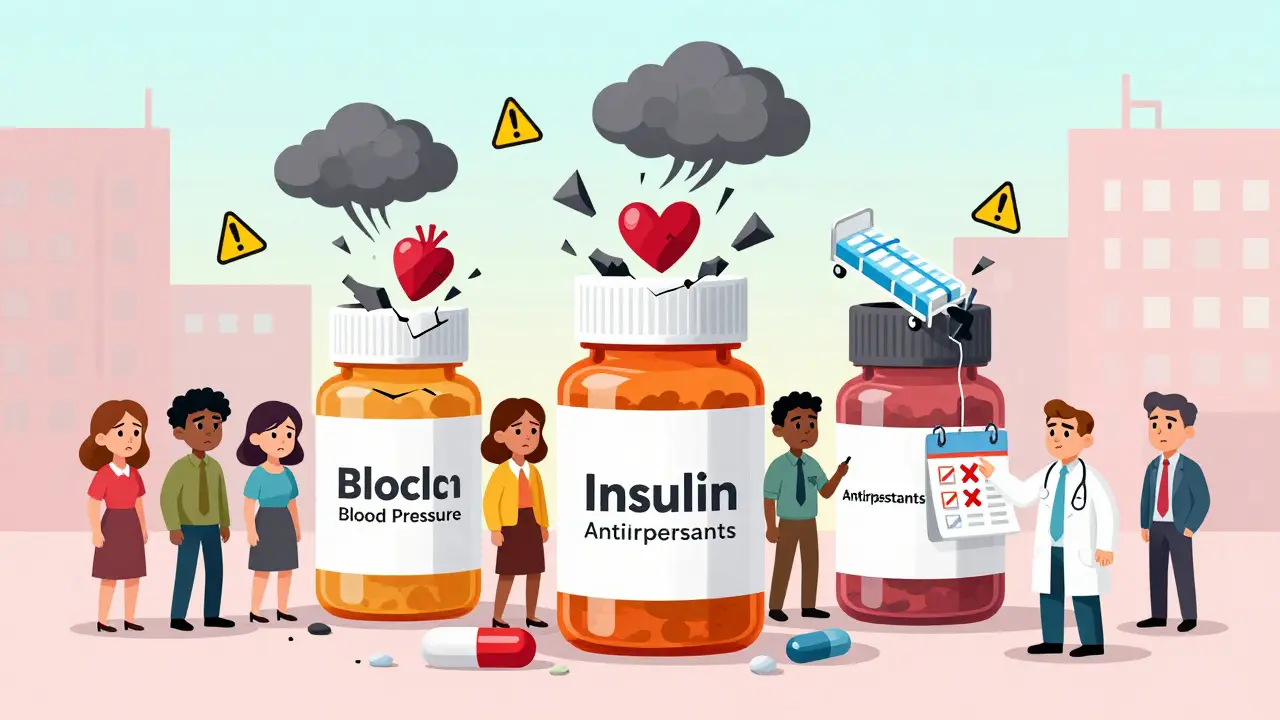
Skipping a pill here and there might seem harmless-maybe you forgot, or it cost too much, or you felt fine so you thought you didn’t need it. But if you’re not taking your medications exactly as your doctor told you, you’re not just being lazy or forgetful. You’re putting your life at risk.
The Real Cost of Skipping Doses
Every year in the U.S., about 125,000 people die because they didn’t take their medicines the way they were supposed to. That’s more than the number of deaths from car accidents or homicides. For people over 50, the risk of dying from not taking meds is nearly 30 times higher than being killed in a homicide. These aren’t statistics from a textbook-they’re real numbers from hospitals, clinics, and public health reports. It doesn’t matter if you’re on blood pressure pills, insulin, antidepressants, or a transplant rejection drug. If you miss doses, your body doesn’t get the steady level of medicine it needs to work right. Your condition can suddenly get worse. What felt like a small slip-missing a few days of your asthma inhaler or skipping your cholesterol pill-can lead to a heart attack, stroke, or hospital stay.Why You’re Not Taking Your Meds
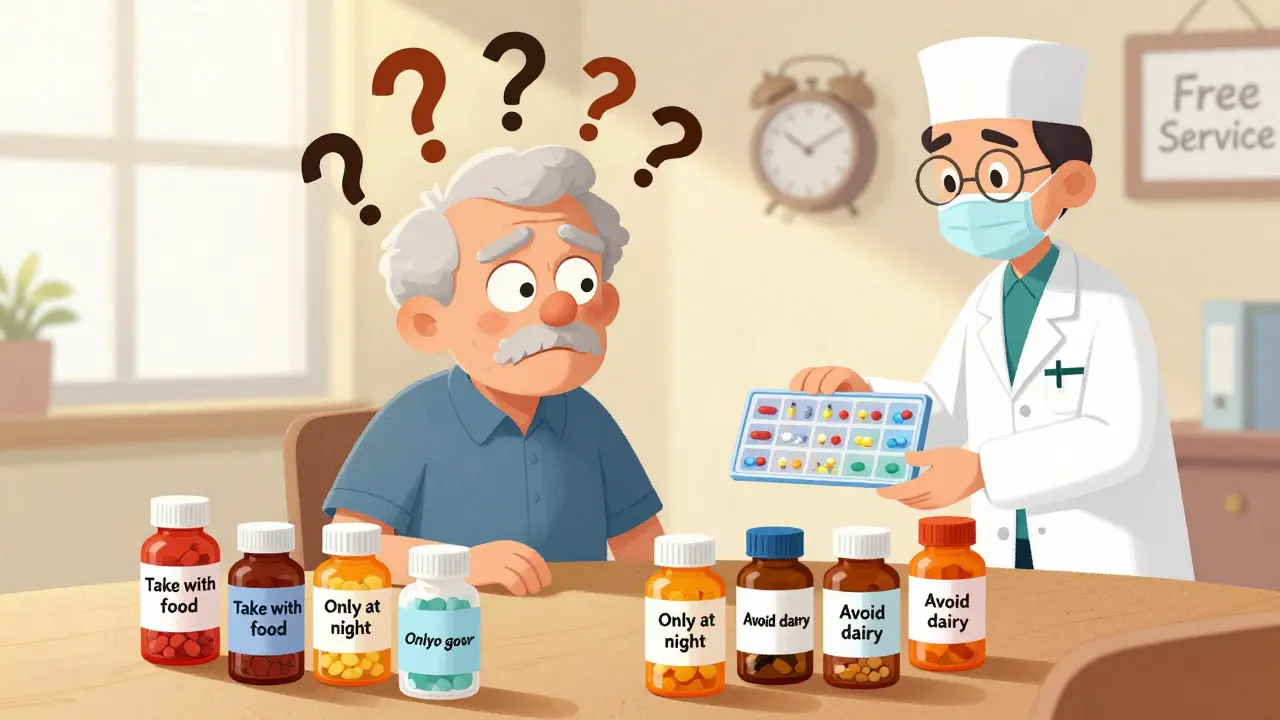
Most people don’t skip pills because they’re careless. They do it because something’s standing in their way. Cost is the biggest reason. In 2021, out-of-pocket spending on prescription drugs in the U.S. jumped to $63 billion. About 8.2% of adults under 65 said they didn’t fill a prescription or skipped doses because they couldn’t afford it. That’s nearly one in 12 people. For seniors on fixed incomes, or families juggling rent and groceries, choosing between medicine and food isn’t a hypothetical-it’s daily reality. Fear plays a big role too. Many patients stop taking meds because they’re scared of side effects. They read the long list of possible reactions and assume the worst. But doctors don’t prescribe drugs lightly. The risks of not taking them are often far greater than the side effects. Then there’s complexity. If you’re on five or six different pills, taken at different times of day, with different food rules, it’s easy to get overwhelmed. One study found that adherence drops sharply after the first month. The longer you’re on a regimen, the more likely you are to slip up. And let’s not forget communication. If your doctor didn’t explain why the medicine matters, or if you felt rushed during your visit, you might not understand how serious skipping doses can be. Many patients don’t realize that taking 80% of your pills isn’t good enough-it’s not even close. For most chronic conditions, you need to take 90% or more to get real protection.What Happens When You Stop
Let’s look at real examples:- High blood pressure: If you stop your pills, your pressure spikes. That silent killer doesn’t warn you. One missed week can raise your stroke risk by 40%.
- Diabetes: Skipping insulin or metformin leads to dangerously high blood sugar. That can cause nerve damage, kidney failure, or vision loss over time-even if you feel fine now.
- Antidepressants: Stopping suddenly can trigger withdrawal symptoms, worsen depression, or even trigger suicidal thoughts. It’s not a quick fix-you can’t just quit when you feel better.
- Transplant meds: Missing even one dose can cause your body to reject the new organ. Many transplant patients who skip doses end up back in the hospital-or worse.
- Asthma/COPD inhalers: Skipping your daily controller inhaler doesn’t mean you’ll wheeze right away. But over time, your lungs get more inflamed. Emergency visits go up. Hospital stays become common.
The Hidden Financial Toll
You might think skipping pills saves money. It doesn’t. In 2016, nonadherence cost the U.S. healthcare system $529 billion. That’s not just hospital bills-it’s ambulance rides, ER visits, lost workdays, long-term disability, and caregiver time. For each person who doesn’t take their meds, the extra cost ranges from $5,000 to over $50,000 a year. Medicare patients who don’t stick to their meds are twice as likely to be readmitted within 30 days. Half of those readmissions are directly linked to skipping pills. And guess who pays? You do-through higher premiums, taxes, and reduced access to care as hospitals get overwhelmed. In the European Union, avoidable costs from nonadherence hit €100 billion a year. That’s money spent on problems that could’ve been prevented with a $10 pill.Who Gets Hit Hardest
This isn’t an equal-opportunity problem. Black, Latino, Indigenous, and low-income communities face higher rates of nonadherence-not because they’re less responsible, but because the system is stacked against them. Pharmacies are harder to reach in these neighborhoods. Doctors are harder to see. Prescription costs hurt more. And many people have lived through medical discrimination-think Tuskegee, forced sterilizations, or being dismissed by providers-and that erodes trust. Older adults are another high-risk group. One study found up to 100,000 preventable deaths each year among seniors due to medication errors or skipped doses. Many are on 10 or more pills. Pill organizers help, but only if someone’s there to remind them.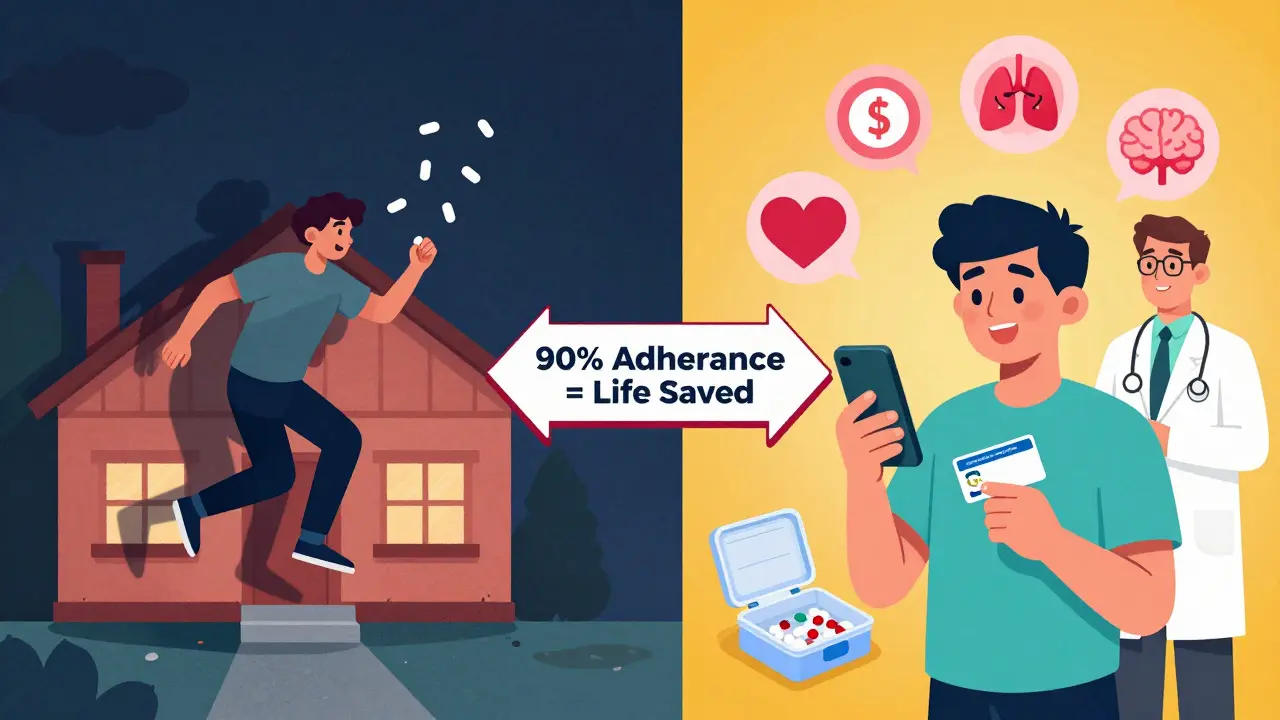
What Actually Works to Fix This
There are solutions-but they’re not magic. They require effort from patients, doctors, pharmacies, and insurers.- Pharmacist counseling: When pharmacists sit down with patients to explain their meds, adherence improves by 15-20%. That’s not a guess-it’s proven in clinical trials.
- Text reminders: Simple text messages saying “Take your blood pressure pill today” boost adherence by 12-18%.
- Simplified regimens: Switching from three pills a day to one combined pill? That can double adherence rates.
- Medication therapy management (MTM): This is a service where a pharmacist reviews all your meds, checks for interactions, and helps you afford them. Studies show for every $1 spent on MTM, $3 to $10 is saved in hospital costs.
What You Can Do Right Now
You don’t need a perfect system. You just need to start small.- Ask your doctor: “What happens if I miss a dose?” Don’t assume they’ll tell you. Ask.
- Ask your pharmacist: “Can you put these in a weekly pill box?” Most will do it for free.
- Use a phone alarm or app. Set one for each pill. Even if you’re not tech-savvy, your phone can remind you.
- If cost is the issue, ask: “Is there a generic version?” or “Can I get a 90-day supply?” Many insurers lower copays for longer fills.
- If you’re scared of side effects, don’t quit. Call your doctor. There’s often a fix-lower dose, different time of day, or another drug.
It’s Not About Willpower
This isn’t about being lazy or irresponsible. It’s about a system that makes adherence hard-and then blames people when they fail. The World Health Organization says medication adherence has a bigger impact on health outcomes than the actual drug itself. That’s shocking. But true. A cheap, simple pill taken daily can save your life more than a $10,000 treatment you only take once. If you’re struggling, you’re not alone. And you’re not broken. You’re just caught in a system that doesn’t support you. But you can still take control-by asking for help, using tools, and speaking up. Your life depends on it.What happens if I skip one day of my medication?
It depends on the medicine. For some, like antibiotics or blood thinners, missing one dose can reduce effectiveness or cause dangerous rebound effects. For others, like blood pressure or cholesterol meds, one missed day won’t cause immediate harm-but it sets a pattern. Missing doses regularly-even just once or twice a week-raises your risk of hospitalization and death over time. Consistency matters more than perfection.
Can I stop my meds if I feel better?
No, not without talking to your doctor. Many medications treat symptoms you can’t feel-like high blood pressure or early kidney damage. Feeling better doesn’t mean the disease is gone. Stopping antidepressants suddenly can cause severe withdrawal. Stopping heart or transplant meds can be deadly. Always consult your provider before making changes.
Why do I keep forgetting to take my pills?
It’s not just memory. It’s complexity. If you’re on five different pills with different schedules, your brain gets overloaded. Stress, depression, or busy routines make it worse. The fix isn’t just “try harder”-it’s simplifying your regimen, using pill organizers, setting phone alarms, or asking your pharmacist for combination pills. You’re not failing-you’re fighting a system that doesn’t make adherence easy.
Are there programs to help me afford my meds?
Yes. Most drug manufacturers offer patient assistance programs for low-income people. Pharmacies often have discount cards. Medicare Part D has a coverage gap help program. Your pharmacist can help you apply. Don’t assume you don’t qualify-many people who get help didn’t think they’d qualify until they asked.
Can my pharmacist help me with adherence?
Absolutely. Pharmacists are trained to help you take your meds correctly. They can simplify your regimen, provide blister packs, explain side effects, and even call your doctor if something doesn’t make sense. Ask them: “Can you help me stay on track?” Most will, even if it’s not billed to insurance.
Jane Lucas
i just forgot my pills for a week last month and my head stopped spinning so i thought i was fine turns out my bp was through the roof and i ended up in the er lol whoops
Janice Holmes
This is not a public health crisis-it’s a corporate extortion racket. The pharmaceutical industry profits from your dependency, then charges you $500 for a pill that costs 12 cents to produce. They don’t want you cured. They want you compliant. The FDA? Complicit. The AMA? Bought. Your ‘medication adherence’ is their revenue stream. Wake up.
Miriam Piro
I’ve been on 7 meds since 2018 and I swear someone’s tampering with my prescriptions. Why does every pharmacy give me different side effect leaflets? Why do my blood tests keep showing ‘anomalies’ right after I refill? The CDC doesn’t track this but I’ve got 14 binders of data-this isn’t about adherence, it’s about population control through pharmacological subjugation. They’re testing compliance thresholds. I’m not paranoid-I’m documented.
Will Neitzer
The data presented here is unequivocally valid and aligns with the 2022 CDC National Adherence Report. Nonadherence constitutes a preventable public health burden of monumental scale, with mortality rates exceeding those of many infectious disease outbreaks. The economic calculus is equally compelling: for every dollar invested in pharmacist-led medication therapy management, a return of $7.30 is realized in reduced hospital utilization. Structural interventions-not individual blame-are required to address this systemic failure.
dean du plessis
in south africa we dont even have access to half these meds. my uncle had diabetes and had to choose between insulin and feeding his kids. no one talks about that. its not about forgetting its about surviving
Kylie Robson
The pharmacokinetic profile of most chronic medications requires therapeutic drug monitoring-missed doses disrupt Cmax and AUC thresholds, leading to subtherapeutic concentrations and potential resistance development. For beta-blockers, even 10% nonadherence increases arrhythmia risk by 22%. This isn’t anecdotal-it’s evidence-based pharmacology.
Caitlin Foster
OH MY GOSH, I JUST REALIZED I’VE BEEN SKIPPING MY ANTIDEPRESSANTS ON WEEKENDS BECAUSE I ‘FELT FINE’ AND NOW I’M CRYING IN THE BATHROOM AT 3AM BECAUSE I’M A MONSTER WHO KILLS PEOPLE WITH NEGLECT 😭😭😭 I’M GETTING A PILL BOX TODAY AND TELLING MY DOCTOR I’M SORRY AND I’LL BE A GOOD PATIENT I PROMISE 😭🙏
Todd Scott
In Nigeria, community health workers use WhatsApp groups to send voice reminders in local languages. In rural India, they tie pill bottles to bicycle handles so patients see them every morning. The solution isn’t tech-it’s trust. If your pharmacist knows your name, your kid’s birthday, and remembers you skipped last month because your bus broke down-that’s adherence. Human connection beats algorithms every time.
Andrew Gurung
You people are so naive. The system wants you dependent. They don’t want you healed-they want you on a lifetime subscription. That $10 pill? It’s a luxury tax for the middle class. The real solution? Ditch the pharmaceutical-industrial complex. Go holistic. Turmeric. Meditation. Fasting. The FDA doesn’t fund those studies because they can’t patent a root. You’re being played.
James Bowers
The statistical correlation between nonadherence and mortality is robust, with hazard ratios exceeding 2.1 for cardiovascular and metabolic conditions. However, the underlying sociological determinants-accessibility, health literacy, and structural inequity-are frequently under-addressed in clinical discourse. A policy framework prioritizing universal medication access, subsidized dispensing, and mandatory pharmacist counseling is not merely advisable-it is ethically imperative.
Will Neitzer
I appreciate the data-driven perspective, but I must emphasize: the human element cannot be quantified. A patient who misses a dose because they’re afraid of gaining weight from steroids, or because their child is sick and they can’t afford childcare to get to the pharmacy-these are not failures of will. They are failures of support. We must design systems that meet people where they are, not where we wish they’d be.